Big Fish
Sailfish
Istiophorus platypterus · Bony fish, family Istiophoridae (billfishes); the IUCN and the Catalog of Fishes treat all sailfish as this one species, while WoRMS and FishBase still list the Atlantic sailfish separately as Istiophorus albicans
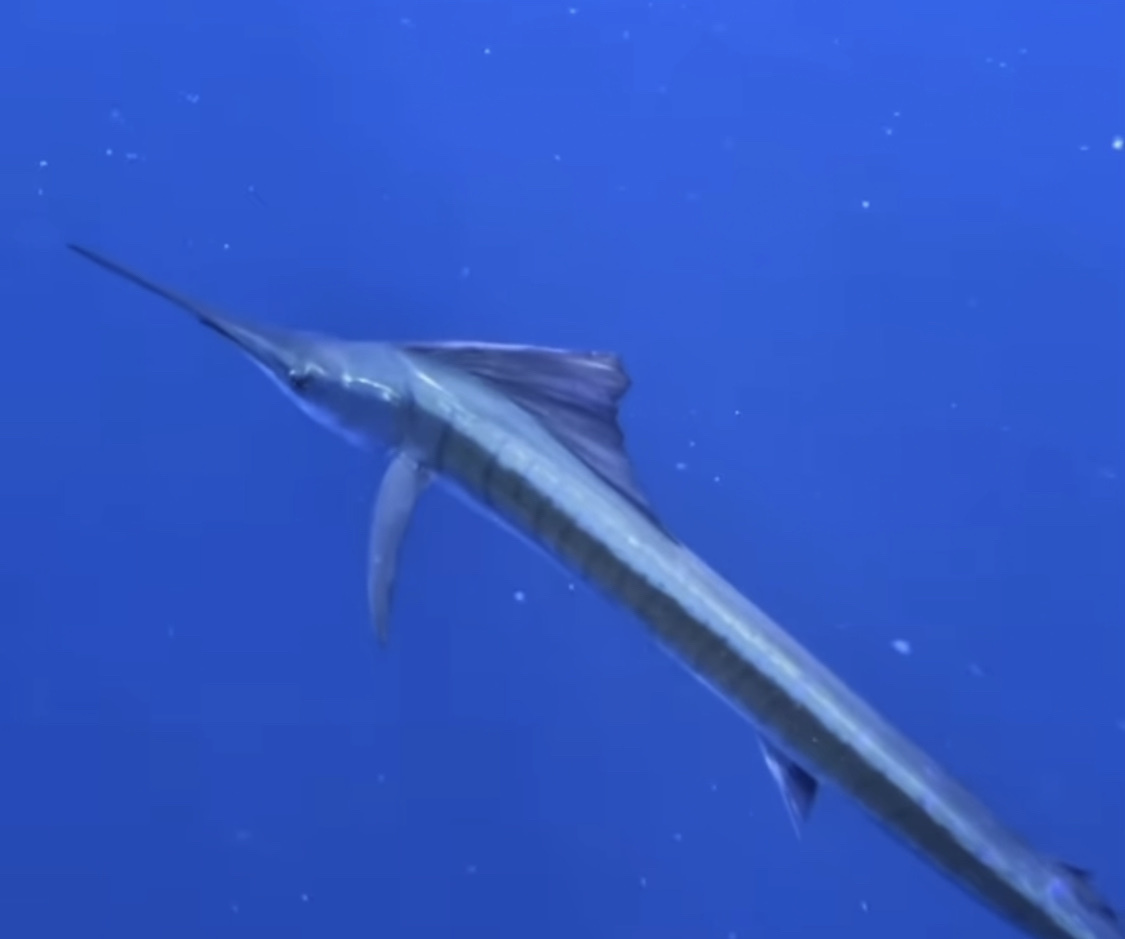
A sailfish on the hunt lights up, flashing its colors and unfurling the huge sail that gives it its name. Off Isla Mujeres and Cancún, groups of them pin schools of sardines against the surface from January to March, and snorkelers can slip in beside the action. Research filmed off Cancún showed how they work: a sailfish eases its bill into a school without triggering an escape, then taps a single fish or slashes sideways with one of the highest accelerations recorded in any aquatic vertebrate. Hunters take turns, and although only about a quarter of attacks catch a fish outright, nearly every pass injures several, so the school weakens with each strike. Boat captains find the action by following frigatebirds. Taxonomists still disagree over whether Atlantic and Indo-Pacific sailfish are one species or two; the IUCN treats them as one and lists it as Vulnerable.
Where and when to see one
"Resident" means most dives at that destination encounter them; "seasonal" means reliably present in the listed months; anything else is a bonus, not a plan.
| Destination | Reliability | Months | Notes |
|---|---|---|---|
| Isla Mujeres & CancúnMexico | Seasonal: reliable in season | Jan–Mar | |
| Koh TaoThailand | Rare | Year-round |
Best month, at a glance
| Month | Reliable destinations |
|---|---|
| January | Isla Mujeres & Cancún · Koh Tao |
| February | Isla Mujeres & Cancún · Koh Tao |
| March | Isla Mujeres & Cancún · Koh Tao |
| April | Koh Tao |
| May | Koh Tao |
| June | Koh Tao |
| July | Koh Tao |
| August | Koh Tao |
| September | Koh Tao |
| October | Koh Tao |
| November | Koh Tao |
| December | Koh Tao |
Understanding them
Habitat: Open ocean above the thermocline, most densely near coasts and islands; FishBase gives a depth range of 0 to 200 m, and fish tagged off Mexico had a median depth of just 4.4 m, though some dived to 452 m.
Range: Warm and temperate waters of the Atlantic, Indian and Pacific Oceans; Atlantic fish (Istiophorus albicans in WoRMS and FishBase) gather off the Yucatán Peninsula in winter and spring, and Indo-Pacific fish range from East Africa to the eastern Pacific.
Behavior: Groups herd sardine schools against the surface and take turns attacking: a fish slips its bill into the school without triggering an escape, then taps a single sardine or slashes sideways through the school. Only about a quarter of attacks catch a fish outright, but almost every attack injures several, which makes the next one easier.
Diet: Mainly schooling fishes, plus crustaceans and cephalopods; off the Yucatán, round sardinella (Sardinella aurita) and cigar minnows.
Size: typically around 2.4 m; documented up to 3.48 m (total length including the bill; FishBase gives common lengths of 2.4 m for Atlantic and 2.7 m for Indo-Pacific fish, and a maximum of 3.48 m fork length and about 100 kg).
How to behave around one
Snorkel and let the boat place you ahead of the action; float at the edge of the bait ball, never in the middle, and never chase, touch or try to grab a sailfish. Give the hunters room and do not let several boats box in the same ball.
Conservation
Listed as Vulnerable (IUCN 2022, an assessment that treats all sailfish as one species); caught on longlines, in set nets and by anglers, and both Atlantic stocks are considered likely overfished.
Charted sites known for them
Highlighted sites were charted for this species by our editors; numbers are GBIF occurrence records logged within about 5 km of a site since 1990.
Watch
From the official channels

Giant Pacific Octopus

Live African Penguin Cam After Hours | Monterey Bay Aquarium

African Penguin Cam After Hours | Monterey Bay Aquarium
Videos are embedded links to their creators' own channels. We host nothing and credit everything.