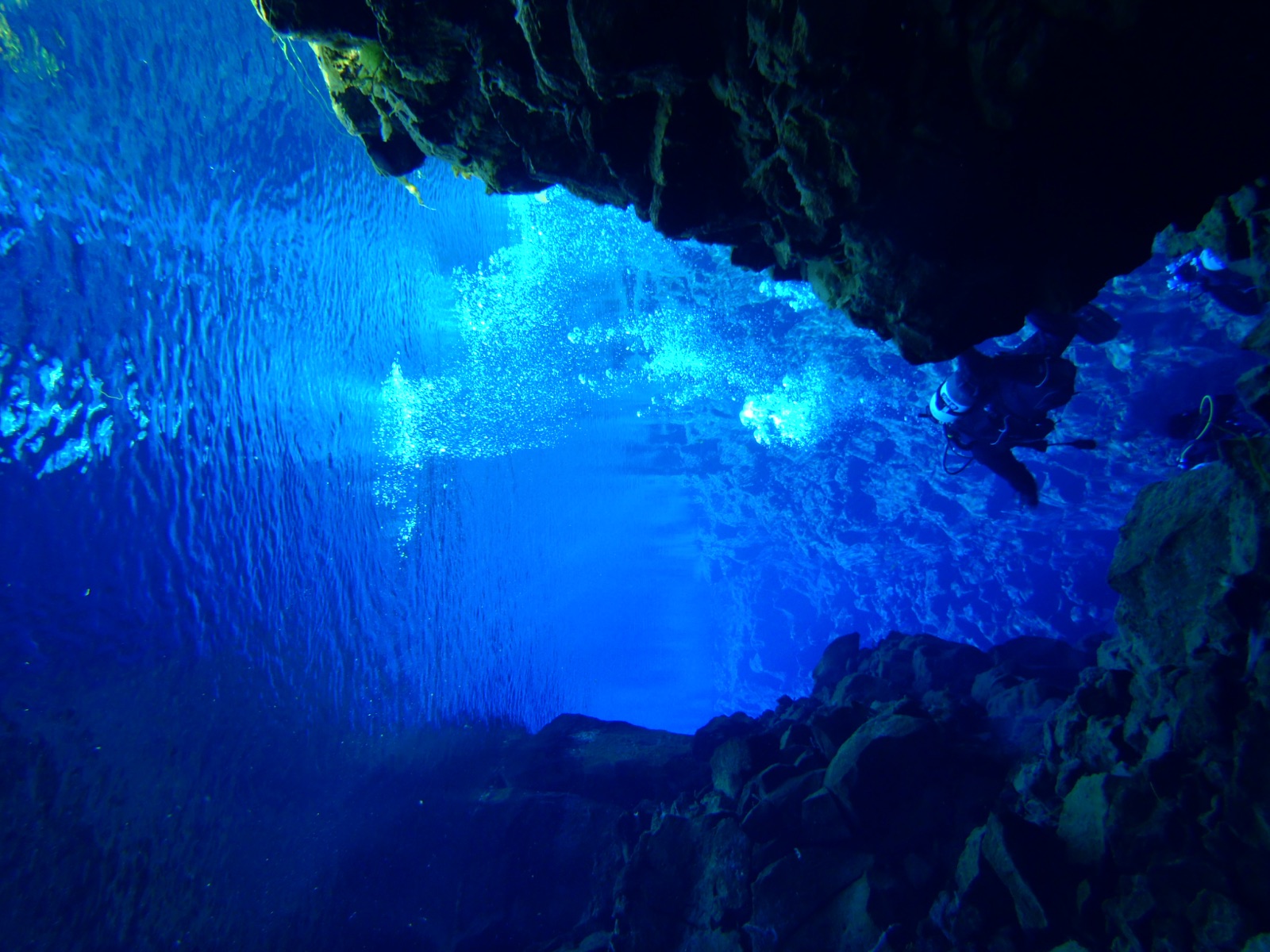
Silfra & Iceland
Silfra is a flooded rift between the North American and Eurasian tectonic plates in Iceland's Thingvellir National Park: glacial meltwater filtered through lava for decades, 2–4 °C in every season, and visibility measured in tens of meters. Divers and snorkelers in drysuits drift a shallow canyon of blue light. Around the country, geothermal chimneys at Strytan and lava fissures add stranger, colder adventures still.
Why dive here
No other dive puts geology this squarely in front of you: at Silfra you swim the gap where two continental plates pull apart a couple of centimeters a year, through water so clear the far wall of the canyon reads like air. Meltwater from Langjokull glacier percolates through porous basalt for decades before welling up into the fissure, arriving polished, drinkable and just above freezing. The dive itself is shallow and gentle (Big Crack, Hall, Cathedral, Lagoon), carried by a light current toward an exit stair, with neon-green 'troll hair' algae the only riot of color. The park requires drysuit qualification or documented drysuit experience, and every dive is guided. Iceland's supporting cast justifies extra days: Davidsgja's trout-patrolled rift in Thingvallavatn's open lake, and in the north the geothermal cones of Eyjafjordur, where mineral-hot water smokes out of chimneys built over thousands of years. It is expensive, cold, tightly managed, and unlike anything else in diving.
Month by month
Silfra runs year-round; the water is 2–4 °C in January and July alike. Summer brings long daylight, easier logistics and the biggest crowds; winter offers low light, possible aurora and hard weather on the roads.
| Month | Water | Visibility | What it's like |
|---|---|---|---|
| January●●●○○ | 2–4 °C / 36–39 °F | 70–100 m | Short daylight and winter roads; the fissure itself is unchanged. |
| February●●●○○ | 2–4 °C / 36–39 °F | 70–100 m | |
| March●●●○○ | 2–4 °C / 36–39 °F | 70–100 m | |
| April●●●●○ | 2–4 °C / 36–39 °F | 70–100 m | |
| May●●●●● | 2–4 °C / 36–39 °F | 70–100 m | Long days, fewer tour buses than midsummer. |
| June●●●●● | 2–4 °C / 36–39 °F | 70–100 m | Near-24-hour daylight. |
| July●●●●● | 2–4 °C / 36–39 °F | 70–100 m | Peak visitor season: book early slots. |
| August●●●●● | 2–4 °C / 36–39 °F | 70–100 m | |
| September●●●●○ | 2–4 °C / 36–39 °F | 70–100 m | |
| October●●●●○ | 2–4 °C / 36–39 °F | 70–100 m | Aurora season begins in earnest. |
| November●●●○○ | 2–4 °C / 36–39 °F | 70–100 m | |
| December●●●○○ | 2–4 °C / 36–39 °F | 70–100 m |
Monthly figures confidence: Documented. Months without a row have no verified data. We would rather show a gap than invent one.
The dive sites (5)
| Site | Type | Depth | Level | Access | |
|---|---|---|---|---|---|
| Arnarnesstrytur Multiple venting cones at friendly depths, lumpfish and wolffish… | Pinnacle | 10–25 m | Intermediate | Boat | |
| Bjarnagja Halocline light effects, sheer lava walls, a wilder alternative to managed… | Shore | 3–18 m | Intermediate | Shore | |
| Davidsgja Uncrowded rift diving, resident brown trout, open-lake atmosphere | Freshwater | 3–21 m | Intermediate | Shore | |
| Silfra Fissure Swimming a tectonic boundary, visibility beyond 80 m, drinkable glacier… | Freshwater | 2–18 m | Intermediate | Shore | |
| Strytan A living hydrothermal chimney, shimmering vent water, wolffish and… | Pinnacle | 15–40 m | Advanced | Boat |
Getting there & staying
Getting there: Fly to Keflavik, base in Reykjavik or the Golden Circle area, and join a guided tour: operators meet divers at the Silfra car park inside Thingvellir National Park. Northern sites like Strytan run out of Akureyri, a domestic flight or a day's drive north.
Where to stay: Reykjavik works for Silfra day trips; a Golden Circle guesthouse shortens the morning. For Strytan, stay in or near Akureyri on Eyjafjordur.
Costs: Guided two-dive Silfra excursions with drysuit equipment typically fall in this band; snorkel tours cost less. Editorial estimate. Iceland is a high-cost destination.
Between dives: The Golden Circle (Thingvellir, Geysir, Gullfoss), waterfalls and volcanic landscapes, whale watching from the north coast, geothermal lagoons, and winter aurora hunting.
Safety & practicalities
Hazards: Cold is the defining hazard: 2–4 °C water punishes equipment and hands, free-flows happen, and dive times are short. Weather and road conditions, not water conditions, cancel winter trips.
Operators require drysuit certification or logged drysuit experience for scuba at Silfra, and all diving is guided under national park rules. Regulators should be cold-water rated; follow your guide's free-flow procedures.
Nearest recompression: Hyperbaric treatment in Iceland is arranged through the national hospital system in Reykjavik; availability changes, so confirm with your operator. Emergencies go through 112 and DAN Europe.