Sharks
Shortfin Mako
Isurus oxyrinchus · Cartilaginous fish, family Lamnidae (mackerel sharks)
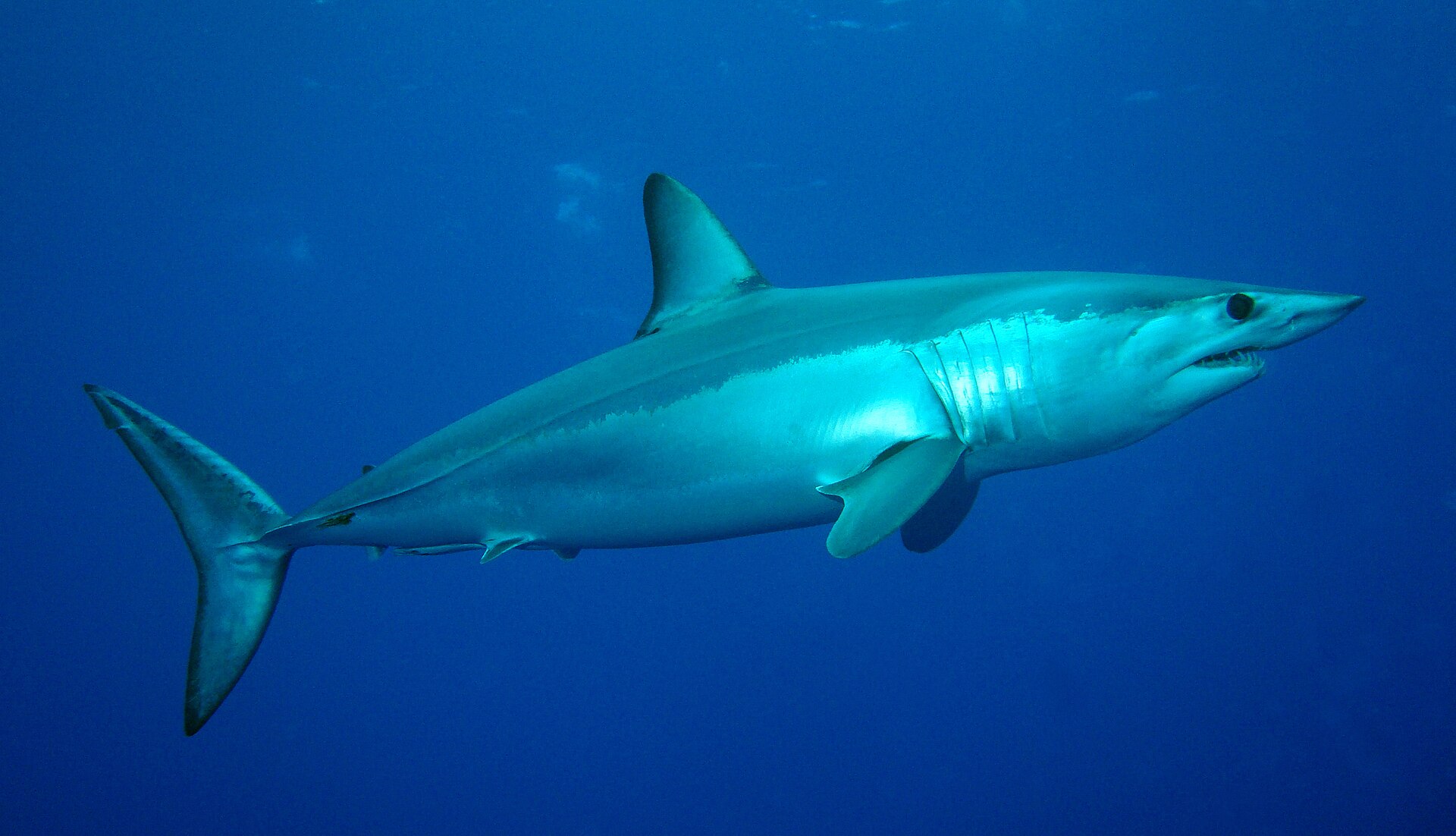
The shortfin mako is the fastest shark in the sea, a metallic-blue torpedo that arrives at speed and then hangs in the blue to inspect you. Encounters happen offshore, almost always on baited drifts, because makos live in open water and spend much of their time below diving depth. In the Azores, operators run blue shark expeditions to offshore seamounts from July to October, and makos join some of them: one Pico operator reports mako sightings on anything from under 10% to 65% of dives, depending on the season. The first passes are fast and close, the pointed snout, black eye and protruding, hooked teeth unmistakable; then the shark usually drops back to a wary distance and circles. It is a warm-bodied hunter of fish, squid and other sharks, so treat each mako as a privilege, keep your hands in, and let the crew manage the bait.
Where and when to see one
"Resident" means most dives at that destination encounter them; "seasonal" means reliably present in the listed months; anything else is a bonus, not a plan.
| Destination | Reliability | Months | Notes |
|---|---|---|---|
| The AzoresPortugal | Occasional | Jul–Oct |
Best month, at a glance
| Month | Reliable destinations |
|---|---|
| July | The Azores |
| August | The Azores |
| September | The Azores |
| October | The Azores |
Understanding them
Habitat: Open ocean, sometimes close inshore, recorded from the surface to 888 m but mostly in the upper 150 m. Divers meet it 5 to 10 m down on baited drifts over offshore seamounts.
Range: Worldwide in tropical and temperate seas: Norway to South Africa and the Mediterranean in the eastern Atlantic, the Gulf of Maine to Argentina in the west, and East Africa to Hawaii, Australia and New Zealand in the Indo-Pacific.
Behavior: Arrives fast and close when there is bait in the water, then slows, backs off to a wary distance and keeps making occasional passes. Its body runs several degrees warmer than the sea, which powers its bursts of speed.
Diet: Bony fish, other sharks and squid; large adults also take billfish and small cetaceans.
Size: typically around 2.7 m; documented up to 4.45 m (total length; FishBase gives a common length of 2.7 m and a maximum of 4.45 m).
How to behave around one
Dive only with an operator that runs a structured pelagic shark program. Stay with the group near the line, keep hands and cameras tucked in rather than reaching toward a passing shark, never handle the bait, and leave the water when the crew calls it.
Conservation
Endangered on the IUCN Red List (2019) after steep declines in longline fisheries, which both target it and catch it as bycatch. Listed on CITES Appendix II and CMS Appendix II.
Recently recorded near our dive sites
1 verified records within 5 to 10 km of 4 of our dive sites over the last 12 months (17 Nov 2025 to 16 Nov 2026). Latest: 8 Jan 2026, near Camp Cove, by snapperline69 ↗ (iNaturalist, CC BY-NC).
Most records near
Research-grade iNaturalist observations shared under CC0, CC BY or CC BY-NC, plus human sightings from GBIF and OBIS datasets under the same licences, within 5 km of a site with a sourced position or 10 km of an approximate one. A record near two sites counts once in the total and once on each site. Each site page credits the observers and datasets behind its records. How these are collected →
Watch
From the official channels

Catch this wave 🌊 | #montereybayaquarium #reeflife

Giant Pacific Octopus

Live African Penguin Cam After Hours | Monterey Bay Aquarium
Videos are embedded links to their creators' own channels. We host nothing and credit everything.