Reptiles
Yellow-bellied Sea Snake
Hydrophis platurus · Reptile, family Elapidae, subfamily Hydrophiinae (true sea snakes); long known as Pelamis platura or Pelamis platurus
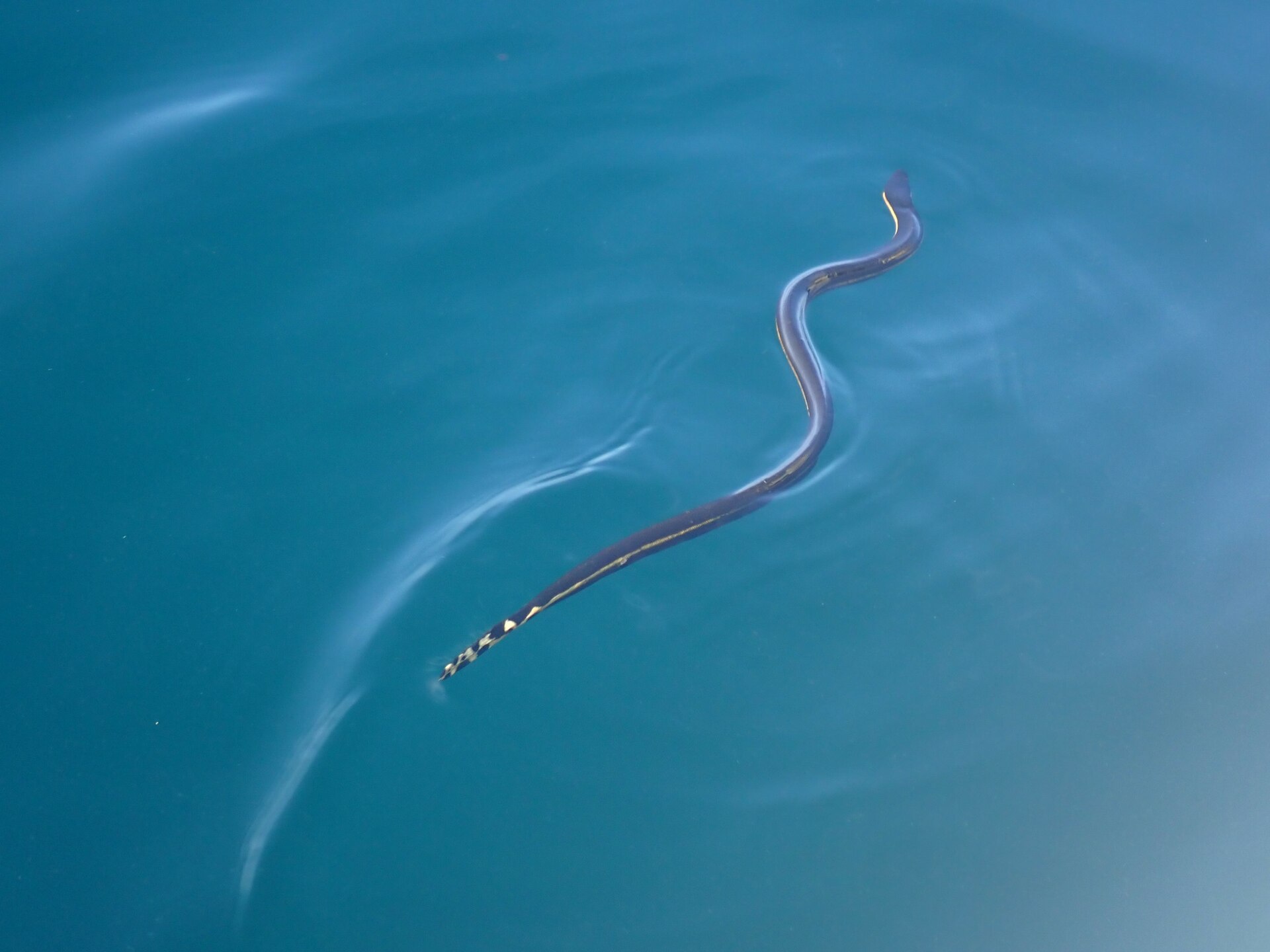
The only sea snake that lives entirely apart from the seabed, adrift on the open ocean. The yellow-bellied sea snake is a two-tone ribbon, dark above and bright yellow below, with a spotted paddle of a tail, and it is one of the most widely distributed snakes in the world, ranging from East Africa to the Pacific coast of the Americas. It rides currents at the surface, sometimes gathering in thousands along slicks of floating debris, where it waits motionless to ambush small fish. On Costa Rica's Pacific coast researchers study a yellow-bellied population in Golfo de Papagayo and an all-yellow subspecies, described in 2017, that lives in the warm inner basin of Golfo Dulce. Most divers meet it at the surface rather than on the reef. Bites are rare and usually involve fishers handling snakes in nets, but the venom is potent: look, never touch.
Where and when to see one
"Resident" means most dives at that destination encounter them; "seasonal" means reliably present in the listed months; anything else is a bonus, not a plan.
| Destination | Reliability | Months | Notes |
|---|---|---|---|
| Costa Rica Pacific CoastCosta Rica | Occasional | Year-round |
Best month, at a glance
| Month | Reliable destinations |
|---|---|
| January | Costa Rica Pacific Coast |
| February | Costa Rica Pacific Coast |
| March | Costa Rica Pacific Coast |
| April | Costa Rica Pacific Coast |
| May | Costa Rica Pacific Coast |
| June | Costa Rica Pacific Coast |
| July | Costa Rica Pacific Coast |
| August | Costa Rica Pacific Coast |
| September | Costa Rica Pacific Coast |
| October | Costa Rica Pacific Coast |
| November | Costa Rica Pacific Coast |
| December | Costa Rica Pacific Coast |
Understanding them
Habitat: Surface waters of the open ocean, especially drift lines and slicks where flotsam gathers, and sometimes shallow inshore water. It dives to about 15 m but forages only in the top 2 m.
Range: Tropical and subtropical Indian and Pacific oceans, from East Africa across Asia and Australia to the Pacific coast of the Americas, from the Gulf of California to Ecuador and the Galápagos. It is the only sea snake to have reached Hawaii.
Behavior: A drifter that floats with the currents, sometimes in aggregations of thousands along slicks, waiting to ambush small fish. It swims with sideways sweeps of a flattened, paddle-shaped tail and can stay submerged for hours.
Diet: Small fish only, ambushed at the surface while the snake floats still.
Size: typically around 65 cm; documented up to 1.13 m (total length; adults in most populations average about 0.6–0.75 m and the largest recorded reach 1.13 m. The all-yellow Golfo Dulce subspecies is smaller, averaging 0.49 m).
How to behave around one
Watch from a meter or two away, never lift or herd a floating snake, and keep boats slow around slicks where snakes gather. Leave stranded snakes alone.
Conservation
Least Concern (assessed 2017). It has no fishery value but is caught in nets; the small Golfo Dulce subspecies lives in a gulf without marine protected status, where human impacts are already affecting the water.
Recently recorded near our dive sites
2 verified records within 5 to 10 km of 2 of our dive sites over the last 12 months (17 Nov 2025 to 16 Nov 2026). Latest: 17 Oct 2026, near Shelly Beach, by richardllewellyn ↗ (iNaturalist, CC BY-NC).
Most records near
Research-grade iNaturalist observations shared under CC0, CC BY or CC BY-NC, plus human sightings from GBIF and OBIS datasets under the same licences, within 5 km of a site with a sourced position or 10 km of an approximate one. A record near two sites counts once in the total and once on each site. Each site page credits the observers and datasets behind its records. How these are collected →
Watch
From the official channels
Catch this wave 🌊 | #montereybayaquarium #reeflife

Giant Pacific Octopus

Live African Penguin Cam After Hours | Monterey Bay Aquarium
Videos are embedded links to their creators' own channels. We host nothing and credit everything.