Rays
Bat Ray
Myliobatis californica · Cartilaginous fish, family Myliobatidae (eagle rays); often written Myliobatis californicus
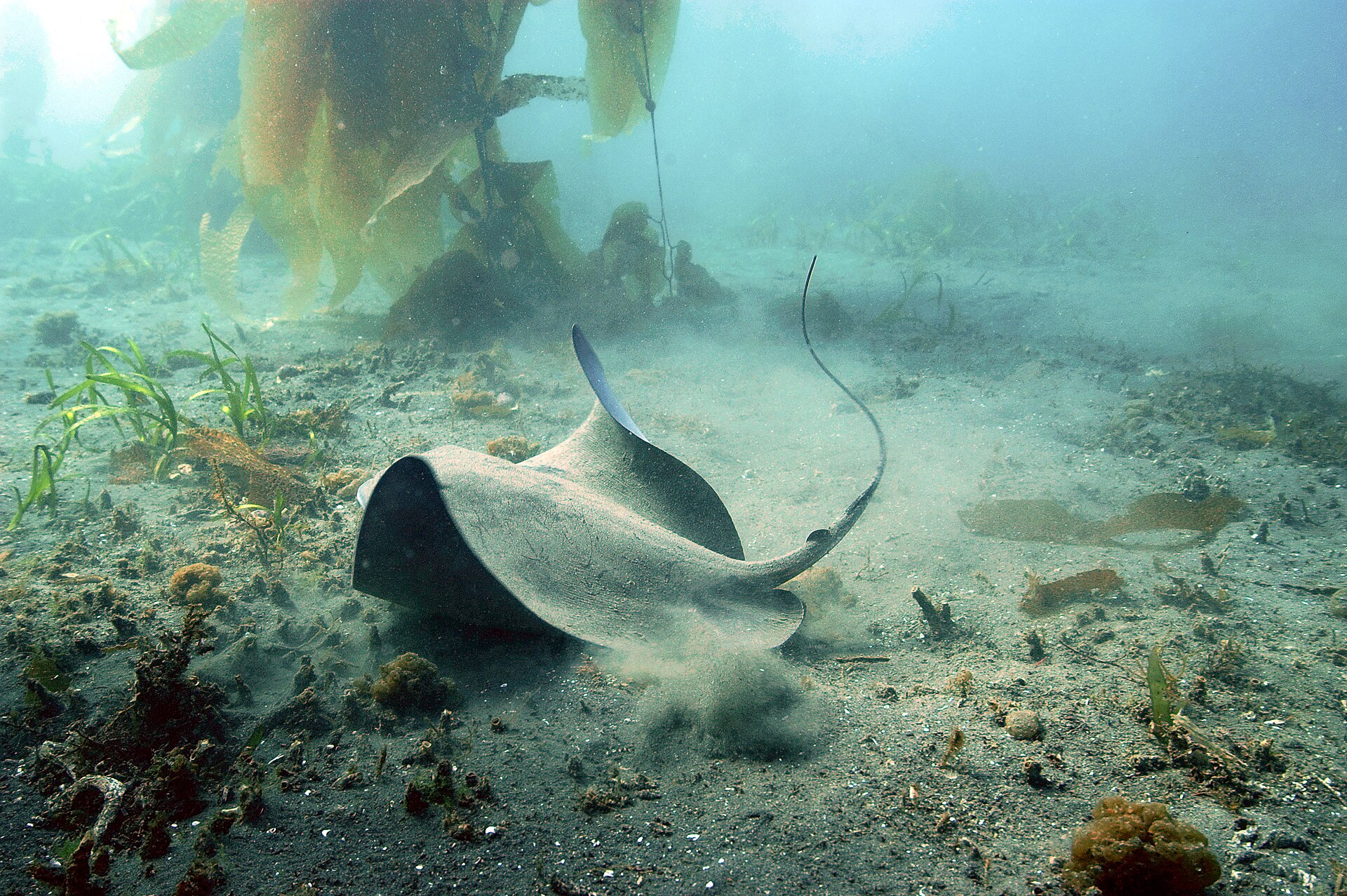
A ray with a bulldog's head and wings like a bat's. The bat ray is the eagle ray of the California coast: a dark, diamond-shaped disc normally 1.2 to 1.5 m across, a raised, rounded head with prominent eyes, and a whip-like tail about twice the length of its body. Around the Channel Islands it shares kelp forests with garibaldi and horn sharks, resting half-buried in sand patches by day and swimming out in the open more at night. It feeds by digging clams, worms and crabs from the bottom, and a big ray can trail an entourage of jack mackerel. Bat rays are common throughout California, sometimes in schools, yet one gliding through the kelp still feels like a special treat. Females grow larger, swim faster and live longer than males, up to about 24 years.
Where and when to see one
"Resident" means most dives at that destination encounter them; "seasonal" means reliably present in the listed months; anything else is a bonus, not a plan.
| Destination | Reliability | Months | Notes |
|---|---|---|---|
| California Channel IslandsUnited States | Occasional | Year-round |
Best month, at a glance
| Month | Reliable destinations |
|---|---|
| January | California Channel Islands |
| February | California Channel Islands |
| March | California Channel Islands |
| April | California Channel Islands |
| May | California Channel Islands |
| June | California Channel Islands |
| July | California Channel Islands |
| August | California Channel Islands |
| September | California Channel Islands |
| October | California Channel Islands |
| November | California Channel Islands |
| December | California Channel Islands |
Understanding them
Habitat: Sandy and muddy bays, sloughs and estuaries, sand patches among rocky reefs, and kelp beds; recorded to 108 m but concentrated in shallow water.
Range: Eastern Pacific from Oregon to the Gulf of California, with records from the Galápagos Islands.
Behavior: By day it often lies partly buried in sand or mud; swimming in the open is more common at night, on slow beats of its pointed wings. It travels alone or in schools, and jack mackerel sometimes follow closely behind a cruising ray.
Diet: Clams, snails, worms, shrimps and crabs excavated from sand and mud.
Size: typically around 1 m; documented up to 1.8 m (disc width; FishBase gives a common width of 1.0 m, a maximum of 1.8 m and 82 kg, while NOAA describes adults as normally 1.2–1.5 m across with reports to 2.4 m. Females grow larger than males).
How to behave around one
Scan sand patches before kneeling, watch a resting ray from the side rather than from above, and let swimming rays pass without chasing them. No touching or feeding.
Conservation
Least Concern (assessed 2015). It is not fished commercially in a targeted way but turns up as bycatch and is caught by recreational anglers.
Charted sites known for them
Highlighted sites were charted for this species by our editors; numbers are GBIF occurrence records logged within about 5 km of a site since 1990.
Recently recorded near our dive sites
2 verified records within 5 to 10 km of 2 of our dive sites over the last 12 months (17 Nov 2025 to 16 Nov 2026). Latest: 18 Jul 2026, near Cathedral Cove (Anacapa Island), by Seth Crawford ↗ (iNaturalist, CC BY-NC).
Most records near
Research-grade iNaturalist observations shared under CC0, CC BY or CC BY-NC, plus human sightings from GBIF and OBIS datasets under the same licences, within 5 km of a site with a sourced position or 10 km of an approximate one. A record near two sites counts once in the total and once on each site. Each site page credits the observers and datasets behind its records. How these are collected →
Watch
From the official channels

Catch this wave 🌊 | #montereybayaquarium #reeflife

Giant Pacific Octopus

Live African Penguin Cam After Hours | Monterey Bay Aquarium
Videos are embedded links to their creators' own channels. We host nothing and credit everything.