Sharks
Horn Shark
Heterodontus francisci · Cartilaginous fish, family Heterodontidae (bullhead sharks)
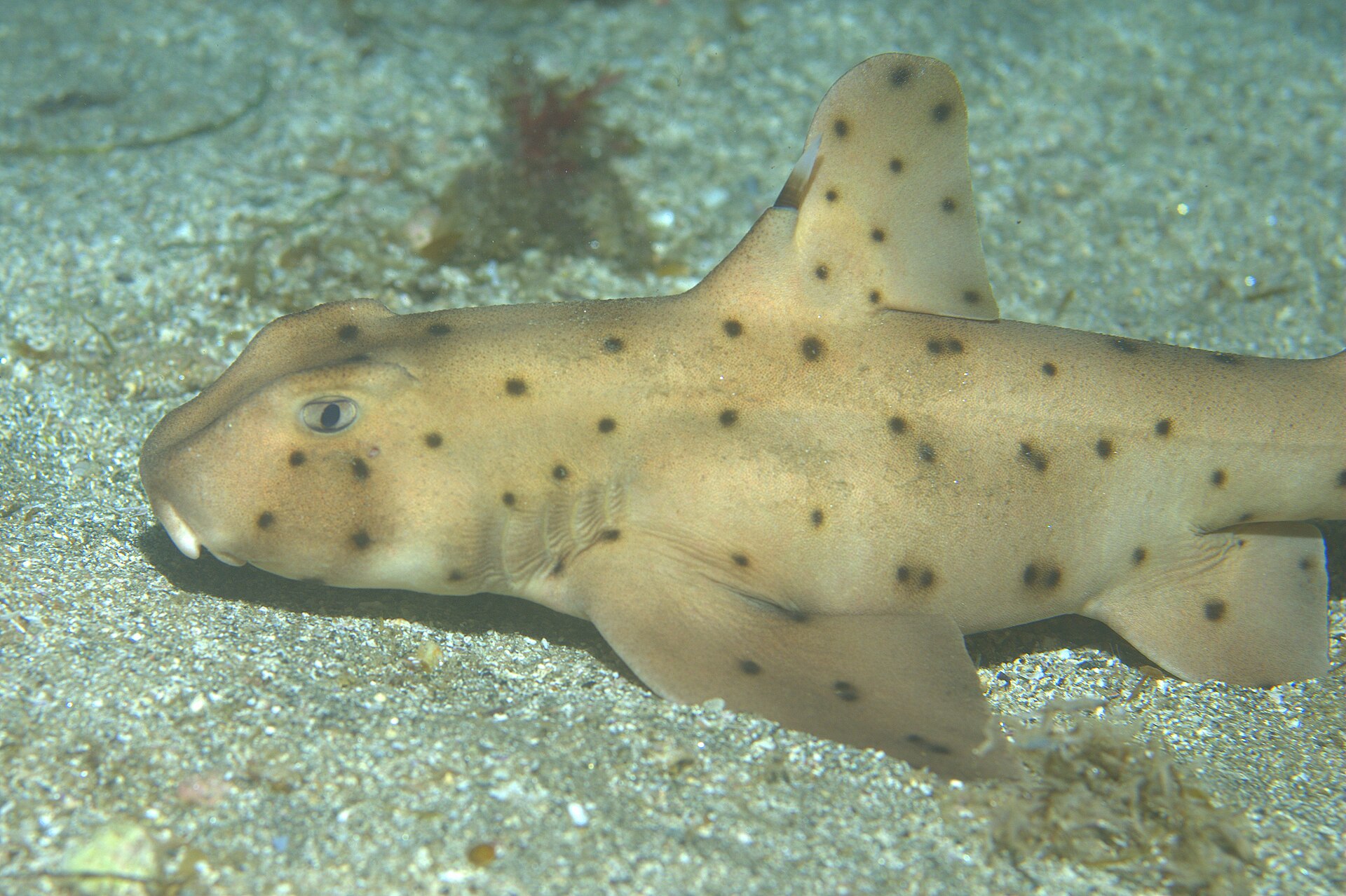
The horn shark is California's bulldog of the reef: a blunt-headed, spotted little shark with a stout spine in front of each dorsal fin. Those spines are the horns of its name. By day it is easy to miss, tucked into a rocky crevice or under a kelp-forest ledge, often the same one it used the day before; after dark it clambers across sand and boulders on muscular fins, hunting sea urchins and crabs. Catalina Island is the classic place to find one, with small horn sharks usually present around 9 m on night dives near Avalon, though the busy Casino Point dive park is less reliable by day. Its egg cases are spiral corkscrews that females wedge into cracks in the rock. Slow-moving and easily approached, it is a dependable night-dive subject, provided nobody grabs it.
Where and when to see one
"Resident" means most dives at that destination encounter them; "seasonal" means reliably present in the listed months; anything else is a bonus, not a plan.
| Destination | Reliability | Months | Notes |
|---|---|---|---|
| California Channel IslandsUnited States | Resident: seen on most dives | Year-round |
Best month, at a glance
| Month | Reliable destinations |
|---|---|
| January | California Channel Islands |
| February | California Channel Islands |
| March | California Channel Islands |
| April | California Channel Islands |
| May | California Channel Islands |
| June | California Channel Islands |
| July | California Channel Islands |
| August | California Channel Islands |
| September | California Channel Islands |
| October | California Channel Islands |
| November | California Channel Islands |
| December | California Channel Islands |
Understanding them
Habitat: Rocky reefs, kelp forests, sand channels between rocks, crevices and caves, usually at 2 to 11 m but recorded to 152 m. Juveniles favor open sand; larger sharks move into deeper, cooler water and bigger caves.
Range: Eastern Pacific from central California, including the Channel Islands, to the Gulf of California, and possibly Ecuador and Peru.
Behavior: Sluggish and nocturnal: it spends the day wedged in a crevice or cave, often returning to the same one every day, and at night clambers over the bottom on its muscular paired fins to feed.
Diet: Bottom invertebrates, especially sea urchins and crabs, plus lobsters, squid and small fish.
Size: typically around 97 cm; documented up to 1.22 m (total length; FishBase gives a common length of 97 cm and a maximum of 122 cm).
How to behave around one
Don't pull a horn shark from its crevice or pick it up, and keep fingers clear of its spines. At night approach slowly and keep your light off its eyes. Leave its corkscrew egg cases wedged in the rocks.
Conservation
Least Concern (IUCN 2025 assessment); it is a minor catch in local fisheries, reduced to fish meal, and its fin spines have been used to make jewelry.
Charted sites known for them
Highlighted sites were charted for this species by our editors; numbers are GBIF occurrence records logged within about 5 km of a site since 1990.
Recently recorded near our dive sites
32 verified records within 5 to 10 km of 2 of our dive sites over the last 12 months (17 Nov 2025 to 16 Nov 2026). Latest: 11 Sep 2026, near Cathedral Cove (Anacapa Island), by Curtis Hart ↗ (iNaturalist, CC BY-NC).
Most records near
Research-grade iNaturalist observations shared under CC0, CC BY or CC BY-NC, plus human sightings from GBIF and OBIS datasets under the same licences, within 5 km of a site with a sourced position or 10 km of an approximate one. A record near two sites counts once in the total and once on each site. Each site page credits the observers and datasets behind its records. How these are collected →
Watch
From the official channels

Giant Pacific Octopus

Live African Penguin Cam After Hours | Monterey Bay Aquarium

African Penguin Cam After Hours | Monterey Bay Aquarium
Videos are embedded links to their creators' own channels. We host nothing and credit everything.