Sharks
Port Jackson Shark
Heterodontus portusjacksoni · Cartilaginous fish, family Heterodontidae (bullhead sharks)
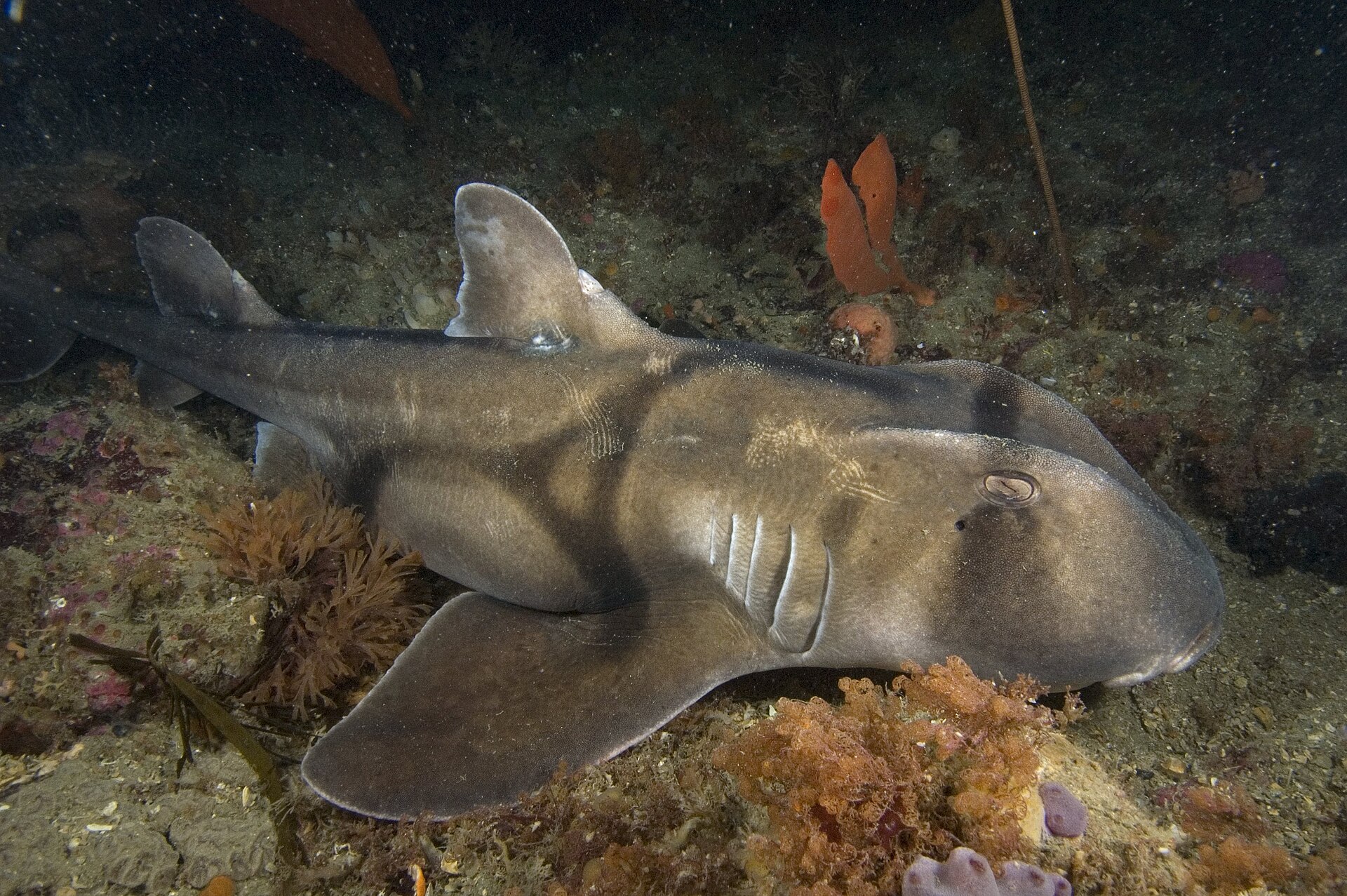
The Port Jackson shark wears a harness: dark bands that saddle its back like straps behind a blunt, ridged head. It is one of southern Australia's most familiar sharks, abundant enough in the south of its range that divers meet it at recreational depths on reefs and around jetties. By day it rests in caves and gullies, sometimes in groups; by night it noses across the bottom for sea urchins, cracking them with flat, plate-like teeth that look nothing like a typical shark's. Each year adults migrate to traditional breeding reefs. Off Adelaide, Port Noarlunga Reef has Port Jacksons all year and a busy mating season in November and December, when females tuck screw-shaped egg cases between the rocks; the eggs take up to a year to hatch. Mind the dorsal spines, keep lights off its eyes, and enjoy an easily approached shark.
Where and when to see one
"Resident" means most dives at that destination encounter them; "seasonal" means reliably present in the listed months; anything else is a bonus, not a plan.
| Destination | Reliability | Months | Notes |
|---|---|---|---|
| South AustraliaAustralia | Resident: seen on most dives | Year-round |
Best month, at a glance
| Month | Reliable destinations |
|---|---|
| January | South Australia |
| February | South Australia |
| March | South Australia |
| April | South Australia |
| May | South Australia |
| June | South Australia |
| July | South Australia |
| August | South Australia |
| September | South Australia |
| October | South Australia |
| November | South Australia |
| December | South Australia |
Understanding them
Habitat: Rocky reefs, gullies and caves with nearby sand and seagrass, from the intertidal zone to 275 m; it rests in caves and under ledges by day and is often found around jetties.
Range: Southern Australia, including Western Australia, with a single record from New Zealand; most common in the south of its range.
Behavior: Nocturnal: rests in caves and rocky gullies by day, sometimes several together, and forages across the bottom at night. Each year it migrates to breeding reefs, where females wedge spiral egg cases into rock crevices.
Diet: Bottom invertebrates, mainly sea urchins and other echinoderms, plus crustaceans and mollusks, crushed with flat, plate-like teeth.
Size: typically around 1.37 m; documented up to 1.65 m (total length; FishBase gives a common length of 1.37 m and a maximum of 1.65 m; hatchlings measure about 23 cm).
How to behave around one
Don't lift or grab resting sharks, and keep hands away from the dorsal spines. Leave egg cases where they are wedged in the rocks. At night keep your light off its eyes, which are sensitive to dive torches.
Conservation
Least Concern (IUCN 2015); it is widespread and common, with only minor commercial catches.
Charted sites known for them
Highlighted sites were charted for this species by our editors; numbers are GBIF occurrence records logged within about 5 km of a site since 1990.
Recently recorded near our dive sites
143 verified records within 5 to 10 km of 14 of our dive sites over the last 12 months (17 Nov 2025 to 16 Nov 2026), 16 of them in the last 30 days. Latest: 15 Nov 2026, near Magic Point, by jenbird88 ↗ (iNaturalist, CC BY-NC).
Most records near
Research-grade iNaturalist observations shared under CC0, CC BY or CC BY-NC, plus human sightings from GBIF and OBIS datasets under the same licences, within 5 km of a site with a sourced position or 10 km of an approximate one. A record near two sites counts once in the total and once on each site. Each site page credits the observers and datasets behind its records. How these are collected →
Watch
From the official channels

Catch this wave 🌊 | #montereybayaquarium #reeflife

Giant Pacific Octopus

Live African Penguin Cam After Hours | Monterey Bay Aquarium
Videos are embedded links to their creators' own channels. We host nothing and credit everything.