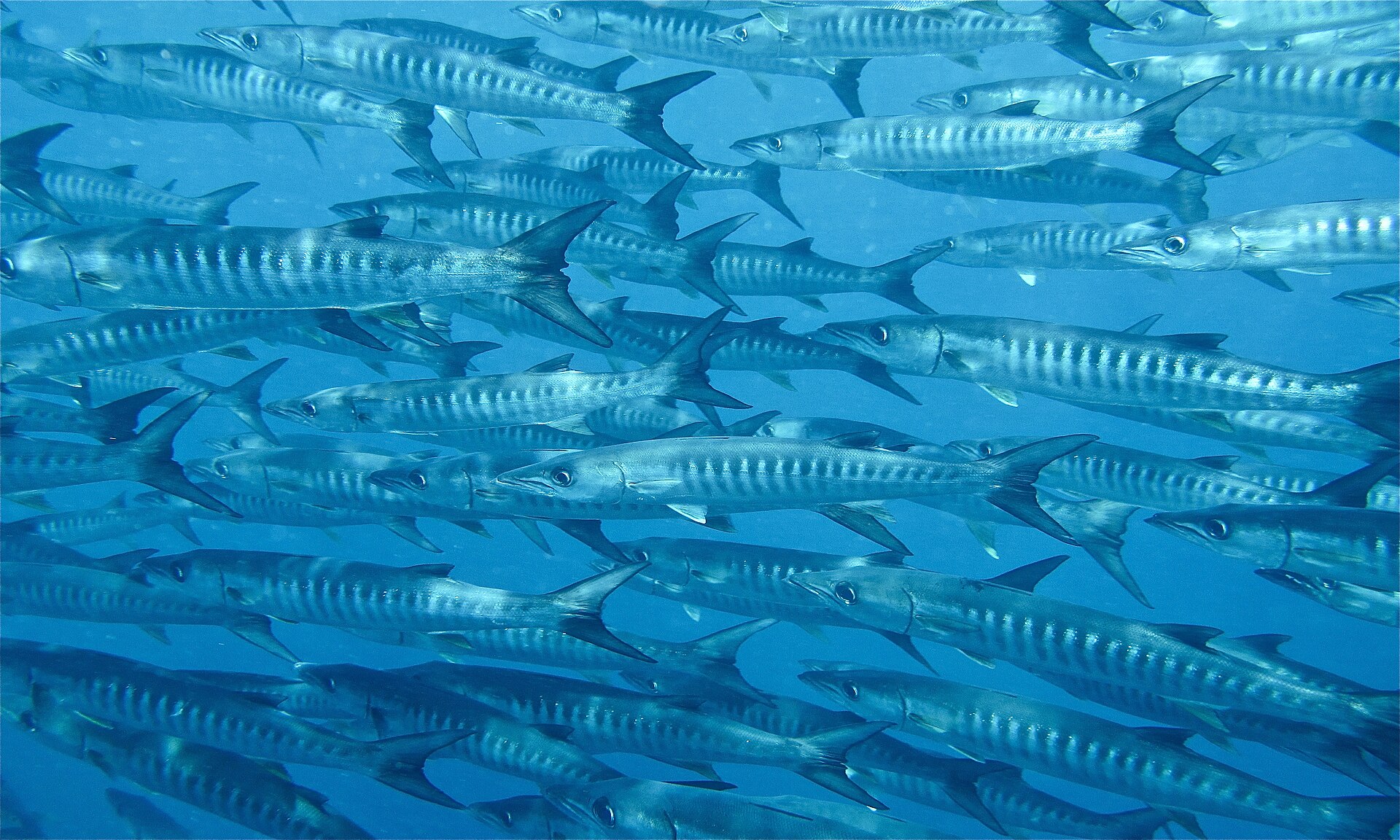
Big Fish
Blackfin Barracuda
Sphyraena qenie · Bony fish, family Sphyraenidae (barracudas); also called the chevron barracuda, and easily confused with the similar Sphyraena jello and Sphyraena putnamae
A wall of blackfin barracuda circling in the current is one of the Indo-Pacific's signature dive scenes. By day the species gathers in large schools that hang almost still on current-swept reefs, and a school can occupy the same spot for months or even years at a time. True to its name, Sipadan's Barracuda Point holds a resident school thousands strong; when it tightens into a spinning 'tornado' photographers get their shot, and when the fish tire of strobes they drift off into the blue. In the Red Sea, groups hover over the reefs off Sharm El Sheikh in summer. At dusk the schools break up and the fish hunt alone. Up close, each is a slim silver torpedo marked with 18 to 22 dark, forward-pointing chevrons, unlike the scattered blotches of the solitary great barracuda. Field identification is not always certain, since similar barracudas share its reefs.
Where and when to see one
"Resident" means most dives at that destination encounter them; "seasonal" means reliably present in the listed months; anything else is a bonus, not a plan.
| Destination | Reliability | Months | Notes |
|---|---|---|---|
| Sipadan & MabulMalaysia | Resident: seen on most dives | Year-round | |
| Sharm El Sheikh & Ras MohammedEgypt | Seasonal: reliable in season | Jun–Sep |
Best month, at a glance
| Month | Reliable destinations |
|---|---|
| January | Sipadan & Mabul |
| February | Sipadan & Mabul |
| March | Sipadan & Mabul |
| April | Sipadan & Mabul |
| May | Sipadan & Mabul |
| June | Sipadan & Mabul · Sharm El Sheikh & Ras Mohammed |
| July | Sipadan & Mabul · Sharm El Sheikh & Ras Mohammed |
| August | Sipadan & Mabul · Sharm El Sheikh & Ras Mohammed |
| September | Sipadan & Mabul · Sharm El Sheikh & Ras Mohammed |
| October | Sipadan & Mabul |
| November | Sipadan & Mabul |
| December | Sipadan & Mabul |
Understanding them
Habitat: Current-swept lagoon and seaward reefs, where schools may hold the same spot for months or years; recorded to 100 m and usually met on reefs above 50 m.
Range: Indo-Pacific from the Red Sea, East Africa and the Persian Gulf to French Polynesia, with rare records in the tropical eastern Pacific off Mexico and Panama; the exact range is uncertain because of confusion with similar barracudas.
Behavior: By day it forms large, semi-stationary schools that hang in the current and sometimes tighten into a spinning column; the schools disperse at dusk to feed.
Diet: Fishes, hunted mostly from late afternoon into the night after the schools leave the reef.
Size: typically around 80 cm; documented up to 1.7 m (total length; FishBase gives a common length of 80 cm and a maximum of 1.7 m (other references give 1.4 m); heaviest published weight 7.1 kg).
How to behave around one
Approach slowly from the side or below and let the school settle around you; chasing or finning through it breaks the formation. Go easy on strobes, since schools drift off into the blue when they tire of flashes, and if you must use a reef hook in current, set it only on bare rock.
Conservation
Least Concern according to the IUCN assessment of 2023 reported by FishBase; it is taken in commercial fisheries and often hooked by trolling between dusk and dawn.
Charted sites known for them
Highlighted sites were charted for this species by our editors; numbers are GBIF occurrence records logged within about 5 km of a site since 1990.
Recently recorded near our dive sites
25 verified records within 5 to 10 km of 26 of our dive sites over the last 12 months (17 Nov 2025 to 16 Nov 2026). Latest: 12 Oct 2026, near Tiputa Pass, by elodie_courtois ↗ (iNaturalist, CC BY-NC).
Most records near
Research-grade iNaturalist observations shared under CC0, CC BY or CC BY-NC, plus human sightings from GBIF and OBIS datasets under the same licences, within 5 km of a site with a sourced position or 10 km of an approximate one. A record near two sites counts once in the total and once on each site. Each site page credits the observers and datasets behind its records. How these are collected →
Watch
From the official channels
Catch this wave 🌊 | #montereybayaquarium #reeflife

Giant Pacific Octopus

Live African Penguin Cam After Hours | Monterey Bay Aquarium
Videos are embedded links to their creators' own channels. We host nothing and credit everything.