Sharks
Blacktip Shark
Carcharhinus limbatus · Cartilaginous fish, family Carcharhinidae (requiem sharks)
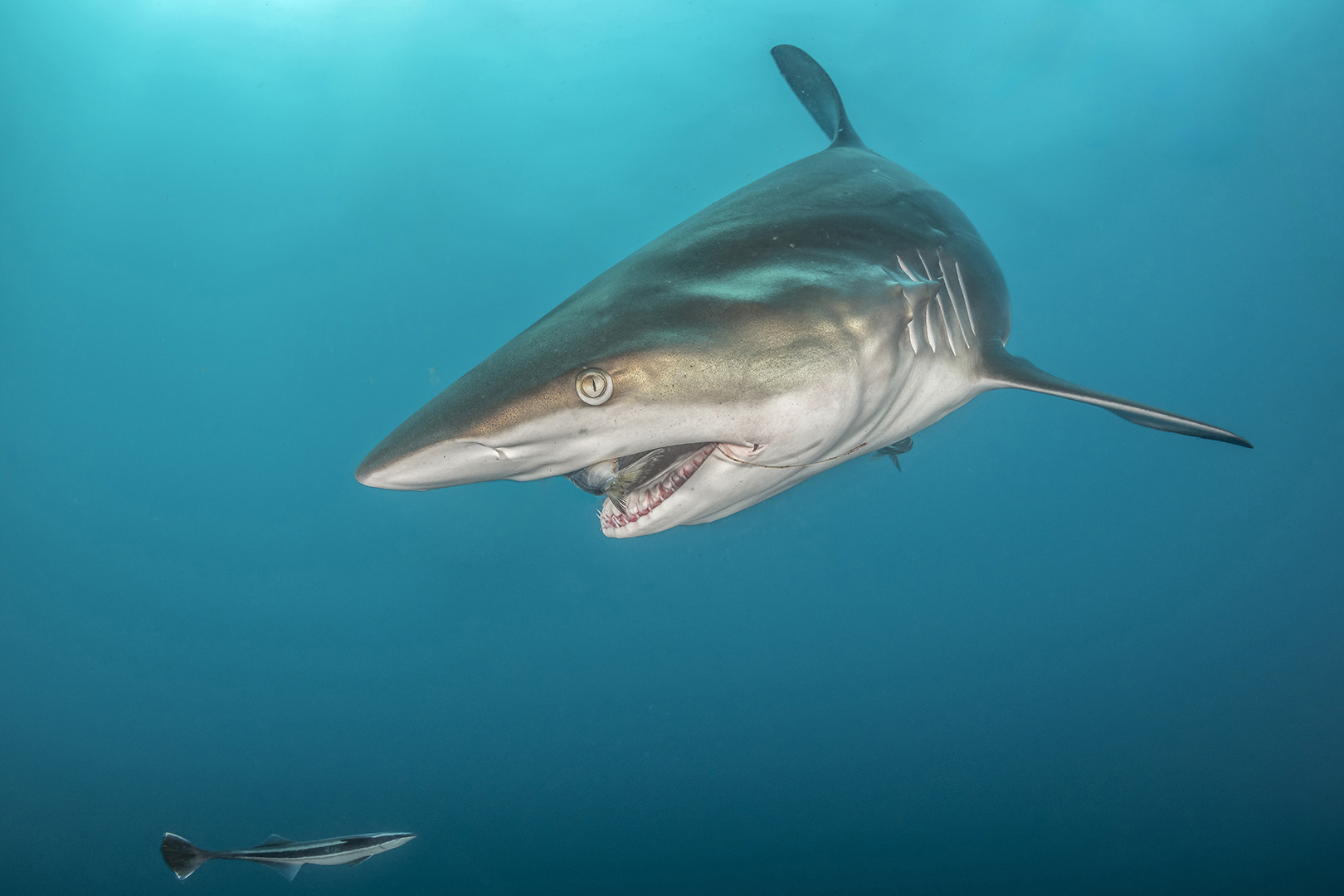
The blacktip shark is a sleek, bronze-gray sprinter with black-marked fins, and at South Africa's Aliwal Shoal it is the star of baited dives. Not to be confused with the smaller blacktip reef shark, this is a bigger coastal and offshore animal with a long, pointed snout and a band running back along each flank; its fin tips are darkest in young sharks and fade with age, except for a persistent black spot on the pelvic fins. Away from bait it is notoriously shy, a fast midwater hunter of fish that rarely lets a diver close. At Aliwal, several operators feed close to one another, which keeps the resident sharks together; there they swirl through the slick, sometimes ignoring divers and sometimes passing within arm's reach or bumping someone before returning to the bait. In the Florida Keys, NOAA reef surveys record it only now and then.
Where and when to see one
"Resident" means most dives at that destination encounter them; "seasonal" means reliably present in the listed months; anything else is a bonus, not a plan.
| Destination | Reliability | Months | Notes |
|---|---|---|---|
| Aliwal Shoal & UmkomaasSouth Africa | Resident: seen on most dives | Year-round | |
| The Sardine Run (Wild Coast)South Africa | Seasonal: reliable in season | Jun–Jul | |
| Galápagos IslandsEcuador | Occasional | Year-round | |
| Florida KeysUnited States | Occasional | Year-round | |
| Sodwana BaySouth Africa | Occasional | Year-round |
Best month, at a glance
Understanding them
Habitat: Inshore and offshore waters over continental and island shelves: river mouths, estuaries, muddy bays, mangroves, lagoons, coral reef drop-offs and seamounts. Recorded to 140 m but usually above 30 m; young are common along beaches.
Range: Worldwide in tropical and subtropical seas: the western Atlantic from Nova Scotia to Brazil, the eastern Atlantic including Madeira, the Canaries and the Mediterranean, the Indo-Pacific from the Red Sea and South Africa to Hawaii and Tahiti, and the eastern Pacific from Baja California to Peru.
Behavior: A fast, active midwater hunter that is usually shy and hard to approach. At baited dives it either ignores divers or investigates them, and some individuals make close passes or bump people.
Diet: Mainly midwater and bottom fish, plus small sharks and rays, squid and crustaceans.
Size: typically around 1.5 m; documented up to 2.86 m (total length; FishBase gives a common length of 1.5 m and a maximum of 2.86 m).
How to behave around one
On baited dives, stay in the position and depth the crew assigns, keep hands tucked in and never reach toward the bait or a passing shark. Away from feeds, don't chase it; it will simply leave.
Conservation
Vulnerable on the IUCN Red List (2021) after declines from fishing; it is caught commercially and by anglers for meat, leather and liver oil, and is listed on CITES Appendix II.
Charted sites known for them
Highlighted sites were charted for this species by our editors; numbers are GBIF occurrence records logged within about 5 km of a site since 1990.
Watch
From the official channels

Catch this wave 🌊 | #montereybayaquarium #reeflife

Giant Pacific Octopus

Live African Penguin Cam After Hours | Monterey Bay Aquarium
Videos are embedded links to their creators' own channels. We host nothing and credit everything.