Crustaceans
Boxer Crab (Pom-pom Crab)
Lybia tessellata · Crustacean, family Xanthidae (mud crabs); the mosaic boxer crab, one of several anemone-carrying Lybia species
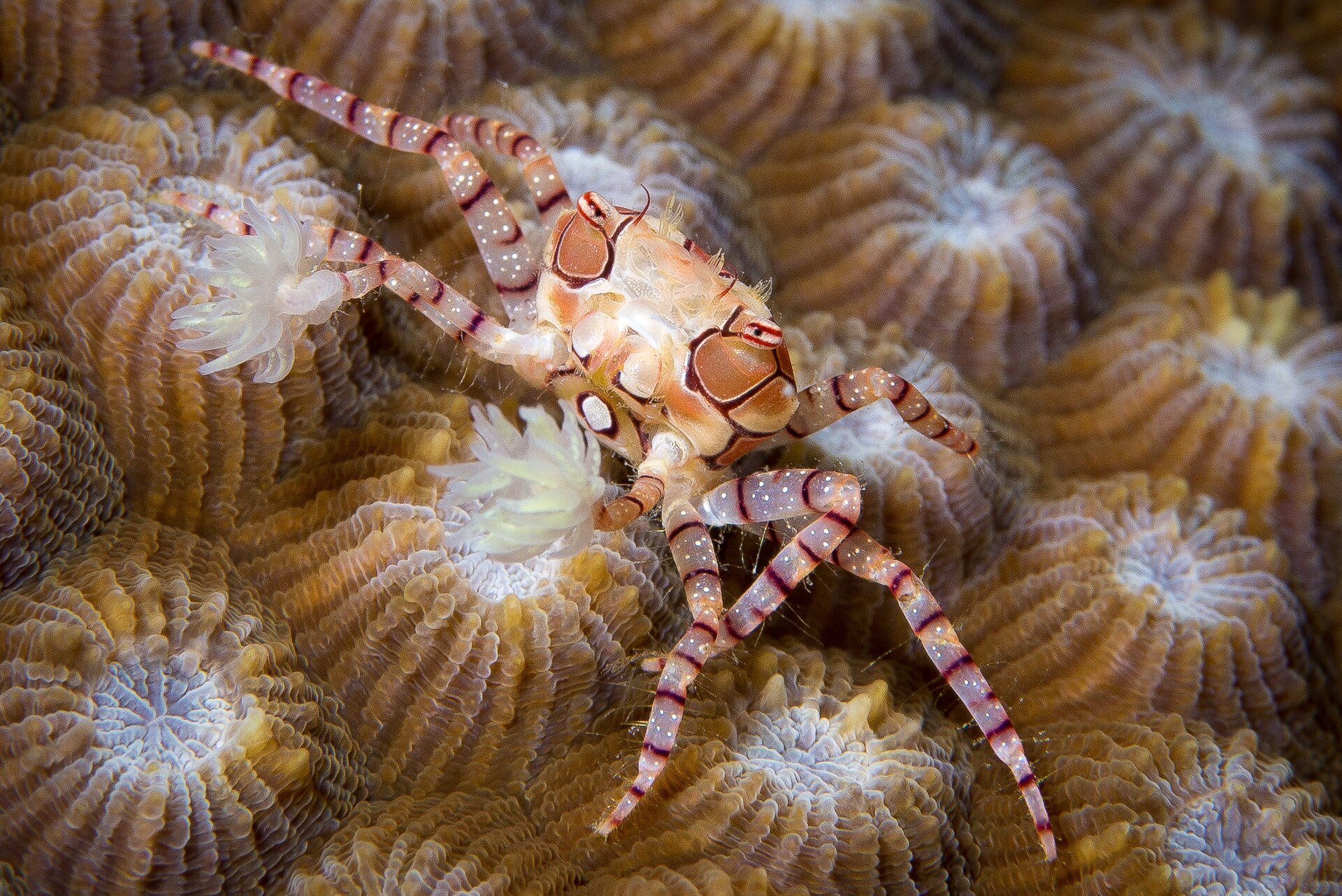
The boxer crab never leaves home without its gloves: a tiny sea anemone held in each claw. Waved at an attacker, the anemones' stinging tentacles do the fighting, and they do the shopping too, because the crab's slender claws are useless for feeding; it wipes food particles off the anemones' tentacles with its mouthparts. The crab is about the size of a thumbnail, its carapace divided into a stained-glass mosaic of white, black and orange, with banded legs. It hides by day under small rocks and in rubble, moves fast, and is one of the harder critters for guides to produce, so a sighting is a genuine bonus. Females carry clutches of red eggs under the abdomen. Never lift rocks to search for one or try to coax the anemones away: they are both its weapons and its larder.
Where and when to see one
"Resident" means most dives at that destination encounter them; "seasonal" means reliably present in the listed months; anything else is a bonus, not a plan.
| Destination | Reliability | Months | Notes |
|---|---|---|---|
| Bali & Nusa PenidaIndonesia | Occasional | Year-round | |
| Lembeh StraitIndonesia | Occasional | Year-round | |
| Bunaken & ManadoIndonesia | Rare | Year-round |
Best month, at a glance
| Month | Reliable destinations |
|---|---|
| January | Bali & Nusa Penida · Lembeh Strait · Bunaken & Manado |
| February | Bali & Nusa Penida · Lembeh Strait · Bunaken & Manado |
| March | Bali & Nusa Penida · Lembeh Strait · Bunaken & Manado |
| April | Bali & Nusa Penida · Lembeh Strait · Bunaken & Manado |
| May | Bali & Nusa Penida · Lembeh Strait · Bunaken & Manado |
| June | Bali & Nusa Penida · Lembeh Strait · Bunaken & Manado |
| July | Bali & Nusa Penida · Lembeh Strait · Bunaken & Manado |
| August | Bali & Nusa Penida · Lembeh Strait · Bunaken & Manado |
| September | Bali & Nusa Penida · Lembeh Strait · Bunaken & Manado |
| October | Bali & Nusa Penida · Lembeh Strait · Bunaken & Manado |
| November | Bali & Nusa Penida · Lembeh Strait · Bunaken & Manado |
| December | Bali & Nusa Penida · Lembeh Strait · Bunaken & Manado |
Understanding them
Habitat: Shallow reefs, rubble and sand-gravel bottoms and live coral, usually hidden under small rocks by day.
Range: Indo-West Pacific, from the Red Sea and East Africa through Indonesia to New Guinea.
Behavior: Scuttles fast between rocks with an anemone held out in each claw; threatened, it menaces the intruder with them.
Diet: An omnivore that cannot feed with its slender claws: it wipes food particles from the tentacles of the anemones it carries, using its mouthparts.
Size: typically around 1.5 cm; documented up to 2.5 cm (carapace width; dive centers give a body of about 1.5 cm, reef guides up to 2.5 cm).
How to behave around one
Never flip rocks or rubble to search for one, never block its retreat, and never try to take or swap its anemones. Keep lights moderate and accept a few frames: it moves fast and stress makes it run.
Conservation
Not assessed by the IUCN. No specific threats are documented; it is also kept in reef aquariums.
Charted sites known for them
Highlighted sites were charted for this species by our editors; numbers are GBIF occurrence records logged within about 5 km of a site since 1990.
Recently recorded near our dive sites
16 verified records within 5 to 10 km of 9 of our dive sites over the last 12 months (17 Nov 2025 to 16 Nov 2026), 3 of them in the last 30 days. Latest: 15 Nov 2026, near Mucky Mosque, by pablo_dbr_ ↗ (iNaturalist, CC BY-NC).
Most records near
Research-grade iNaturalist observations shared under CC0, CC BY or CC BY-NC, plus human sightings from GBIF and OBIS datasets under the same licences, within 5 km of a site with a sourced position or 10 km of an approximate one. A record near two sites counts once in the total and once on each site. Each site page credits the observers and datasets behind its records. How these are collected →
Watch
From the official channels

Giant Pacific Octopus

Live African Penguin Cam After Hours | Monterey Bay Aquarium

African Penguin Cam After Hours | Monterey Bay Aquarium
Videos are embedded links to their creators' own channels. We host nothing and credit everything.