Sharks
Brownbanded Bamboo Shark
Chiloscyllium punctatum · Cartilaginous fish, family Hemiscylliidae (longtail carpet sharks)
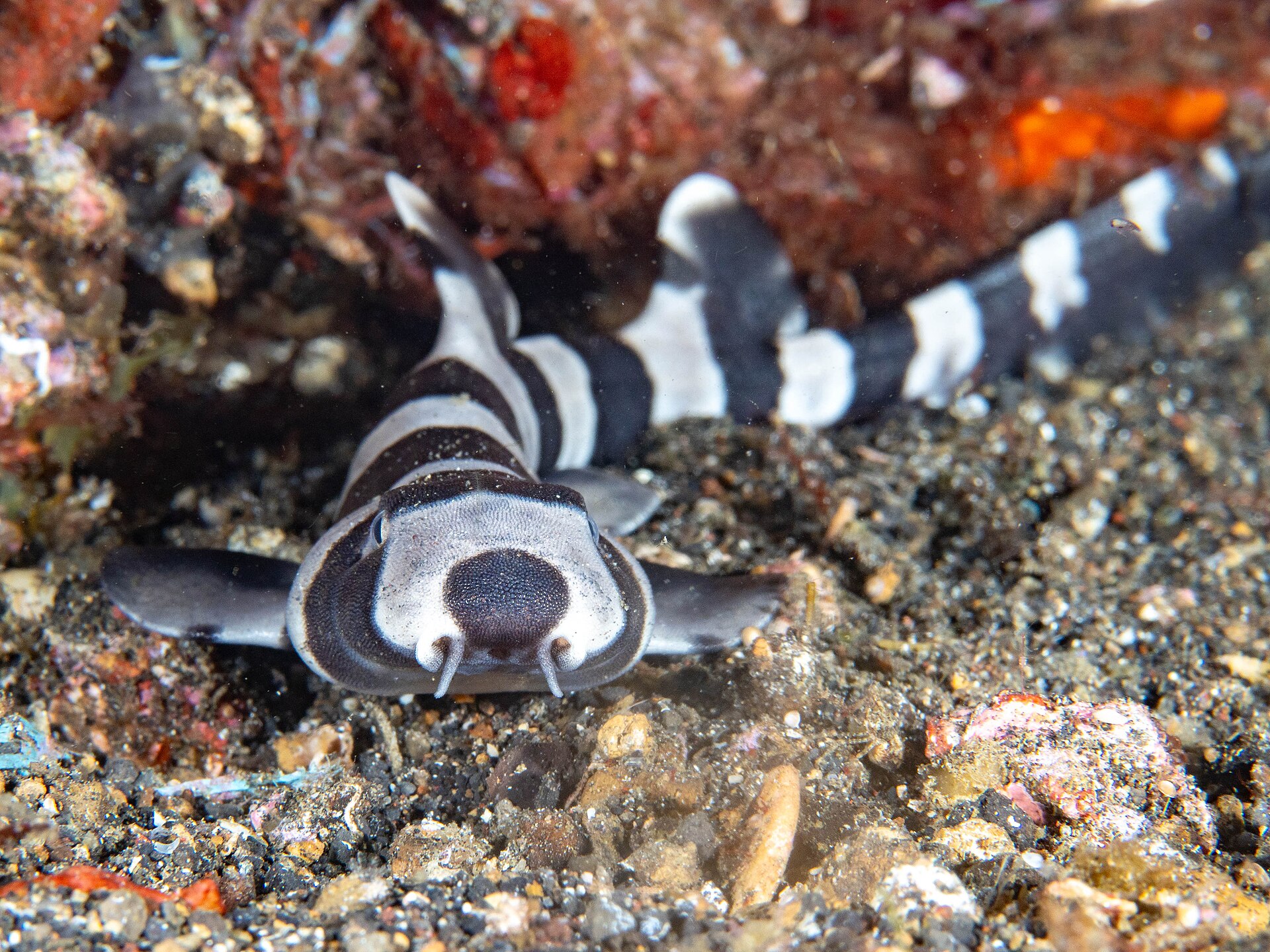
Juvenile brownbanded bamboo sharks look like striped toys, and on night and muck dives in the Coral Triangle they are a prized find. The bands are a juvenile uniform: as the shark grows toward its maximum of about 1.3 m they fade to plain light brown, and several related bamboo sharks look much the same, especially as banded juveniles. It is a fairly common inshore species across Southeast Asia and northern Australia, yet rarely seen, because it spends daylight wedged under ledges and slides deeper when a light finds it. Citizen-science records place it at Anilao in the Philippines and around Raja Ampat, where one was logged at 18 m. It is tough enough to survive hours out of water between tides, lays its eggs in pairs, and is a staple of the aquarium trade. In the wild, a slow search of rubble and ledges is the only way to meet one.
Where and when to see one
"Resident" means most dives at that destination encounter them; "seasonal" means reliably present in the listed months; anything else is a bonus, not a plan.
| Destination | Reliability | Months | Notes |
|---|---|---|---|
| Raja AmpatIndonesia | Occasional | Year-round | |
| KomodoIndonesia | Occasional | Year-round | |
| AnilaoPhilippines | Occasional | Year-round | |
| Lembeh StraitIndonesia | Occasional | Year-round | |
| AlorIndonesia | Occasional | Year-round |
Best month, at a glance
| Month | Reliable destinations |
|---|---|
| January | Raja Ampat · Komodo · Anilao · Lembeh Strait · Alor |
| February | Raja Ampat · Komodo · Anilao · Lembeh Strait · Alor |
| March | Raja Ampat · Komodo · Anilao · Lembeh Strait · Alor |
| April | Raja Ampat · Komodo · Anilao · Lembeh Strait · Alor |
| May | Raja Ampat · Komodo · Anilao · Lembeh Strait · Alor |
| June | Raja Ampat · Komodo · Anilao · Lembeh Strait · Alor |
| July | Raja Ampat · Komodo · Anilao · Lembeh Strait · Alor |
| August | Raja Ampat · Komodo · Anilao · Lembeh Strait · Alor |
| September | Raja Ampat · Komodo · Anilao · Lembeh Strait · Alor |
| October | Raja Ampat · Komodo · Anilao · Lembeh Strait · Alor |
| November | Raja Ampat · Komodo · Anilao · Lembeh Strait · Alor |
| December | Raja Ampat · Komodo · Anilao · Lembeh Strait · Alor |
Understanding them
Habitat: Coral reefs, rubble and sandy bottoms near reefs, from tide pools down to 85 m; it can survive out of water for up to 12 hours between tides.
Range: Indo-West Pacific from the Andaman Islands and India east to the Philippines, north to Japan and south to northern Australia.
Behavior: Shy: hides under ledges and in crevices by day and, when found, tries to wedge itself deeper or bolts for new cover. Juveniles wear bold dark bands that fade to plain light brown in adults.
Diet: Probably bottom invertebrates and small fish.
Size: typically around 80 cm; documented up to 1.32 m (total length; no common length is published, so 0.8 m, just under the size at maturity (82 to 87 cm), is a conservative adult figure. The banded juveniles divers often find are much smaller, hatching at 11 to 15 cm).
How to behave around one
Don't pull it out of a crevice or chase it across the sand; a stressed shark bolts and loses its shelter. When a guide knows where a juvenile hides, look and photograph without touching, keep strobes and lights brief, and move on.
Conservation
Near Threatened (IUCN 2024): it is caught frequently in demersal gillnet, longline and trawl fisheries in shelf waters across its range and is used for its meat and fins.
Charted sites known for them
Highlighted sites were charted for this species by our editors; numbers are GBIF occurrence records logged within about 5 km of a site since 1990.
Recently recorded near our dive sites
1 verified records within 5 to 10 km of 1 of our dive sites over the last 12 months (17 Nov 2025 to 16 Nov 2026). Latest: 30 Sep 2026, near Navy Pier, by Kristin Anderson ↗ (iNaturalist, CC BY-NC).
Most records near
Research-grade iNaturalist observations shared under CC0, CC BY or CC BY-NC, plus human sightings from GBIF and OBIS datasets under the same licences, within 5 km of a site with a sourced position or 10 km of an approximate one. A record near two sites counts once in the total and once on each site. Each site page credits the observers and datasets behind its records. How these are collected →
Watch
From the official channels

Catch this wave 🌊 | #montereybayaquarium #reeflife

Giant Pacific Octopus

Live African Penguin Cam After Hours | Monterey Bay Aquarium
Videos are embedded links to their creators' own channels. We host nothing and credit everything.