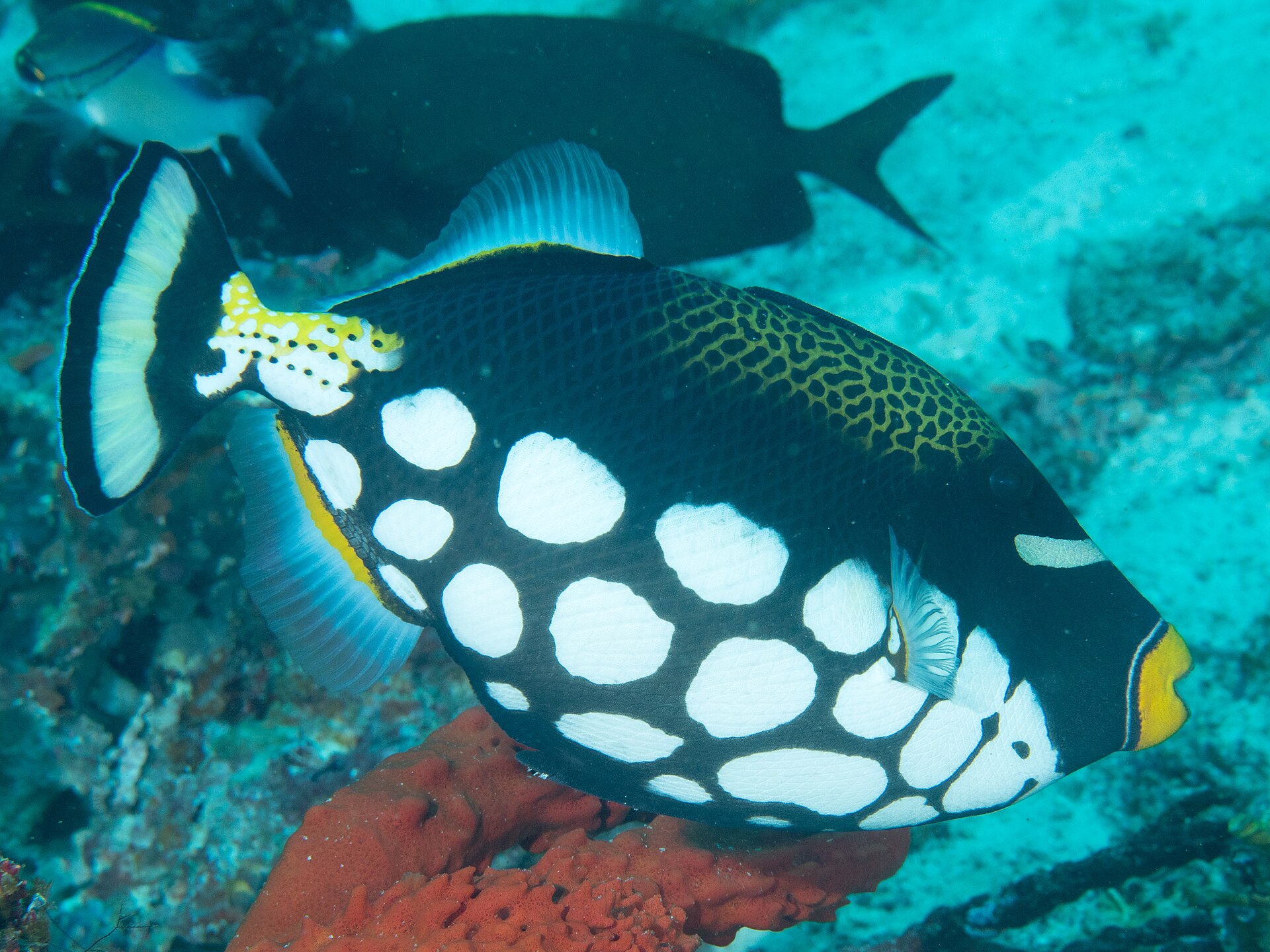
Reef Fish
Clown Triggerfish
Balistoides conspicillum · Bony fish, family Balistidae (triggerfishes)
Big white spots on a black belly, a yellow net over the back and an orange-yellow mouth make the clown triggerfish impossible to mistake. It is one of the most highly prized aquarium fishes, yet on the reef it is a fairly uncommon sight: usually a single adult swimming openly along a steep drop-off, slipping into a cave if a diver crowds it. Juveniles are secretive and stay tucked into small caves with rich invertebrate growth. Adults reach 50 cm and feed on sea urchins, crabs, mollusks and tunicates. Reef Life Survey divers record it at fewer than one in ten of the sites they survey, and almost always one fish at a time. Near Lizard Island on the northern Great Barrier Reef it is rarely seen at the island itself but frequently seen on the slopes of the outer reefs.
Where and when to see one
"Resident" means most dives at that destination encounter them; "seasonal" means reliably present in the listed months; anything else is a bonus, not a plan.
| Destination | Reliability | Months | Notes |
|---|---|---|---|
| Cairns & the Ribbon ReefsAustralia | Resident: seen on most dives | Year-round | |
| PalauPalau | Occasional | Year-round | |
| Raja AmpatIndonesia | Occasional | Year-round | |
| North & South Malé AtollsMaldives | Occasional | Year-round | |
| KomodoIndonesia | Occasional | Year-round | |
| Taveuni & Rainbow ReefFiji | Occasional | Year-round | |
| Tubbataha ReefsPhilippines | Occasional | Year-round |
Best month, at a glance
Understanding them
Habitat: Clear seaward reefs next to steep drop-offs, usually with rich coral growth. Adults swim in the open along the drop-off, while juveniles hide in small caves with rich invertebrate growth. Recorded from 1 to 75 m.
Range: Indo-Pacific from East Africa east through northern Australia to Samoa, and north to southern Japan. In Australia it occurs on the northern Great Barrier Reef and Coral Sea reefs.
Behavior: Solitary; adults swim openly along deep drop-offs and retreat into caves when approached. It is uncommon to rare through most of its range.
Diet: Sea urchins, crabs and other crustaceans, mollusks and tunicates.
Size: typically around 30 cm; documented up to 50 cm (total length; 50 cm is the recorded maximum, and the typical figure is our conservative estimate (a large adult photographed at Yonge Reef was about 40 cm)).
How to behave around one
Watch it from a few meters away as it cruises the drop-off; following it only pushes it into a cave. Keep hands and fins off the reef around its shelter.
Conservation
Least Concern on the IUCN Red List (2022 assessment). It is uncommon to rare in most of its range and among the most highly prized aquarium fishes.
Charted sites known for them
Highlighted sites were charted for this species by our editors; numbers are GBIF occurrence records logged within about 5 km of a site since 1990.
Recently recorded near our dive sites
122 verified records within 5 to 10 km of 89 of our dive sites over the last 12 months (17 Nov 2025 to 16 Nov 2026), 1 of them in the last 30 days. Latest: 2 Nov 2026, near HP Reef, by martinmoscovich ↗ (iNaturalist, CC BY-NC).
Most records near
Research-grade iNaturalist observations shared under CC0, CC BY or CC BY-NC, plus human sightings from GBIF and OBIS datasets under the same licences, within 5 km of a site with a sourced position or 10 km of an approximate one. A record near two sites counts once in the total and once on each site. Each site page credits the observers and datasets behind its records. How these are collected →
Watch
From the official channels

Giant Pacific Octopus

Live African Penguin Cam After Hours | Monterey Bay Aquarium

African Penguin Cam After Hours | Monterey Bay Aquarium
Videos are embedded links to their creators' own channels. We host nothing and credit everything.