Reef Fish
Emperor Angelfish
Pomacanthus imperator · Bony fish, family Pomacanthidae (marine angelfishes)
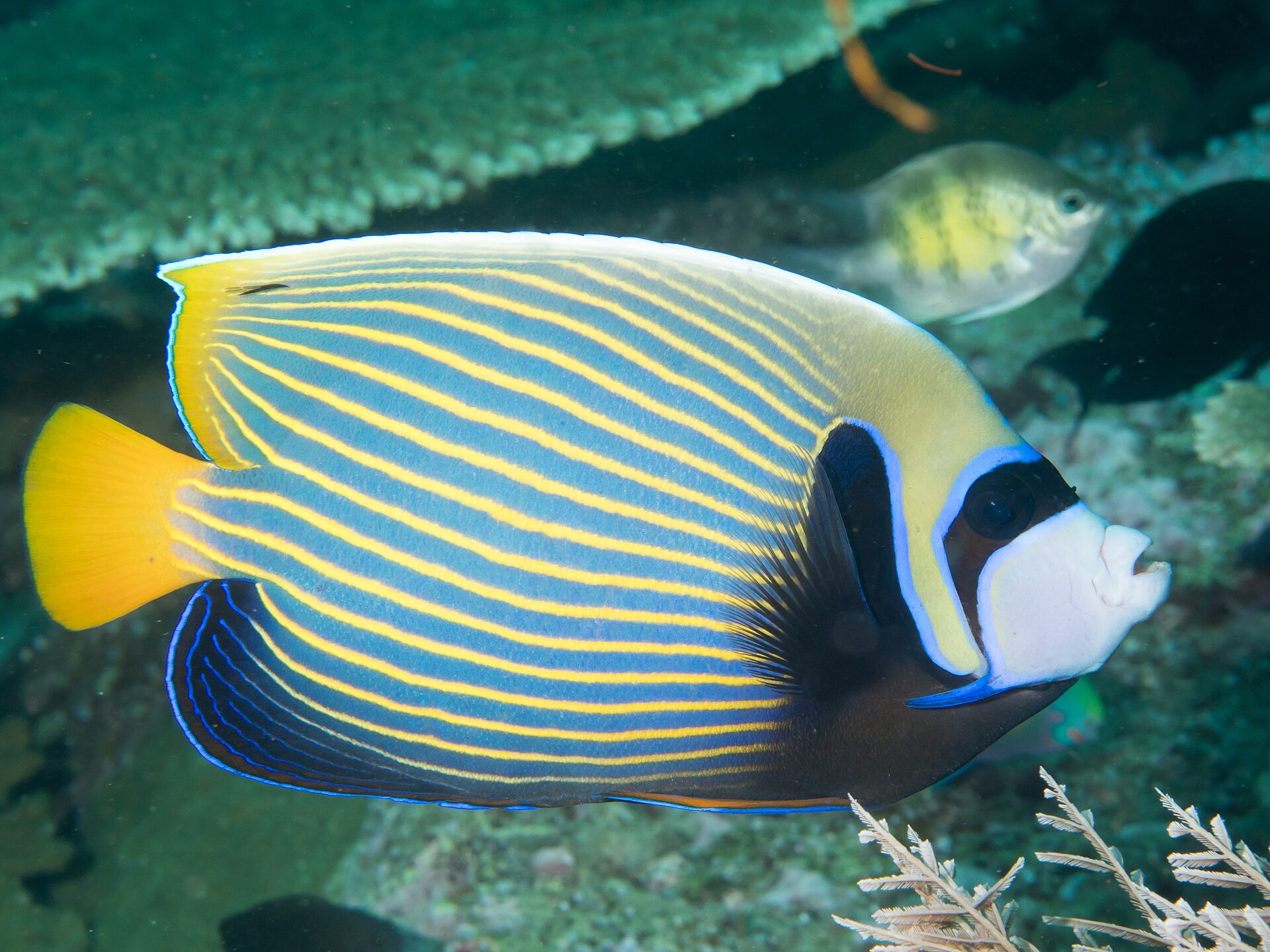
Few reef fish change costume as completely as the emperor angelfish. Juveniles are dark with concentric blue curved lines, the innermost closing into a ring just before the tail. Adults wear fine oblique yellow stripes on blue, a black mask edged in electric blue across the eyes and a bright yellow tail. As it grows it also moves house: juveniles shelter under ledges in lagoons and channels, subadults take to holes on the reef front, and large adults hold ledges and caves on rich outer reefs. Adults reach 40 cm in standard length, usually live alone or in pairs, feed on sponges and tunicates, and can live 14 years. FishBase even records young and adults cleaning far larger fishes such as ocean sunfish. Reef Life Survey divers find it at about one in nine of the sites they survey, usually one fish per transect.
Where and when to see one
"Resident" means most dives at that destination encounter them; "seasonal" means reliably present in the listed months; anything else is a bonus, not a plan.
| Destination | Reliability | Months | Notes |
|---|---|---|---|
| Sharm El Sheikh & Ras MohammedEgypt | Occasional | Year-round | |
| PalauPalau | Occasional | Year-round | |
| Cairns & the Ribbon ReefsAustralia | Occasional | Year-round | |
| Tubbataha ReefsPhilippines | Occasional | Year-round | |
| Zanzibar & MnembaTanzania | Occasional | Year-round | |
| AqabaJordan | Occasional | Year-round | |
| SeychellesSeychelles | Occasional | Year-round |
Best month, at a glance
Understanding them
Habitat: Juveniles shelter under ledges and in holes on outer lagoon patch reefs and channel edges; subadults move to reef-front holes and surge channels, and large adults hold ledges and caves in rich coral on clear lagoon, channel and seaward reefs. Recorded to 100 m.
Range: Indo-Pacific from the Red Sea and East Africa to the Line and Tuamotu islands, north to southern Japan and the Ogasawara Islands, south to the Great Barrier Reef, New Caledonia and the Austral Islands. Records from Hawaii are thought to be aquarium releases.
Behavior: Usually seen alone or in pairs close to ledges and caves on coral-rich reef. Young and adults have been recorded cleaning much larger fishes, including ocean sunfish.
Diet: Sponges and other encrusting organisms, plus tunicates.
Size: typically around 30 cm; documented up to 40 cm (standard length; FishBase gives 40 cm as the maximum, and the typical figure is our conservative estimate for adults seen on dives; juveniles are far smaller).
How to behave around one
Approach slowly along the reef instead of dropping on it from above, and never chase one into its cave. Juveniles under ledges are best photographed without pushing a light or camera into their hole.
Conservation
Least Concern on the IUCN Red List (2010 assessment). It is frequently exported through the aquarium trade.
Charted sites known for them
Highlighted sites were charted for this species by our editors; numbers are GBIF occurrence records logged within about 5 km of a site since 1990.
Recently recorded near our dive sites
187 verified records within 5 to 10 km of 163 of our dive sites over the last 12 months (17 Nov 2025 to 16 Nov 2026), 11 of them in the last 30 days. Latest: 15 Nov 2026, near Mucky Mosque, by pablo_dbr_ ↗ (iNaturalist, CC BY-NC).
Most records near
Research-grade iNaturalist observations shared under CC0, CC BY or CC BY-NC, plus human sightings from GBIF and OBIS datasets under the same licences, within 5 km of a site with a sourced position or 10 km of an approximate one. A record near two sites counts once in the total and once on each site. Each site page credits the observers and datasets behind its records. How these are collected →
Watch
From the official channels

Giant Pacific Octopus

Live African Penguin Cam After Hours | Monterey Bay Aquarium

African Penguin Cam After Hours | Monterey Bay Aquarium
Videos are embedded links to their creators' own channels. We host nothing and credit everything.