Reef Fish
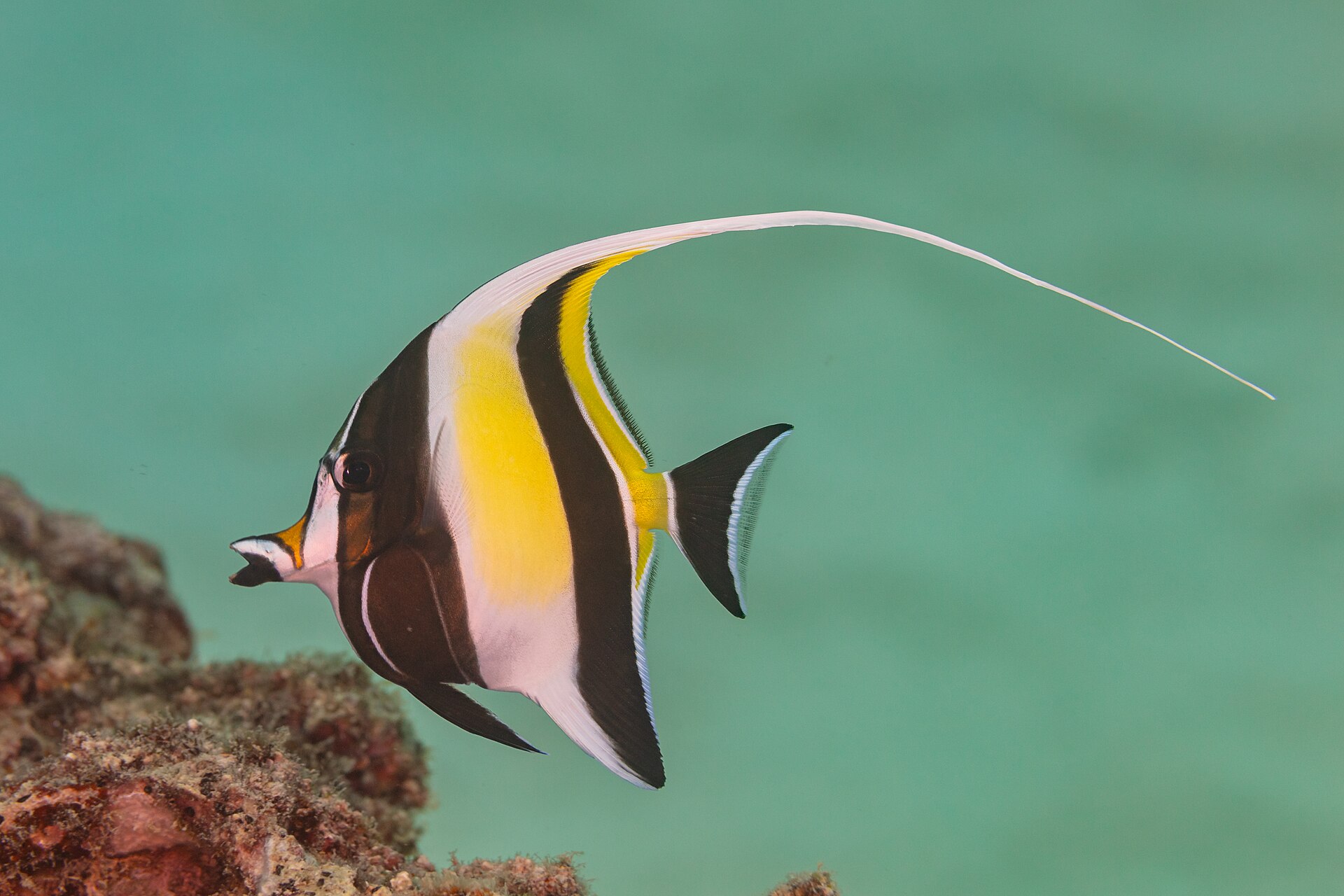
Moorish Idol
Zanclus cornutus · Bony fish, family Zanclidae; the only living member of its family, most closely related to the surgeonfishes
The Moorish idol is the only living member of its family: a flat disc of black, white and yellow bands trailing a long white dorsal filament. It is common across the Indo-Pacific, recorded at about 38 percent of the reef sites Reef Life Survey divers count, usually as a pair or small group browsing sponges. Its start in life explains its huge range: a long open-ocean larval stage that ends only at about 7.5 cm, a very large size for a reef fish to settle. In Palau, adults gather at Blue Corner and Siaes Corner from December to March around the first-quarter moon, rise off the reef at midday and spawn in open water, where gray reef sharks attack the schools in a feeding frenzy. In aquariums it rarely survives, because its natural diet is mostly encrusting sponges.
Where and when to see one
"Resident" means most dives at that destination encounter them; "seasonal" means reliably present in the listed months; anything else is a bonus, not a plan.
| Destination | Reliability | Months | Notes |
|---|---|---|---|
| Cairns & the Ribbon ReefsAustralia | Resident: seen on most dives | Year-round | |
| OʻahuUnited States | Resident: seen on most dives | Year-round | |
| PalauPalau | Seasonal: reliable in season | Dec–Mar | |
| FakaravaFrench Polynesia | Occasional | Year-round | |
| Kona, HawaiʻiUnited States | Occasional | Year-round | |
| MauritiusMauritius | Occasional | Year-round | |
| Maui & MolokiniUnited States | Occasional | Year-round | |
| Beqa Lagoon & Pacific HarbourFiji | Occasional | Year-round | |
| SeychellesSeychelles | Occasional | Year-round |
Best month, at a glance
Understanding them
Habitat: Turbid inner lagoons, reef flats and clear seaward coral and rocky reefs. Most divers meet it in the shallows, but it has been recorded to 182 m.
Range: Indo-Pacific from East Africa to Hawaii and the Rapa and Ducie islands, north to southern Japan and south to Lord Howe Island, plus the eastern Pacific from the southern Gulf of California to Peru. It is absent from the Red Sea.
Behavior: Usually alone, in pairs or in small groups of two to five that roam widely, occasionally in large schools; juveniles hold small territories. In Palau, schools of a hundred to several thousand gather from December to March to spawn.
Diet: Mostly encrusting sponges, plus coral polyps, tunicates, other small bottom-living invertebrates and some algae, picked off the reef with its small tubular mouth.
Size: typically around 16 cm; documented up to 23 cm (total length; commonly to about 16 cm, with the dorsal fin drawn out into a long white filament).
How to behave around one
Watch from a little distance and let pairs drift past; never feed them. Hanauma Bay banned fish feeding in 1999 after it drew unnatural crowds of fish into the lagoon. At Palau's spawning sites, stay low on the reef and clear of the rising schools and the sharks hunting them.
Conservation
Least Concern on the IUCN Red List (2016 assessment). It is collected for the aquarium trade, as one of the 20 most collected aquarium fishes in West Hawaii, even though it rarely survives in captivity.
Charted sites known for them
Highlighted sites were charted for this species by our editors; numbers are GBIF occurrence records logged within about 5 km of a site since 1990.
Recently recorded near our dive sites
617 verified records within 5 to 10 km of 214 of our dive sites over the last 12 months (17 Nov 2025 to 16 Nov 2026), 22 of them in the last 30 days. Latest: 15 Nov 2026, near El Vencedor Wreck (Cabo Pulmo), by bielpiza ↗ (iNaturalist, CC BY-NC).
Most records near
Research-grade iNaturalist observations shared under CC0, CC BY or CC BY-NC, plus human sightings from GBIF and OBIS datasets under the same licences, within 5 km of a site with a sourced position or 10 km of an approximate one. A record near two sites counts once in the total and once on each site. Each site page credits the observers and datasets behind its records. How these are collected →
Watch
From the official channels
Catch this wave 🌊 | #montereybayaquarium #reeflife

Giant Pacific Octopus

Live African Penguin Cam After Hours | Monterey Bay Aquarium
Videos are embedded links to their creators' own channels. We host nothing and credit everything.