Reef Fish
Queen Angelfish
Holacanthus ciliaris · Bony fish, family Pomacanthidae (angelfishes)
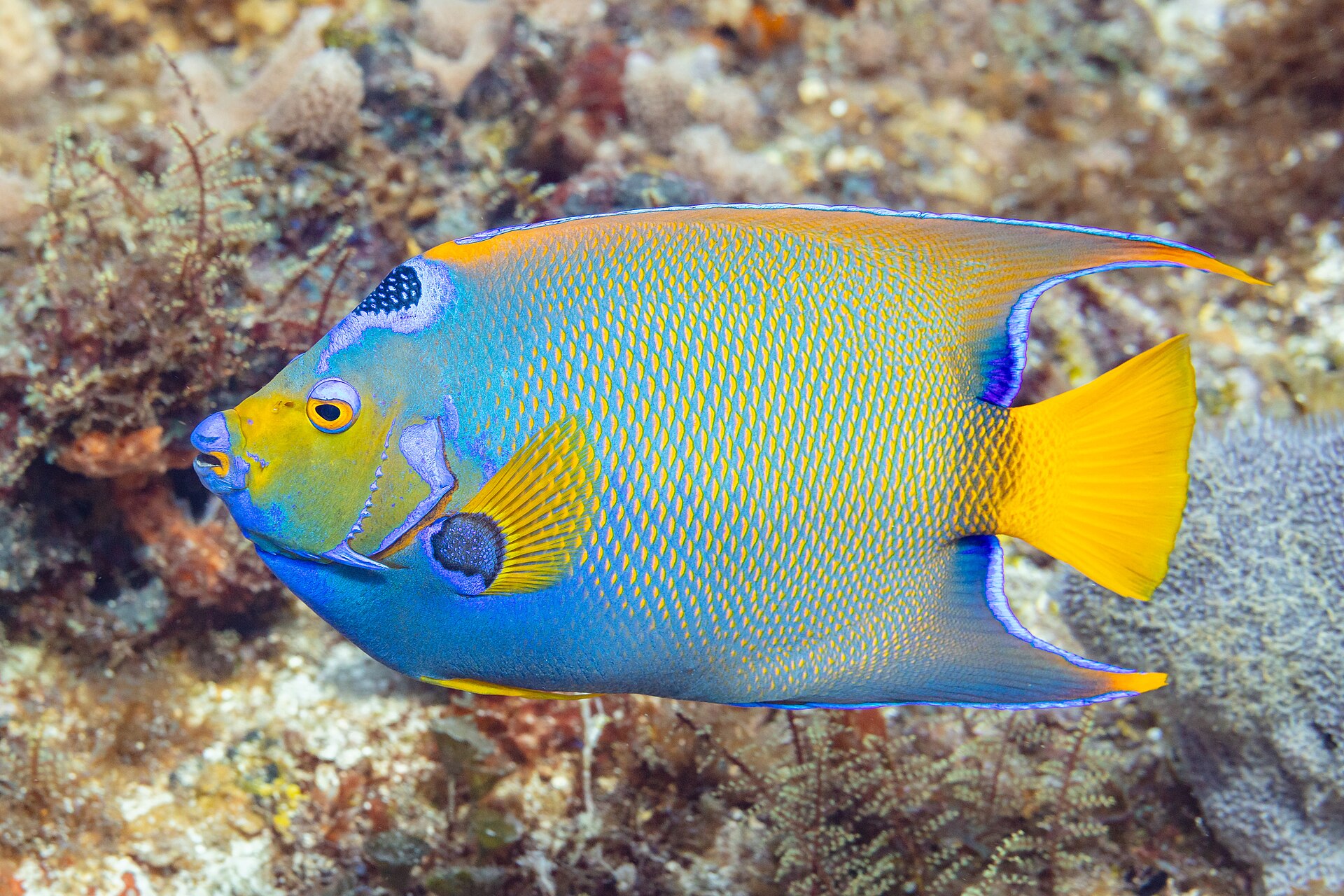
The queen angelfish wears a crown: a dark spot ringed in electric blue on its forehead, the mark that sets it apart from the similar blue angelfish. Around it, iridescent blue scales are rimmed in gold and the tail is solid yellow, on a deep, flattened body up to 45 cm long. For all the finery it lives on sponges, which make up almost its entire diet, and adults usually travel in pairs that stay together year-round. In the evening a pair rises off the reef, bellies close, to release eggs and sperm; a female can shed 25,000 to 75,000 eggs a night. Juveniles look like a different species, dark blue with curved electric-blue bars, and set up cleaning stations within their small territories. Queens occasionally hybridize with blue angelfish, producing rare intermediate fish. Volunteer surveys show how dependable it can be: REEF divers logged it on 74% of 166 survey dives around Cozumel in late 2025.
Where and when to see one
"Resident" means most dives at that destination encounter them; "seasonal" means reliably present in the listed months; anything else is a bonus, not a plan.
| Destination | Reliability | Months | Notes |
|---|---|---|---|
| CozumelMexico | Resident: seen on most dives | Year-round | |
| Belize Barrier ReefBelize | Resident: seen on most dives | Year-round | |
| Florida KeysUnited States | Resident: seen on most dives | Year-round | |
| RoatánHonduras | Resident: seen on most dives | Year-round | |
| Jardines de la ReinaCuba | Resident: seen on most dives | Year-round | |
| UtilaHonduras | Resident: seen on most dives | Year-round | |
| BonaireBonaire | Occasional | Year-round | |
| Turks and CaicosTurks and Caicos Islands | Occasional | Year-round |
Best month, at a glance
Understanding them
Habitat: Coral reefs from nearshore shallows to about 70 m, where coral growth gives out; adults glide between sea fans, sea whips, sponges and coral heads, and juveniles keep to small territories around finger sponges and coral.
Range: Tropical western Atlantic from Bermuda and Florida through the Gulf of Mexico and the Caribbean to Brazil, with an outpost at St. Paul's Rocks in the central Atlantic; most abundant in the Caribbean.
Behavior: Adults cruise the reef alone or in pairs, and pairs stay together year-round. Juveniles, dark blue with curved electric-blue bars and a yellow tail, run cleaning stations inside their small territories, where larger fish hold still to be picked over.
Diet: Mostly sponges: stomachs of 26 fish held almost nothing else, topped up with algae, tunicates, hydroids and bryozoans. Juveniles pick parasites off other fishes.
Size: typically around 30 cm; documented up to 45 cm (total length; FishBase gives a common length of 30 cm and a maximum of 45 cm and 1.6 kg).
How to behave around one
Approach slowly and side-on, then hold still: a circling queen often swings back for a closer look. Don't chase it into the reef or feed it, and watch juvenile cleaning stations from a meter or two away without blocking the clients.
Conservation
Least Concern on the IUCN Red List (2010 assessment). It is fished on a minor scale and collected for the aquarium trade, and some reports link it to ciguatera poisoning when eaten.
Charted sites known for them
Highlighted sites were charted for this species by our editors; numbers are GBIF occurrence records logged within about 5 km of a site since 1990.
Recently recorded near our dive sites
169 verified records within 5 to 10 km of 79 of our dive sites over the last 12 months (17 Nov 2025 to 16 Nov 2026), 4 of them in the last 30 days. Latest: 12 Nov 2026, near Playa del Carmen Bull Shark Dive, by Mathieu Vandeginste ↗ (iNaturalist, CC BY-NC).
Most records near
Research-grade iNaturalist observations shared under CC0, CC BY or CC BY-NC, plus human sightings from GBIF and OBIS datasets under the same licences, within 5 km of a site with a sourced position or 10 km of an approximate one. A record near two sites counts once in the total and once on each site. Each site page credits the observers and datasets behind its records. How these are collected →
Watch
From the official channels
Catch this wave 🌊 | #montereybayaquarium #reeflife

Giant Pacific Octopus

Live African Penguin Cam After Hours | Monterey Bay Aquarium
Videos are embedded links to their creators' own channels. We host nothing and credit everything.