Reef Fish
Spotted Drum
Eques punctatus · Bony fish, family Sciaenidae (drums and croakers); long known as Equetus punctatus, the name most field guides and the IUCN assessment still use
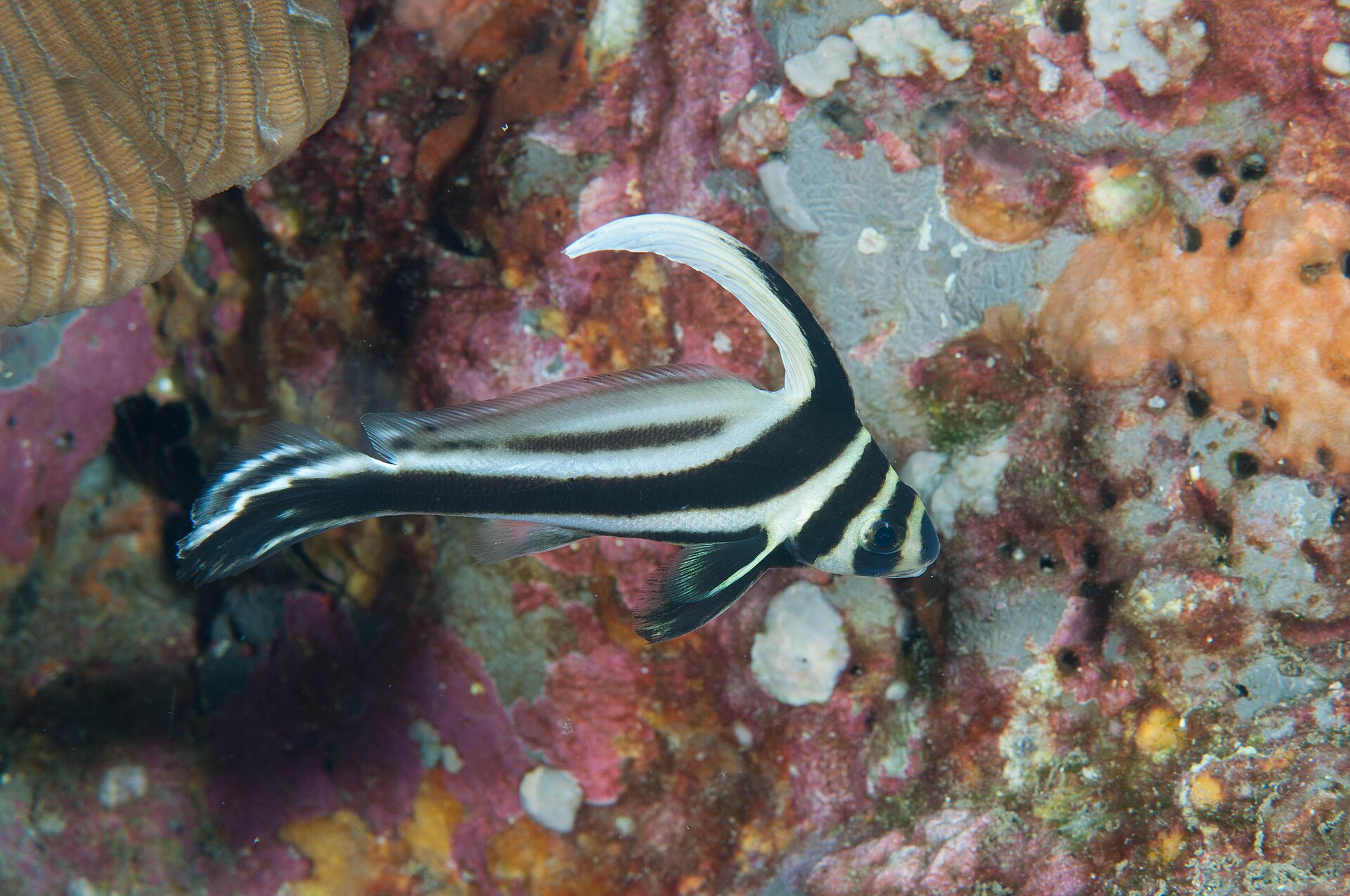
Small juvenile spotted drums look like an ink drawing set loose on the reef. A white body is crossed by three black bars, with an oval black spot on the snout and a first dorsal fin raised absurdly high. Adults keep the tall fin and trade the bars for dark brown stripes, with dark, white-spotted rear fins and tail; a common adult length is about 18 cm. By day the drum is a homebody, lingering under the same ledge, cave mouth or coral base, and FishBase rates it easily approached, which makes it a rewarding subject for a patient diver. After dark it comes out to hunt crabs, shrimps and worms. Taxonomists now place it in the genus Eques, so expect both Eques and Equetus in guides. Check shaded overhangs on Curaçao and Bonaire: REEF volunteers recorded it on about 40% of survey dives on both islands.
Where and when to see one
"Resident" means most dives at that destination encounter them; "seasonal" means reliably present in the listed months; anything else is a bonus, not a plan.
| Destination | Reliability | Months | Notes |
|---|---|---|---|
| BonaireBonaire | Occasional | Year-round | |
| DominicaDominica | Occasional | Year-round | |
| GrenadaGrenada | Occasional | Year-round | |
| Saint LuciaSaint Lucia | Occasional | Year-round | |
| UtilaHonduras | Occasional | Year-round | |
| British Virgin IslandsBritish Virgin Islands | Occasional | Year-round | |
| CuraçaoCuraçao | Occasional | Year-round | |
| Jardines de la ReinaCuba | Occasional | Year-round |
Best month, at a glance
Understanding them
Habitat: Coral reefs, under ledges, near small caves and around the bases of coral heads; usually met at 3 to 30 m, with records to about 105 m.
Range: Western Atlantic from Bermuda, Florida and the Bahamas through the Antilles and Yucatán to Brazil.
Behavior: Secretive and usually solitary by day, staying close to one ledge, small cave or coral base. Easily approached; it leaves cover to forage at night.
Diet: Crabs, shrimps and polychaete worms, hunted at night.
Size: typically around 18 cm; documented up to 27 cm (total length; FishBase gives a common length of 18 cm and a maximum of 27 cm).
How to behave around one
It stays close to one ledge or coral base, so settle outside the overhang, keep fins and knees off the reef and let it swim past you rather than pushing a camera into its hole. On night dives keep lights moderate and brief.
Conservation
Least Concern on the IUCN Red List (2020 assessment, published under Equetus punctatus). It is taken in small numbers by fisheries and for the aquarium trade.
Charted sites known for them
Highlighted sites were charted for this species by our editors; numbers are GBIF occurrence records logged within about 5 km of a site since 1990.
Recently recorded near our dive sites
94 verified records within 5 to 10 km of 74 of our dive sites over the last 12 months (17 Nov 2025 to 16 Nov 2026), 2 of them in the last 30 days. Latest: 21 Oct 2026, near Mixing Bowl, by Dwight Baker ↗ (iNaturalist, CC BY-NC).
Most records near
Research-grade iNaturalist observations shared under CC0, CC BY or CC BY-NC, plus human sightings from GBIF and OBIS datasets under the same licences, within 5 km of a site with a sourced position or 10 km of an approximate one. A record near two sites counts once in the total and once on each site. Each site page credits the observers and datasets behind its records. How these are collected →
Watch
From the official channels

Giant Pacific Octopus

Live African Penguin Cam After Hours | Monterey Bay Aquarium

African Penguin Cam After Hours | Monterey Bay Aquarium
Videos are embedded links to their creators' own channels. We host nothing and credit everything.