Invertebrates
Disco Clam (Electric Flame Scallop)
Ctenoides ales · Mollusk, bivalve, family Limidae (file clams); not a true scallop despite the common name
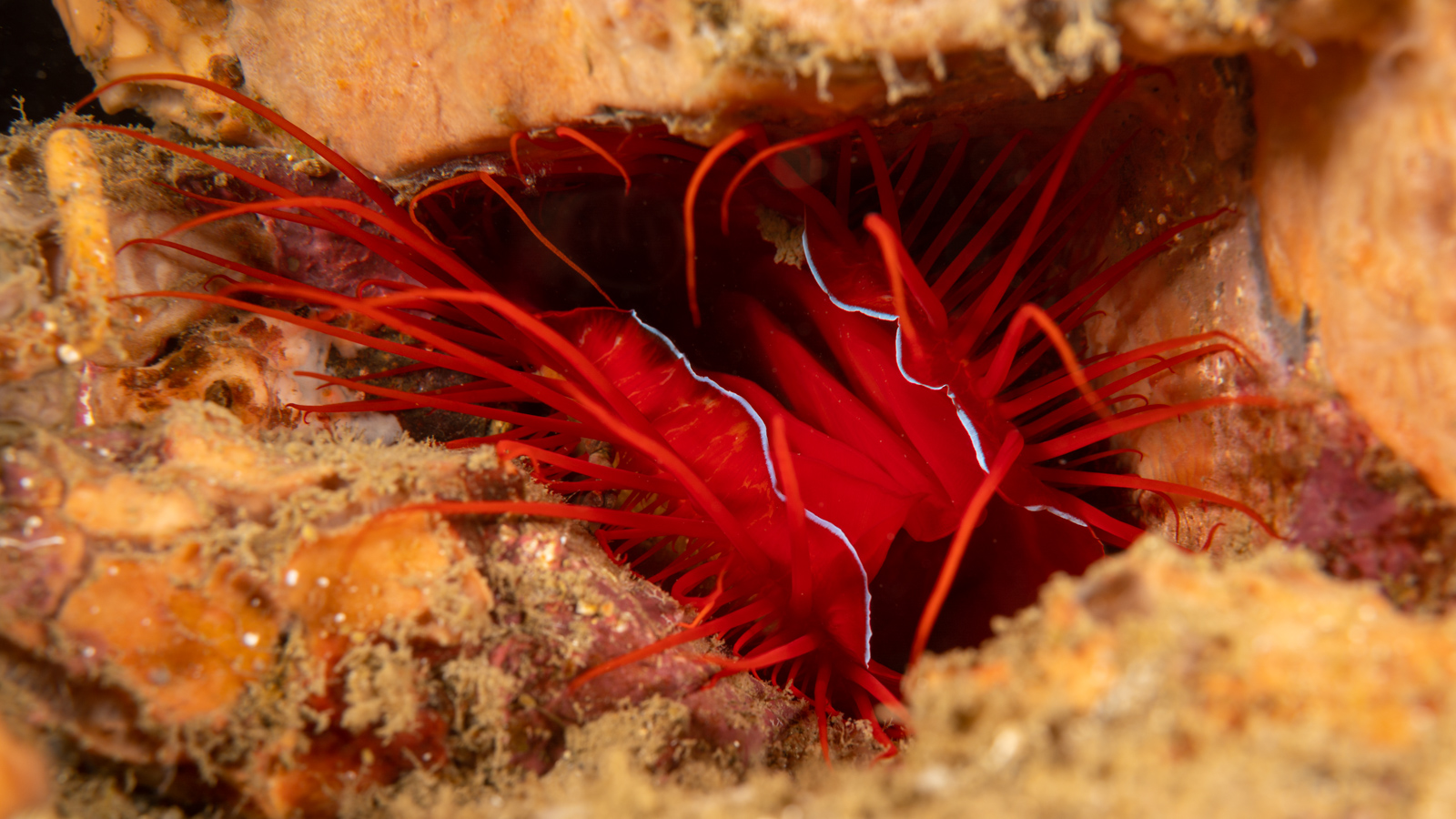
The disco clam seems to pulse with electricity, but it is not glowing: it is flashing a mirror. Along the lip of its mantle runs a strip of tissue packed with tiny silica spheres that scatter light brilliantly, and the clam rolls that strip in and out of view two to four times a second, so a ripple of white light races along a red, tentacle-fringed mantle. Researchers led by Lindsey Dougherty worked out the trick in 2014, later found that the clams flash faster when a shadow passes, and showed that a peacock mantis shrimp attacking one met a wide-open display of bright tissue it preferred not to eat. The clam lives wedged in narrow reef crevices, often two to four together, anchored by threads. Watch from outside the crevice with a steady light, and never reach in: even a diver's shadow changes how it behaves.
Where and when to see one
"Resident" means most dives at that destination encounter them; "seasonal" means reliably present in the listed months; anything else is a bonus, not a plan.
| Destination | Reliability | Months | Notes |
|---|---|---|---|
| Raja AmpatIndonesia | Occasional | Year-round | |
| Lembeh StraitIndonesia | Occasional | Year-round | |
| AnilaoPhilippines | Occasional | Year-round | |
| Dumaguete, Dauin & Apo IslandPhilippines | Occasional | Year-round |
Best month, at a glance
| Month | Reliable destinations |
|---|---|
| January | Raja Ampat · Lembeh Strait · Anilao · Dumaguete, Dauin & Apo Island |
| February | Raja Ampat · Lembeh Strait · Anilao · Dumaguete, Dauin & Apo Island |
| March | Raja Ampat · Lembeh Strait · Anilao · Dumaguete, Dauin & Apo Island |
| April | Raja Ampat · Lembeh Strait · Anilao · Dumaguete, Dauin & Apo Island |
| May | Raja Ampat · Lembeh Strait · Anilao · Dumaguete, Dauin & Apo Island |
| June | Raja Ampat · Lembeh Strait · Anilao · Dumaguete, Dauin & Apo Island |
| July | Raja Ampat · Lembeh Strait · Anilao · Dumaguete, Dauin & Apo Island |
| August | Raja Ampat · Lembeh Strait · Anilao · Dumaguete, Dauin & Apo Island |
| September | Raja Ampat · Lembeh Strait · Anilao · Dumaguete, Dauin & Apo Island |
| October | Raja Ampat · Lembeh Strait · Anilao · Dumaguete, Dauin & Apo Island |
| November | Raja Ampat · Lembeh Strait · Anilao · Dumaguete, Dauin & Apo Island |
| December | Raja Ampat · Lembeh Strait · Anilao · Dumaguete, Dauin & Apo Island |
Understanding them
Habitat: Narrow crevices and holes in coral reefs, anchored by byssal threads, often two to four together. Recorded from about 3 m to at least 50 m, most often around 5 to 20 m.
Range: Tropical central Indo-Pacific, from Indonesia and the Philippines to Palau, northern Australia and New Caledonia.
Behavior: Sits in its crevice with the shell open and red tentacles extended, rippling a line of reflected white light along the mantle edge two to four times a second; it flashes faster when a shadow or looming object passes.
Diet: Like other bivalves it filters plankton and fine particles from the water passing through its gaping shell.
Size: typically around 4 cm; documented up to 8 cm (shell height; animals in field studies ranged from 1 to 8 cm, and Lembeh guides quote up to 5 cm; the typical figure is a conservative estimate).
How to behave around one
Watch from outside the crevice; never reach in, wedge a light into the hole or leave a torch fixed on it. A brief, steady beam shows the flashing best, and your shadow alone changes its behavior.
Conservation
Not assessed by the IUCN, and no specific threats have been documented.
Watch
From the official channels

Giant Pacific Octopus

Live African Penguin Cam After Hours | Monterey Bay Aquarium

African Penguin Cam After Hours | Monterey Bay Aquarium
Videos are embedded links to their creators' own channels. We host nothing and credit everything.