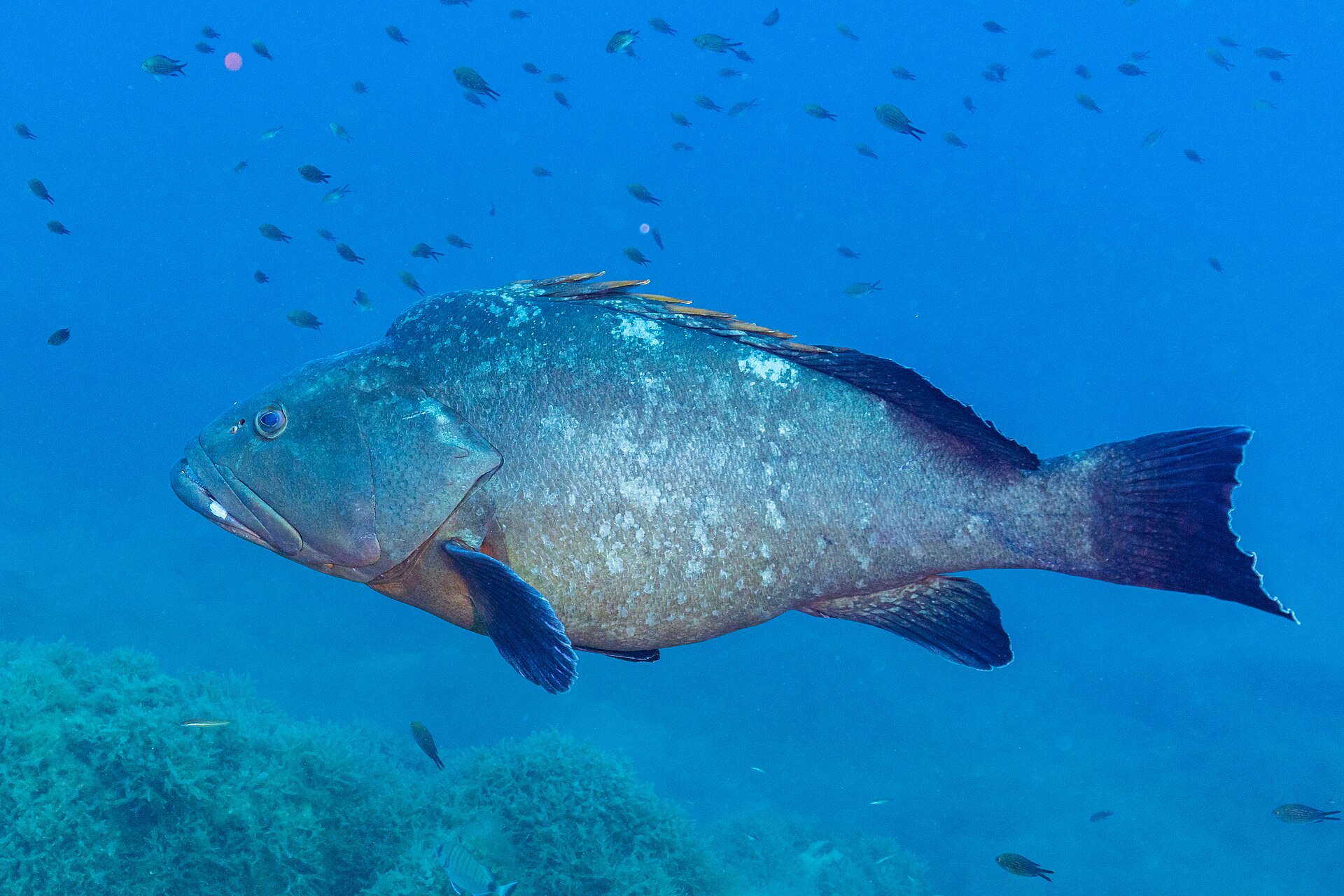
Big Fish
Dusky Grouper
Epinephelus marginatus · Bony fish, family Epinephelidae (groupers); a protogynous hermaphrodite in which every male starts life as a female
Outside marine reserves a big dusky grouper is now a rare sight; inside them, it swims up to meet you. Decades of fishing pressure pushed the species to very low numbers, and today divers see large ones mostly in protected areas, where they turn remarkably bold. At Madeira's Garajau reserve, groupers of over 50 kg come so close that divers call it puppy-like behavior, and five or six may appear on one dive; at Corvo in the Azores, more than a dozen can gather around a diver at once. In Spain's Medes Islands, protected since 1983, the population rebuilt until it reached the reserve's carrying capacity, and researchers there documented the species spawning for the first time in the Mediterranean. Every male begins life as a female and changes sex after roughly 7 to 17 years; with a lifespan of up to 60 years, recovery is measured in decades.
Where and when to see one
"Resident" means most dives at that destination encounter them; "seasonal" means reliably present in the listed months; anything else is a bonus, not a plan.
| Destination | Reliability | Months | Notes |
|---|---|---|---|
| The AzoresPortugal | Resident: seen on most dives | Year-round | |
| Medes IslandsSpain | Resident: seen on most dives | Year-round | |
| MadeiraPortugal | Resident: seen on most dives | Year-round |
Best month, at a glance
| Month | Reliable destinations |
|---|---|
| January | The Azores · Medes Islands · Madeira |
| February | The Azores · Medes Islands · Madeira |
| March | The Azores · Medes Islands · Madeira |
| April | The Azores · Medes Islands · Madeira |
| May | The Azores · Medes Islands · Madeira |
| June | The Azores · Medes Islands · Madeira |
| July | The Azores · Medes Islands · Madeira |
| August | The Azores · Medes Islands · Madeira |
| September | The Azores · Medes Islands · Madeira |
| October | The Azores · Medes Islands · Madeira |
| November | The Azores · Medes Islands · Madeira |
| December | The Azores · Medes Islands · Madeira |
Understanding them
Habitat: Rocky reefs with caves, crevices and boulder slopes, usually above 50 m but recorded to 300 m; juveniles live closer to shore, even in rocky tide pools.
Range: Eastern Atlantic from the Bay of Biscay to the tip of southern Africa, including the Azores, Madeira and Canary Islands, throughout the Mediterranean, southeastern Brazil to Argentina, and the western Indian Ocean to southern Mozambique and Madagascar.
Behavior: Solitary and territorial, keeping to its own cave or crack; inside reserves it loses its fear and swims up to divers so closely that guides call it puppy-like. Mature fish gather in spawning aggregations.
Diet: Mainly crabs and octopus; larger fish take a growing share of reef fishes.
Size: typically around 50 cm; documented up to 1.5 m (total length; no common length is published, but fish mature at about 49 cm; up to 60 kg and 60 years, and females change to males at roughly 0.5 to 0.9 m).
How to behave around one
No feeding or touching; in reserves the groupers come close on their own. Stay off the bottom, do not block a grouper's cave, and let a retreating fish go.
Conservation
Vulnerable (IUCN 2018) after decades of fishing pressure; it recovers well but slowly in no-take reserves such as the Medes Islands, Garajau and Corvo's voluntary reserve.
Charted sites known for them
Highlighted sites were charted for this species by our editors; numbers are GBIF occurrence records logged within about 5 km of a site since 1990.
Recently recorded near our dive sites
60 verified records within 5 to 10 km of 13 of our dive sites over the last 12 months (17 Nov 2025 to 16 Nov 2026), 2 of them in the last 30 days. Latest: 16 Nov 2026, near Playa Chica, by Susanne Spindler ↗ (iNaturalist, CC BY-NC).
Most records near
Research-grade iNaturalist observations shared under CC0, CC BY or CC BY-NC, plus human sightings from GBIF and OBIS datasets under the same licences, within 5 km of a site with a sourced position or 10 km of an approximate one. A record near two sites counts once in the total and once on each site. Each site page credits the observers and datasets behind its records. How these are collected →
Watch
From the official channels

Catch this wave 🌊 | #montereybayaquarium #reeflife

Giant Pacific Octopus

Live African Penguin Cam After Hours | Monterey Bay Aquarium
Videos are embedded links to their creators' own channels. We host nothing and credit everything.