Cephalopods
Common Octopus
Octopus vulgaris · Cephalopod mollusk, family Octopodidae; Octopus vulgaris in the strict sense, one member of a species complex
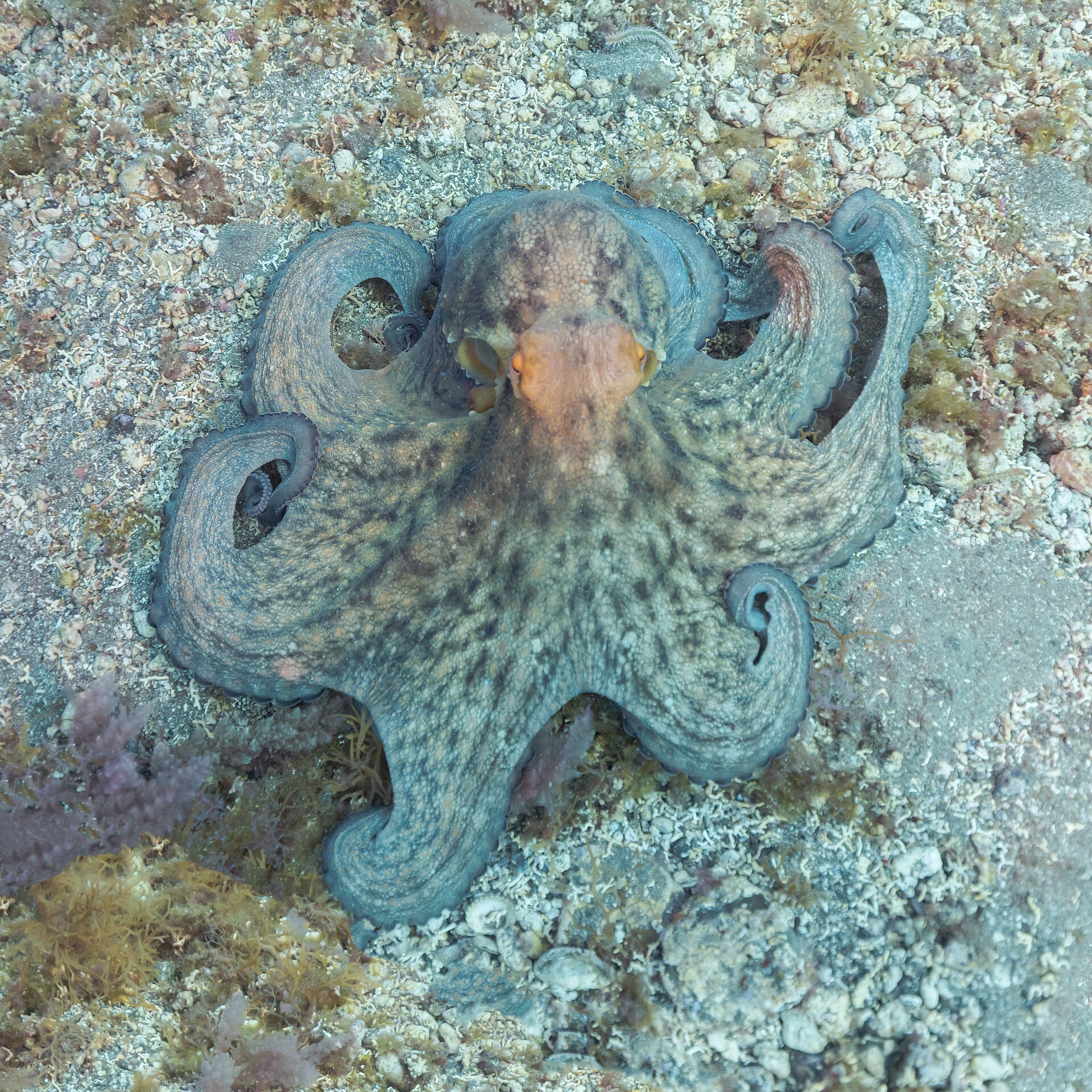
The common octopus is the Mediterranean diver's daily puzzle: a pair of eyes in a crack that becomes a whole animal once you look again. It is the most common octopus in Maltese waters and a regular on rocky shore dives from the Mediterranean to the Canaries and the Azores. Its color, texture and outline change in an instant, and it hunts crabs, mollusks and fish mainly at night, probing crevices with sensitive arm tips. Life is short. Most live one to two years, and a female ends hers in a cave or crevice, guarding her eggs, fanning them with water from her siphon and fasting until she dies. The name has narrowed too: genetic work treats Octopus vulgaris as a species complex, and the true common octopus lives in the Mediterranean and eastern Atlantic, while the lookalikes of the Americas and East Asia are separate species. As one of the Mediterranean's most valuable catches, the confident animals of marine reserves are worth protecting.
Where and when to see one
"Resident" means most dives at that destination encounter them; "seasonal" means reliably present in the listed months; anything else is a bonus, not a plan.
| Destination | Reliability | Months | Notes |
|---|---|---|---|
| Malta & GozoMalta | Occasional | Year-round | |
| The AzoresPortugal | Occasional | Year-round | |
| Canary IslandsSpain | Occasional | Year-round |
Best month, at a glance
| Month | Reliable destinations |
|---|---|
| January | Malta & Gozo · The Azores · Canary Islands |
| February | Malta & Gozo · The Azores · Canary Islands |
| March | Malta & Gozo · The Azores · Canary Islands |
| April | Malta & Gozo · The Azores · Canary Islands |
| May | Malta & Gozo · The Azores · Canary Islands |
| June | Malta & Gozo · The Azores · Canary Islands |
| July | Malta & Gozo · The Azores · Canary Islands |
| August | Malta & Gozo · The Azores · Canary Islands |
| September | Malta & Gozo · The Azores · Canary Islands |
| October | Malta & Gozo · The Azores · Canary Islands |
| November | Malta & Gozo · The Azores · Canary Islands |
| December | Malta & Gozo · The Azores · Canary Islands |
Understanding them
Habitat: Rocky reefs, boulder fields, wrecks and rubble, also sand and mud, from the intertidal to the edge of the continental shelf; usually above 100 m.
Range: Mediterranean and eastern Atlantic, from the English Channel south along West Africa and around the Macaronesian islands. Lookalikes elsewhere, such as Octopus americanus in the western Atlantic and O. sinensis off Japan, are now treated as separate species.
Behavior: By day most sit in a den with eyes up and arms tucked, changing color and skin texture in an instant if disturbed. Females lay their eggs in a cave or crevice, then guard and aerate them for weeks without feeding until they die.
Diet: Crabs and other crustaceans, bivalves and other mollusks, and fish, hunted mainly at night or ambushed from a crevice.
Size: typically around 12 cm; documented up to 25 cm (mantle length; arms reach about 1 m. SeaLifeBase gives size at maturity as 8 to 11 cm and weights up to 10 kg; the typical figure is a conservative adult size).
How to behave around one
Watch from a respectful distance and let it decide whether to come out; never pull an octopus from its den, poke it, or hand it around. Keep lights off a female guarding eggs in a crevice and do not linger at her den.
Conservation
Least Concern (IUCN, 2018 assessment). Heavily fished, with the largest catches off northwest Africa and high value across the Mediterranean; its one-to-two-year life makes local stocks vulnerable to overfishing without management.
Charted sites known for them
Highlighted sites were charted for this species by our editors; numbers are GBIF occurrence records logged within about 5 km of a site since 1990.
Recently recorded near our dive sites
176 verified records within 5 to 10 km of 35 of our dive sites over the last 12 months (17 Nov 2025 to 16 Nov 2026), 14 of them in the last 30 days. Latest: 16 Nov 2026, near Playa Chica, by Susanne Spindler ↗ (iNaturalist, CC BY-NC).
Most records near
Research-grade iNaturalist observations shared under CC0, CC BY or CC BY-NC, plus human sightings from GBIF and OBIS datasets under the same licences, within 5 km of a site with a sourced position or 10 km of an approximate one. A record near two sites counts once in the total and once on each site. Each site page credits the observers and datasets behind its records. How these are collected →
Watch
From the official channels

Giant Pacific Octopus

Live African Penguin Cam After Hours | Monterey Bay Aquarium

African Penguin Cam After Hours | Monterey Bay Aquarium
Videos are embedded links to their creators' own channels. We host nothing and credit everything.