Cephalopods
Caribbean Reef Octopus
Octopus briareus · Mollusk, cephalopod, family Octopodidae
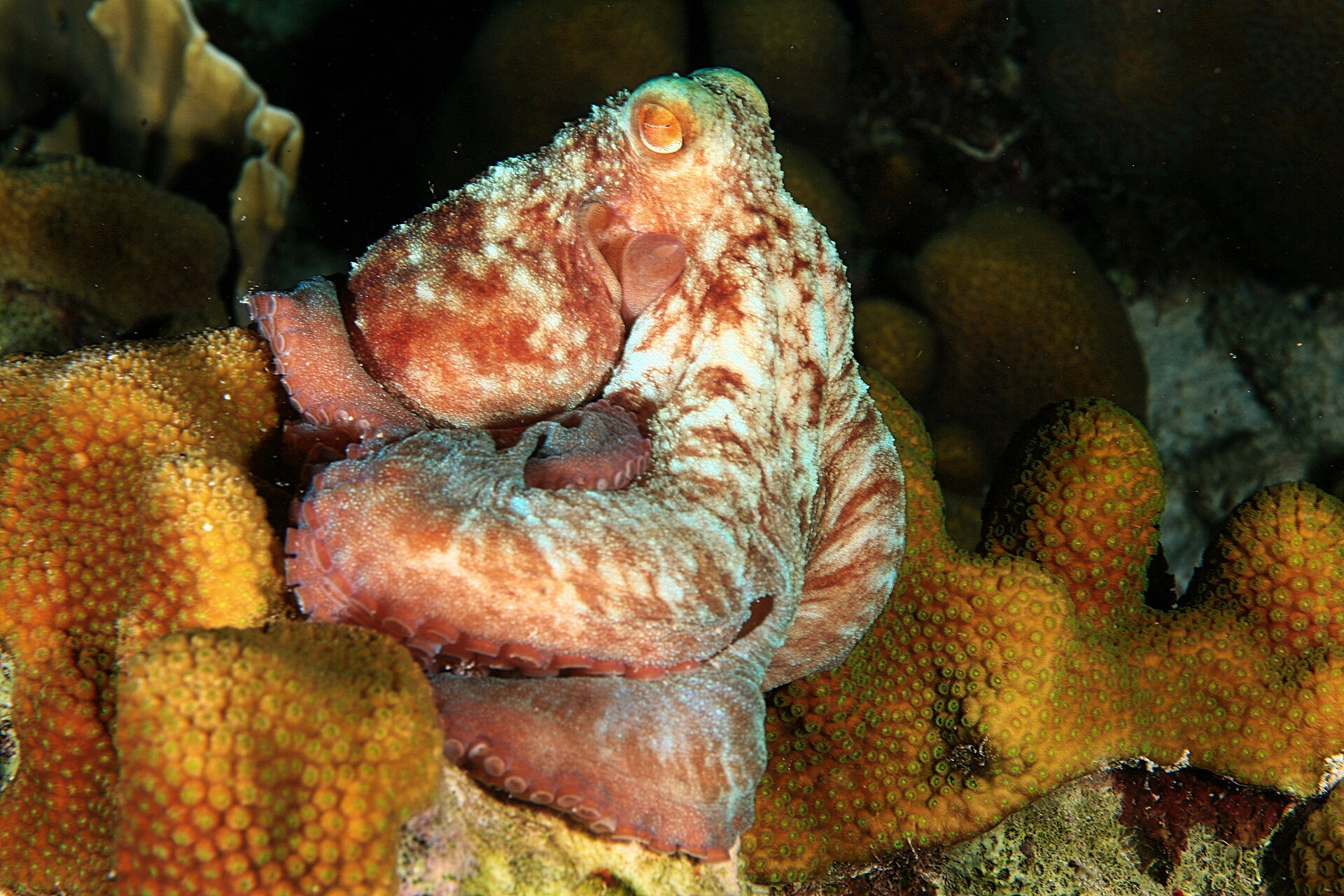
Sweep a dive light across a Caribbean reef at night and this octopus often gives itself away with a flash of blue-green. That reflected glow makes it, by octopus standards, easy to find. By day it is invisible, tucked into a dark den in the reef; after sunset it pours out to hunt, flickering between greens, blues and red-browns and stretching its long arms, the longest about five times the length of its compact mantle. Its main prey is the Caribbean spiny lobster, with crabs, shrimps and small fish on the side. Life is short: about ten to twelve months in the wild. Females from the Florida Keys lay around 500 large eggs, and the hatchlings emerge as miniature adults, already able to jet, ink and crawl. The Cephalopod Page calls it common in the Florida Keys, and night snorkels over shallow reefs are a classic way to meet one.
Where and when to see one
"Resident" means most dives at that destination encounter them; "seasonal" means reliably present in the listed months; anything else is a bonus, not a plan.
| Destination | Reliability | Months | Notes |
|---|---|---|---|
| CozumelMexico | Occasional | Year-round | |
| Florida KeysUnited States | Occasional | Year-round | |
| Turks and CaicosTurks and Caicos Islands | Occasional | Year-round |
Best month, at a glance
| Month | Reliable destinations |
|---|---|
| January | Cozumel · Florida Keys · Turks and Caicos |
| February | Cozumel · Florida Keys · Turks and Caicos |
| March | Cozumel · Florida Keys · Turks and Caicos |
| April | Cozumel · Florida Keys · Turks and Caicos |
| May | Cozumel · Florida Keys · Turks and Caicos |
| June | Cozumel · Florida Keys · Turks and Caicos |
| July | Cozumel · Florida Keys · Turks and Caicos |
| August | Cozumel · Florida Keys · Turks and Caicos |
| September | Cozumel · Florida Keys · Turks and Caicos |
| October | Cozumel · Florida Keys · Turks and Caicos |
| November | Cozumel · Florida Keys · Turks and Caicos |
| December | Cozumel · Florida Keys · Turks and Caicos |
Understanding them
Habitat: Coral reefs, seagrass, rubble and sand from the intertidal to about 20 m, living in dark dens in reef crevices that it keeps to itself.
Range: Southern Florida and the southeast Gulf of Mexico through the Bahamas and the Caribbean to the north coast of South America.
Behavior: Nocturnal and solitary. It spends the day in its den and forages across the reef at night, changing color and texture as it goes; in a dive light its skin reflects a distinctive blue-green.
Diet: Caribbean spiny lobsters are a major prey; also crabs, shrimps, small fishes, small mollusks and smaller octopuses.
Size: typically around 30 cm; documented up to 60 cm (total length including arms; the mantle averages about 5.4 cm and reaches 12 cm, and the longest arms run about five times the mantle length (Animal Diversity Web); Florent's Guide gives 30 to 60 cm overall, SeaLifeBase 60 cm in the warm part of the range and weights to 1.5 kg).
How to behave around one
Keep your light on the edge of the animal rather than full in its eyes, don't follow it across the reef, and never pull or prod one out of its den. Brooding females guard their eggs in the den: leave them in peace.
Conservation
Least Concern on the IUCN Red List (2018 assessment). Its fortunes are tied to the reefs and seagrass that hold its dens and its lobster prey.
Charted sites known for them
Highlighted sites were charted for this species by our editors; numbers are GBIF occurrence records logged within about 5 km of a site since 1990.
Recently recorded near our dive sites
66 verified records within 5 to 10 km of 54 of our dive sites over the last 12 months (17 Nov 2025 to 16 Nov 2026), 2 of them in the last 30 days. Latest: 12 Nov 2026, near Orange Canyon, by Peter van Batenburg-Stafford ↗ (iNaturalist, CC BY-NC).
Most records near
Research-grade iNaturalist observations shared under CC0, CC BY or CC BY-NC, plus human sightings from GBIF and OBIS datasets under the same licences, within 5 km of a site with a sourced position or 10 km of an approximate one. A record near two sites counts once in the total and once on each site. Each site page credits the observers and datasets behind its records. How these are collected →
Watch
From the official channels

Giant Pacific Octopus

Live African Penguin Cam After Hours | Monterey Bay Aquarium

African Penguin Cam After Hours | Monterey Bay Aquarium
Videos are embedded links to their creators' own channels. We host nothing and credit everything.