Cephalopods
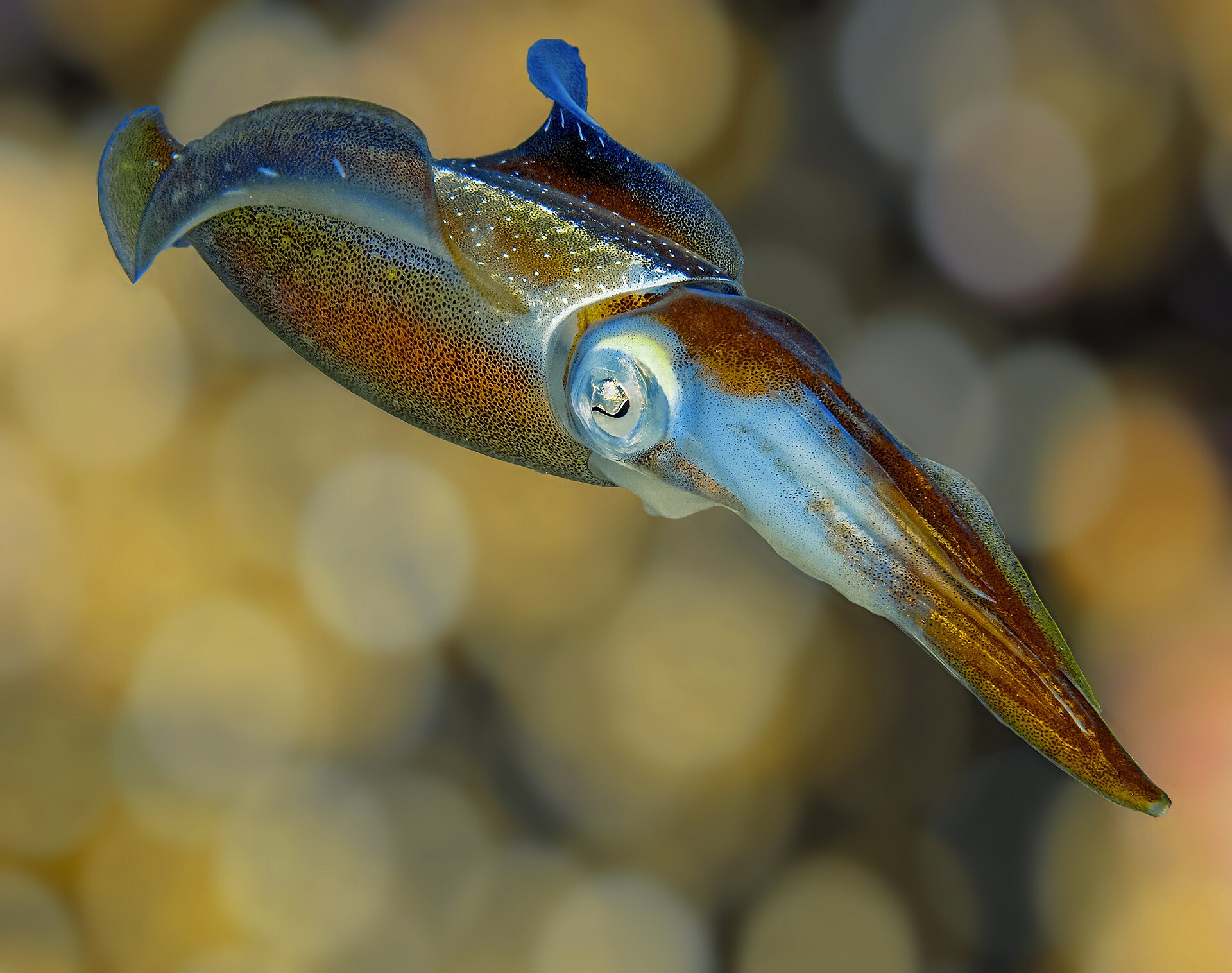
Caribbean Reef Squid
Sepioteuthis sepioidea · Mollusk, cephalopod, family Loliginidae (inshore squids)
Caribbean reef squid talk in color. A group hanging in the shallows ripples through stripes, saddles, pale flashes and dark eye spots, and researchers led by Jennifer Mather have been decoding the system in Bonaire since 1998: who is courting whom, which male is contesting a female, which signal is aimed at a passing predator. The squid are easy to watch. They live in about 2 to 3 m of water, groups of four to fifty stay in the same spot for days or weeks, and the action peaks in early morning, all within reach of a snorkeler. Individuals can even be recognized by the pattern of dots on their fins, which let one team follow more than a hundred squid day after day. Life is brief and ends after a single breeding season. Commonly seen by snorkelers and divers in shallow water across the Caribbean, it is the best reason to set an alarm for a dawn snorkel.
Where and when to see one
"Resident" means most dives at that destination encounter them; "seasonal" means reliably present in the listed months; anything else is a bonus, not a plan.
| Destination | Reliability | Months | Notes |
|---|---|---|---|
| BonaireBonaire | Resident: seen on most dives | Year-round | |
| CozumelMexico | Occasional | Year-round | |
| Belize Barrier ReefBelize | Occasional | Year-round | |
| RoatánHonduras | Occasional | Year-round | |
| Turks and CaicosTurks and Caicos Islands | Occasional | Year-round |
Best month, at a glance
| Month | Reliable destinations |
|---|---|
| January | Bonaire · Cozumel · Belize Barrier Reef · Roatán · Turks and Caicos |
| February | Bonaire · Cozumel · Belize Barrier Reef · Roatán · Turks and Caicos |
| March | Bonaire · Cozumel · Belize Barrier Reef · Roatán · Turks and Caicos |
| April | Bonaire · Cozumel · Belize Barrier Reef · Roatán · Turks and Caicos |
| May | Bonaire · Cozumel · Belize Barrier Reef · Roatán · Turks and Caicos |
| June | Bonaire · Cozumel · Belize Barrier Reef · Roatán · Turks and Caicos |
| July | Bonaire · Cozumel · Belize Barrier Reef · Roatán · Turks and Caicos |
| August | Bonaire · Cozumel · Belize Barrier Reef · Roatán · Turks and Caicos |
| September | Bonaire · Cozumel · Belize Barrier Reef · Roatán · Turks and Caicos |
| October | Bonaire · Cozumel · Belize Barrier Reef · Roatán · Turks and Caicos |
| November | Bonaire · Cozumel · Belize Barrier Reef · Roatán · Turks and Caicos |
| December | Bonaire · Cozumel · Belize Barrier Reef · Roatán · Turks and Caicos |
Understanding them
Habitat: Clear, shallow inshore water over reefs, seagrass and sand. Hatchlings stay within a meter of the surface and small juveniles within about two; breeding adults gather over coral reefs at about 1.5 to 8 m, and nonbreeding adults range to about 100 m.
Range: Florida and Bermuda through the West Indies and along the Caribbean coasts of Central America and northern South America.
Behavior: Hangs in groups of four to fifty in the shallows, constantly sculling with its long fins and flickering through color patterns that work as signals. A threatened squid pales and jets away, or turns side-on, spreads its fins and flashes two or four eye spots.
Diet: Mainly small fishes, many of them schooling sardines, and crustaceans such as shrimps, hunted by sight.
Size: typically around 12 cm; documented up to 20 cm (mantle length; adult females reach at least 12 cm and males at least 11.4 cm (Animal Diversity Web), with a maximum of 20 cm (SeaLifeBase); Florent's Guide gives 15 to 30 cm overall).
How to behave around one
Float still and let the group come to you; squid that pale and back off are uncomfortable. Don't chase or corner them or fire a strobe at point-blank range, and give courting groups space in the early morning, when they are most active.
Conservation
Least Concern on the IUCN Red List (2019 assessment). It is caught locally with spears, night lights and dip nets.
Charted sites known for them
Highlighted sites were charted for this species by our editors; numbers are GBIF occurrence records logged within about 5 km of a site since 1990.
Recently recorded near our dive sites
158 verified records within 5 to 10 km of 91 of our dive sites over the last 12 months (17 Nov 2025 to 16 Nov 2026), 9 of them in the last 30 days. Latest: 8 Nov 2026, near Kate, by Johanna Marshall ↗ (iNaturalist, CC BY).
Most records near
Research-grade iNaturalist observations shared under CC0, CC BY or CC BY-NC, plus human sightings from GBIF and OBIS datasets under the same licences, within 5 km of a site with a sourced position or 10 km of an approximate one. A record near two sites counts once in the total and once on each site. Each site page credits the observers and datasets behind its records. How these are collected →
Watch
From the official channels
Catch this wave 🌊 | #montereybayaquarium #reeflife

Giant Pacific Octopus

Live African Penguin Cam After Hours | Monterey Bay Aquarium
Videos are embedded links to their creators' own channels. We host nothing and credit everything.