Cephalopods
Common Cuttlefish
Sepia officinalis · Cephalopod mollusk, family Sepiidae (cuttlefishes)
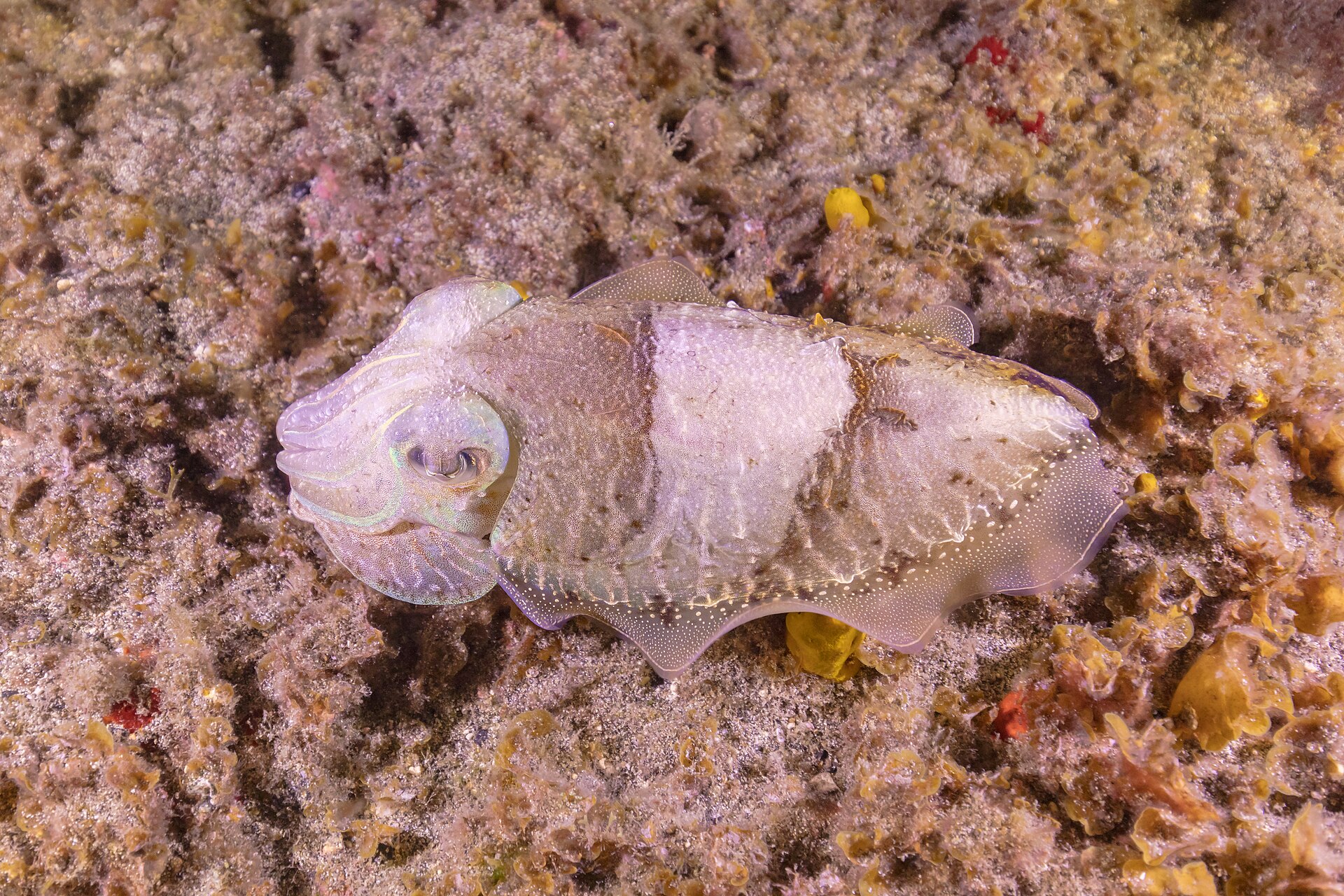
The common cuttlefish changes its whole look while you watch, from sand-colored camouflage to bold black-and-white bars. It is the cuttlefish of Europe's shores, from the Shetlands to North Africa and right around the Mediterranean, and in the Canary Islands it is counted among the relatively abundant species that marine observers record. Divers usually meet it on sand, seagrass or rubble. By day many lie half-buried and quiet; at night they hunt, shooting out two long tentacles to snatch crabs and small fish. In spring and summer adults move into shallow water to breed, males put on a zebra-striped display, and females attach clusters of ink-stained eggs to seaweed, shells and debris. Then they die: the species lives one to two years, and most adults die soon after spawning. Approach low and slow, stop when the arms go up, and you may get a long, close look.
Where and when to see one
"Resident" means most dives at that destination encounter them; "seasonal" means reliably present in the listed months; anything else is a bonus, not a plan.
| Destination | Reliability | Months | Notes |
|---|---|---|---|
| Malta & GozoMalta | Occasional | Year-round | |
| Canary IslandsSpain | Occasional | Year-round |
Best month, at a glance
| Month | Reliable destinations |
|---|---|
| January | Malta & Gozo · Canary Islands |
| February | Malta & Gozo · Canary Islands |
| March | Malta & Gozo · Canary Islands |
| April | Malta & Gozo · Canary Islands |
| May | Malta & Gozo · Canary Islands |
| June | Malta & Gozo · Canary Islands |
| July | Malta & Gozo · Canary Islands |
| August | Malta & Gozo · Canary Islands |
| September | Malta & Gozo · Canary Islands |
| October | Malta & Gozo · Canary Islands |
| November | Malta & Gozo · Canary Islands |
| December | Malta & Gozo · Canary Islands |
Understanding them
Habitat: Sand, mud, seagrass and rocky bottoms, mostly shallower than 50 m though recorded to about 240 m; adults move inshore to spawn.
Range: Eastern Atlantic from the Shetlands and southern Norway to northwest Africa, including the Canary Islands, and throughout the Mediterranean.
Behavior: By day many lie half-buried and quiet; at night they hunt. In spring and summer breeding males flash a black-and-white zebra pattern, and females fix ink-darkened eggs to seaweed, shells and other supports in shallow water.
Diet: Crabs and small bottom fish such as gobies and pipefish, with some amphipods, snatched with two shooting tentacles.
Size: typically around 20 cm; documented up to 49 cm (mantle length; commonly 15 to 25 cm, up to 49 cm and 4 kg in temperate waters but only about 30 cm and 2 kg in the subtropics).
How to behave around one
Approach low and slow from the side and stop when it starts to flash or raise its arms; never chase one until it inks and jets away. Leave egg clusters on seagrass, ropes and debris untouched.
Conservation
Least Concern (IUCN, 2012 assessment), though SeaLifeBase notes heavy fishing pressure in parts of its range such as the Mediterranean.
Charted sites known for them
Highlighted sites were charted for this species by our editors; numbers are GBIF occurrence records logged within about 5 km of a site since 1990.
Recently recorded near our dive sites
100 verified records within 5 to 10 km of 31 of our dive sites over the last 12 months (17 Nov 2025 to 16 Nov 2026), 2 of them in the last 30 days. Latest: 16 Nov 2026, near Playa Chica, by Susanne Spindler ↗ (iNaturalist, CC BY-NC).
Most records near
Research-grade iNaturalist observations shared under CC0, CC BY or CC BY-NC, plus human sightings from GBIF and OBIS datasets under the same licences, within 5 km of a site with a sourced position or 10 km of an approximate one. A record near two sites counts once in the total and once on each site. Each site page credits the observers and datasets behind its records. How these are collected →
Watch
From the official channels
Catch this wave 🌊 | #montereybayaquarium #reeflife

Giant Pacific Octopus

Live African Penguin Cam After Hours | Monterey Bay Aquarium
Videos are embedded links to their creators' own channels. We host nothing and credit everything.