Crustaceans
Emperor Shrimp
Zenopontonia rex · Crustacean, family Palaemonidae (palaemonid shrimps); long known as Periclimenes imperator, now Zenopontonia rex in WoRMS
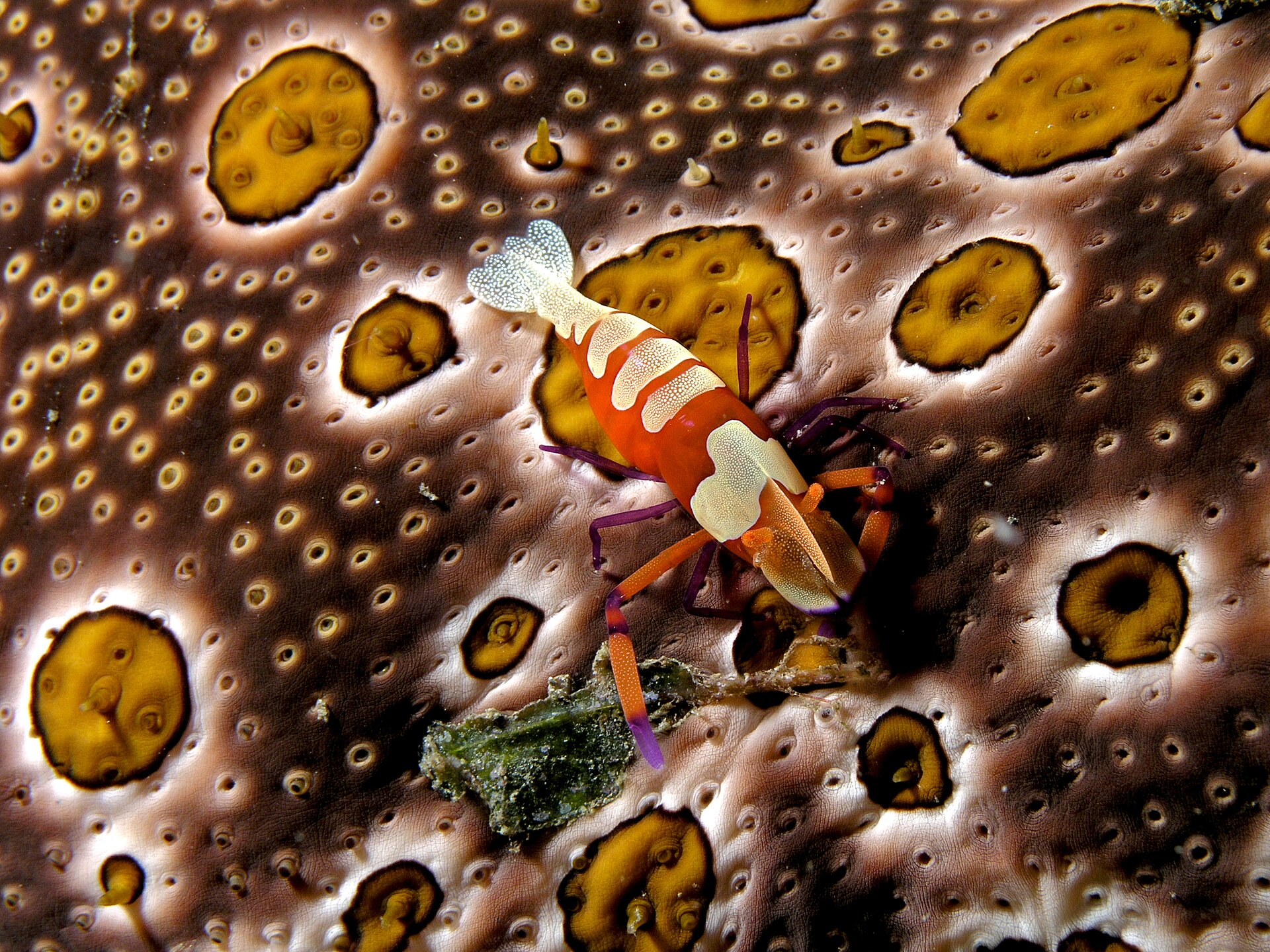
The emperor shrimp travels first class, riding sea cucumbers, Spanish dancers and other big nudibranchs across the reef. It is barely two centimeters long, orange to red with white patches and purple claws, and its colors shift with the host it lives on. Pairs often share one host, clinging to the back or flanks and slipping around to the far side when a diver leans in. The shrimp eats mucus, droppings and particles from its host and from the seabed the host crosses, but it is not quite the gentle hitchhiker it looks: researchers have watched emperor shrimp seize other small shrimp and even a post-larval fish. Finding one is simple in principle: check every large sea cucumber and every Spanish dancer, especially on night dives. Never move or turn the host for a better angle; the shrimp stays because the host does.
Where and when to see one
"Resident" means most dives at that destination encounter them; "seasonal" means reliably present in the listed months; anything else is a bonus, not a plan.
| Destination | Reliability | Months | Notes |
|---|---|---|---|
| Lembeh StraitIndonesia | Resident: seen on most dives | Year-round | |
| Bunaken & ManadoIndonesia | Resident: seen on most dives | Year-round | |
| AnilaoPhilippines | Occasional | Year-round | |
| Dumaguete, Dauin & Apo IslandPhilippines | Occasional | Year-round |
Best month, at a glance
Understanding them
Habitat: Reefs, rubble and sand slopes, always aboard a large host: sea cucumbers such as Bohadschia, Stichopus, Thelenota and Synapta, Spanish dancers and other big nudibranchs, now and then a sea star. Recorded to about 45 m.
Range: Tropical Indo-Pacific, from the Red Sea and the western Indian Ocean to Hawaii and French Polynesia, and from southern Japan to New Caledonia and northern Australia.
Behavior: Rides on the back or flanks of its host, often as a pair, and slips around to the far side when a diver leans in. Its colors shift to suit the host it lives on.
Diet: Mucus, droppings and particles picked from its host's skin and from the seabed the host crosses; it has also been seen seizing small shrimp and a post-larval fish.
Size: typically around 1.5 cm; documented up to 2 cm (total length; reef guides give up to 2 cm, and females are slightly larger and a little less colorful than males).
How to behave around one
Never lift, turn or prod a sea cucumber or nudibranch to reach the shrimp, and never move a shrimp onto a better-looking host. Approach low and slowly from the side, keep strobe bursts short, and give a swimming Spanish dancer open water.
Conservation
Not assessed by the IUCN. Its fortunes are tied to its hosts, the large sea cucumbers and nudibranchs it spends its whole life on.
Charted sites known for them
Highlighted sites were charted for this species by our editors; numbers are GBIF occurrence records logged within about 5 km of a site since 1990.
Recently recorded near our dive sites
44 verified records within 5 to 10 km of 23 of our dive sites over the last 12 months (17 Nov 2025 to 16 Nov 2026), 3 of them in the last 30 days. Latest: 4 Nov 2026, near Twilight Zone (Laha), by Gregor Bailar ↗ (iNaturalist, CC BY).
Most records near
Research-grade iNaturalist observations shared under CC0, CC BY or CC BY-NC, plus human sightings from GBIF and OBIS datasets under the same licences, within 5 km of a site with a sourced position or 10 km of an approximate one. A record near two sites counts once in the total and once on each site. Each site page credits the observers and datasets behind its records. How these are collected →
Watch
From the official channels
Catch this wave 🌊 | #montereybayaquarium #reeflife

Giant Pacific Octopus

Live African Penguin Cam After Hours | Monterey Bay Aquarium
Videos are embedded links to their creators' own channels. We host nothing and credit everything.