Invertebrates
Fire Coral
Millepora · Cnidarian, hydrozoan, family Milleporidae (fire corals); genus-level overview of fewer than twenty species, not a true stony coral
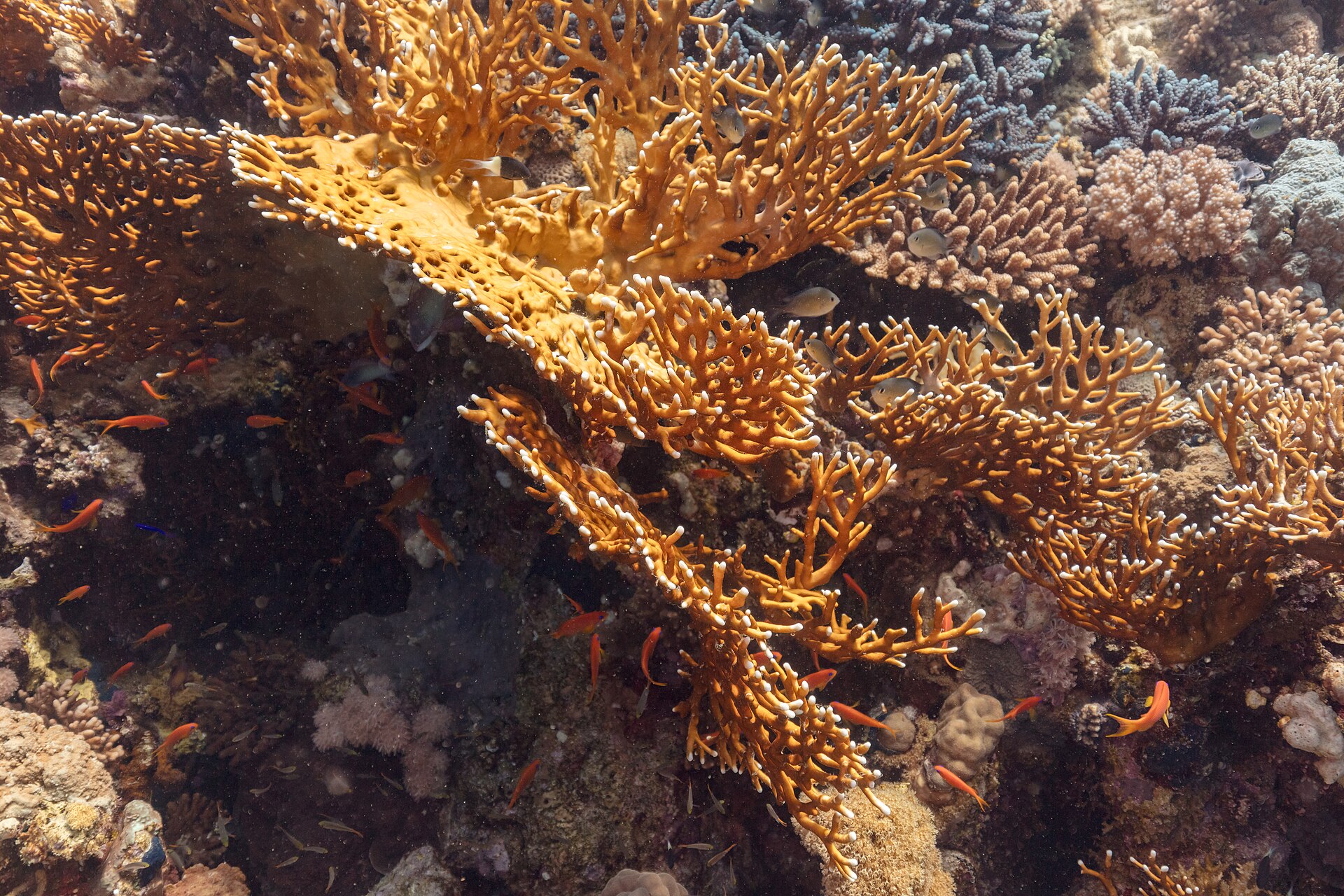
Fire coral is the reef's tripwire: smooth, mustard-colored blades, branches and crusts that look harmless until a bare forearm brushes them. It is not a true coral at all but a colonial hydrozoan, closer to the Portuguese man-of-war than to the stony corals it grows among, and its surface is studded with pinhole pores from which hair-like stinging polyps rise. Touch delivers a burning sting and often a rash that comes back days or weeks later. DAN notes that fire coral incidents are common among divers, especially those with poor buoyancy. The genus matters well beyond the sting: fire corals rank as the second most common reef-forming organisms, blade fire coral thrives in shallow, surge-swept water, and Indo-Pacific plate fire coral builds colonies two to three meters across. In the Caribbean, branching and blade fire corals are now listed as threatened. Treat every mustard-colored surface as live until proven otherwise.
Where and when to see one
"Resident" means most dives at that destination encounter them; "seasonal" means reliably present in the listed months; anything else is a bonus, not a plan.
| Destination | Reliability | Months | Notes |
|---|---|---|---|
| BonaireBonaire | Occasional | Year-round | |
| KomodoIndonesia | Occasional | Year-round | |
| Cairns & the Ribbon ReefsAustralia | Occasional | Year-round | |
| Sharm El Sheikh & Ras MohammedEgypt | Occasional | Year-round | |
| Hurghada & El GounaEgypt | Occasional | Year-round | |
| DahabEgypt | Occasional | Year-round | |
| Grand CaymanCayman Islands | Occasional | Year-round | |
| Nassau & New ProvidenceThe Bahamas | Occasional | Year-round | |
| AqabaJordan | Occasional | Year-round |
Best month, at a glance
Understanding them
Habitat: Shallow, sunlit reef tops and edges, especially where surge and current are strong, plus seagrass beds and mangrove roots; branching fire coral is recorded to 55 m. Encrusting growth also coats dead coral, sea fans, rocks, wrecks and debris.
Range: Tropical and subtropical seas worldwide. Branching (M. alcicornis) and blade (M. complanata) fire corals are the western Atlantic species divers meet; plate fire coral (M. platyphylla) ranges across the Indo-Pacific west to the Red Sea, and net fire coral (M. dichotoma) through the Red Sea and Indo-West Pacific.
Behavior: Sessile colonies with a smooth, mustard to tan surface and paler tips, peppered with tiny pores from which hair-like stinging polyps extend. Colonies release tiny medusae that carry the eggs and sperm.
Diet: Plankton snared by stinging polyps that rise from pinhole pores, supplemented by sugars from symbiotic algae in the tissue.
Size: typically around 30 cm; documented up to 3 m (colony width; Caribbean branching and blade fire corals run 2.5 to 45 cm per Florent's Guide, while the Indo-Pacific plate fire coral commonly forms colonies 2 to 3 m across with plates up to 2 m tall (SeaLifeBase)).
How to behave around one
Learn its look (smooth mustard-brown blades, branches or crusts with pale edges, often coating sea fans, wrecks and lines) and keep clear. Hold buoyancy off reef tops, never kneel or grab on hard bottom, wear full-length exposure protection, and look down as you descend.
Conservation
Not assessed at genus level. The IUCN lists branching fire coral (M. alcicornis) and net fire coral (M. dichotoma) as Endangered (2024) and blade fire coral (M. complanata) as Critically Endangered (2022), all on projected population declines, and fire corals are listed on CITES Appendix II.
Charted sites known for them
Highlighted sites were charted for this species by our editors; numbers are GBIF occurrence records logged within about 5 km of a site since 1990.
Watch
From the official channels

Giant Pacific Octopus

Live African Penguin Cam After Hours | Monterey Bay Aquarium

African Penguin Cam After Hours | Monterey Bay Aquarium
Videos are embedded links to their creators' own channels. We host nothing and credit everything.