Macro
Leaf Sheep
Costasiella kuroshimae · Mollusk, sacoglossan sea slug (not a nudibranch), family Costasiellidae
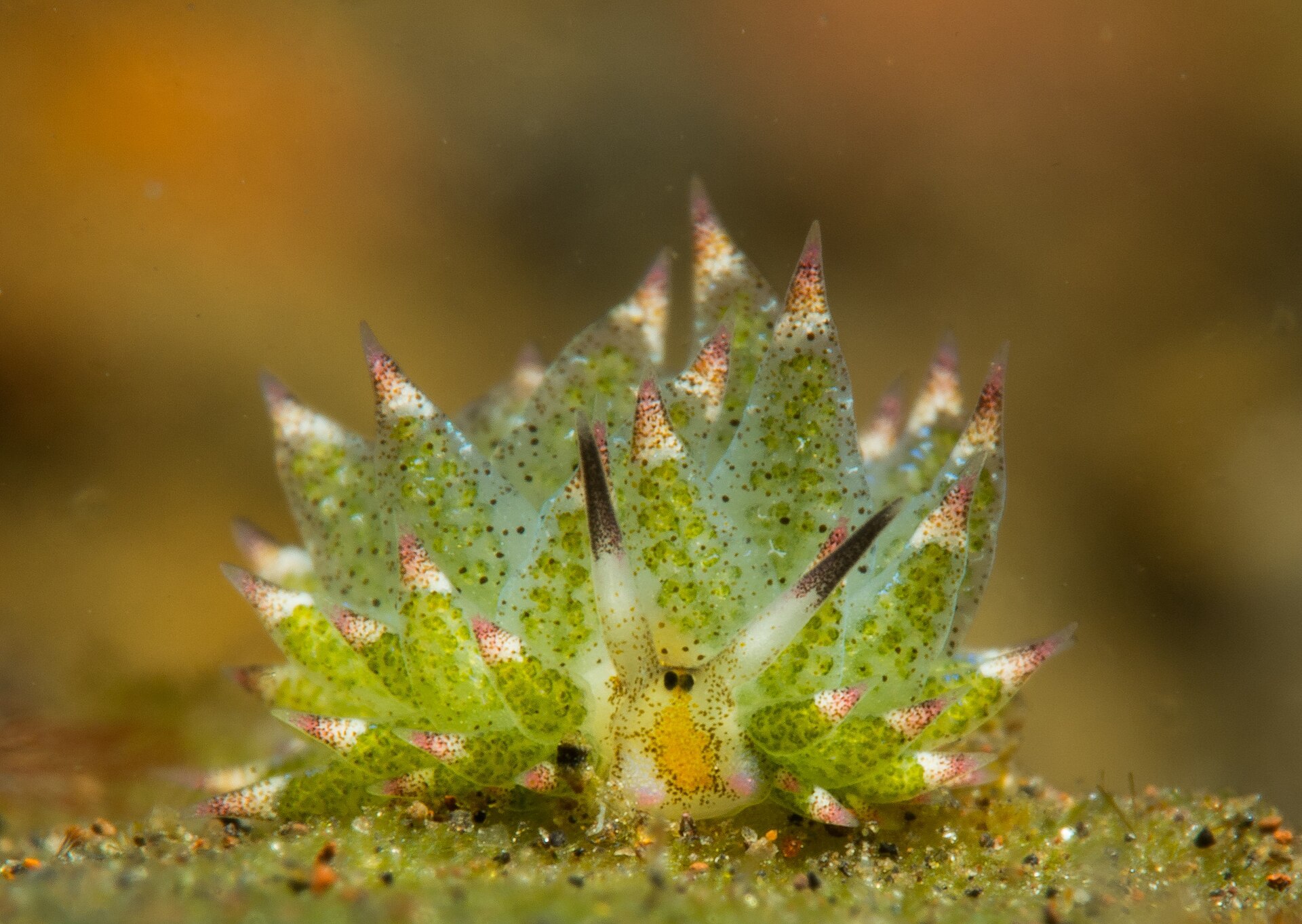
A cartoon sheep on a green leaf, a few millimeters long, that steals working chloroplasts from the alga it eats. The leaf sheep is a sacoglossan, a sap-sucking sea slug, not a nudibranch: it pierces the cells of the green alga Avrainvillea, drinks the contents and keeps the chloroplasts alive in the leaf-shaped cerata on its back. That kleptoplasty is real but modest. A 2014 study found Costasiella kuroshimae keeps its stolen chloroplasts working only for the short term, and in a related species they acted mainly as a food reserve during starvation, so think of a pantry rather than solar power. The name needs care too: specialists note several look-alike, still undescribed Costasiella species, and many viral 'leaf sheep' photos may show one of them. The face that made it famous is two black-tipped rhinophores over small dark eyes. Finding one means searching Avrainvillea patches on sandy slopes, slowly, with a guide who knows where the algae grow.
Where and when to see one
"Resident" means most dives at that destination encounter them; "seasonal" means reliably present in the listed months; anything else is a bonus, not a plan.
| Destination | Reliability | Months | Notes |
|---|---|---|---|
| Bali & Nusa PenidaIndonesia | Occasional | Year-round | |
| AnilaoPhilippines | Occasional | Year-round | |
| Lembeh StraitIndonesia | Occasional | Year-round | |
| Okinawa & the Kerama IslandsJapan | Occasional | Year-round |
Best month, at a glance
Understanding them
Habitat: Sandy and silty bottoms where its food alga Avrainvillea grows; photographed records run from 5 m on Okinawa to 20 m at Tulamben.
Range: Western Pacific: described from Kuroshima in Japan's Ryukyu Islands and recorded from Japan, the Philippines and Indonesia.
Behavior: Sits on or inches across Avrainvillea blades with its leaf-shaped cerata raised like a fleece; at a few millimeters long it is nearly invisible until a guide points it out.
Diet: The green alga Avrainvillea, whose cells it pierces and sucks, keeping the alga's chloroplasts working in its own tissue for a short time (kleptoplasty).
Size: typically around 0.4 cm; documented up to 0.5 cm (body length; the holotype measured 4 mm and field records run about 2–5 mm, so a hand lens or a guide's pointer helps).
How to behave around one
Never pluck the algal blade or move the slug for a cleaner background, hover well off the silt so your fins do not bury the patch, and use a pointer only to indicate, never to touch.
Conservation
Not evaluated by the IUCN Red List. It lives only where Avrainvillea grows, so its fate follows those algal patches.
Recently recorded near our dive sites
8 verified records within 5 to 10 km of 14 of our dive sites over the last 12 months (17 Nov 2025 to 16 Nov 2026). Latest: 4 Oct 2026, near Lighthouse Reef, by Ale’s Pokédex ↗ (iNaturalist, CC BY-NC).
Most records near
Research-grade iNaturalist observations shared under CC0, CC BY or CC BY-NC, plus human sightings from GBIF and OBIS datasets under the same licences, within 5 km of a site with a sourced position or 10 km of an approximate one. A record near two sites counts once in the total and once on each site. Each site page credits the observers and datasets behind its records. How these are collected →
Watch
From the official channels

Catch this wave 🌊 | #montereybayaquarium #reeflife

Giant Pacific Octopus

Live African Penguin Cam After Hours | Monterey Bay Aquarium
Videos are embedded links to their creators' own channels. We host nothing and credit everything.