Reef Fish
Lyretail Anthias (Sea Goldie)
Pseudanthias squamipinnis · Bony fish, family Anthiadidae (anthias, long placed within Serranidae, the groupers and sea basses)
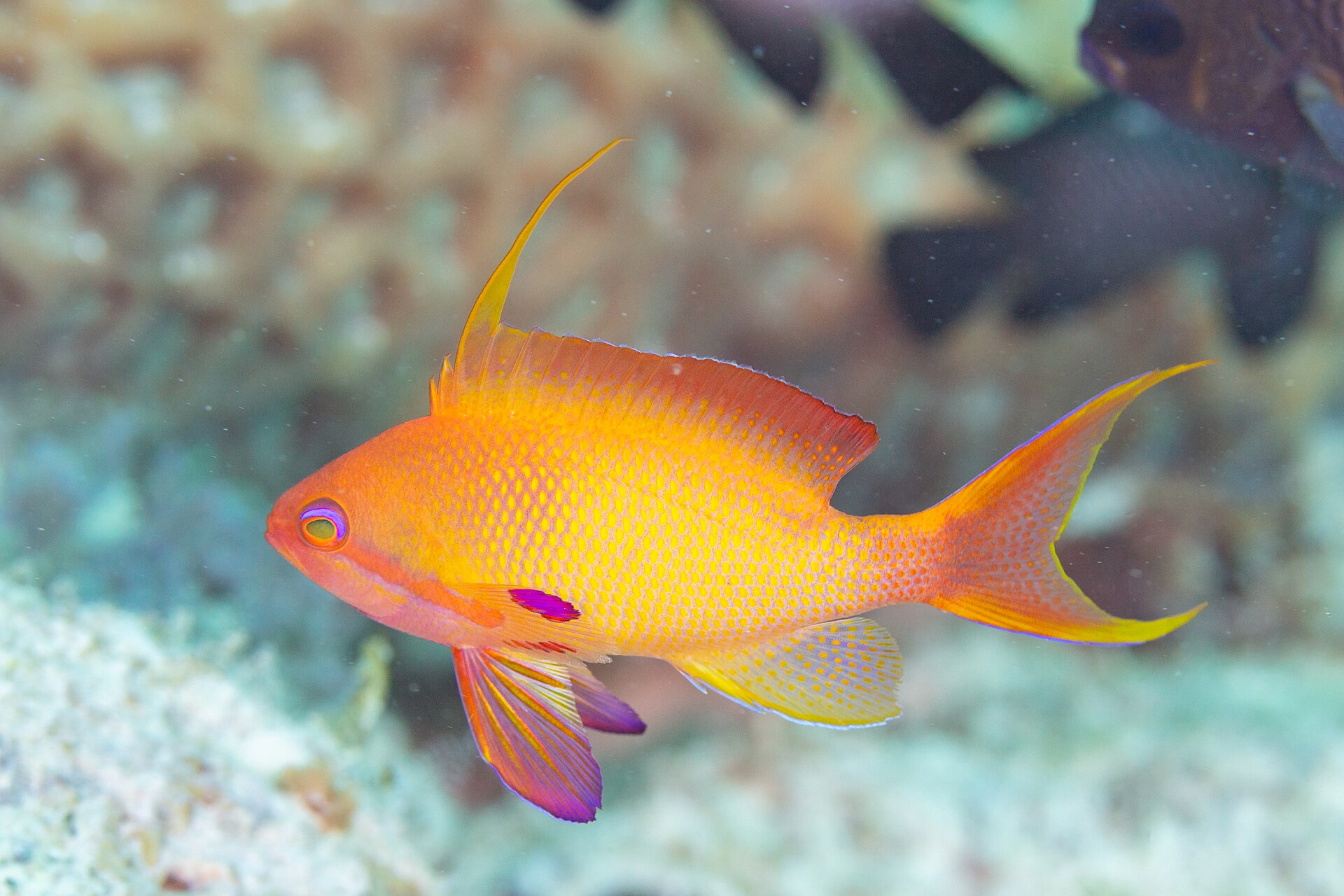
On many Red Sea reefs, the orange clouds hanging over the coral heads are mostly one species: the lyretail anthias. In visual censuses on Jordan's Gulf of Aqaba reefs it made up nearly a quarter of all fish counted, more than any other species, and surveys from Eilat to Sudan's Sanganeb atoll found it the most abundant fish too. Reef Life Survey calls it the most common basslet on shallow reefs, averaging more than a hundred per transect where it occurs. Each shoal is a set of harems. Females are small, about 7 cm; the few males are twice that size, with a purple patch on the pectoral fin and a long third dorsal spine. Take a male away and a female becomes one within two to four weeks. The whole shoal feeds on plankton, so it is thickest where current hits the reef.
Where and when to see one
"Resident" means most dives at that destination encounter them; "seasonal" means reliably present in the listed months; anything else is a bonus, not a plan.
| Destination | Reliability | Months | Notes |
|---|---|---|---|
| AqabaJordan | Resident: seen on most dives | Year-round | |
| Port Sudan & SanganebSudan | Resident: seen on most dives | Year-round | |
| Cairns & the Ribbon ReefsAustralia | Occasional | Year-round |
Best month, at a glance
| Month | Reliable destinations |
|---|---|
| January | Aqaba · Port Sudan & Sanganeb · Cairns & the Ribbon Reefs |
| February | Aqaba · Port Sudan & Sanganeb · Cairns & the Ribbon Reefs |
| March | Aqaba · Port Sudan & Sanganeb · Cairns & the Ribbon Reefs |
| April | Aqaba · Port Sudan & Sanganeb · Cairns & the Ribbon Reefs |
| May | Aqaba · Port Sudan & Sanganeb · Cairns & the Ribbon Reefs |
| June | Aqaba · Port Sudan & Sanganeb · Cairns & the Ribbon Reefs |
| July | Aqaba · Port Sudan & Sanganeb · Cairns & the Ribbon Reefs |
| August | Aqaba · Port Sudan & Sanganeb · Cairns & the Ribbon Reefs |
| September | Aqaba · Port Sudan & Sanganeb · Cairns & the Ribbon Reefs |
| October | Aqaba · Port Sudan & Sanganeb · Cairns & the Ribbon Reefs |
| November | Aqaba · Port Sudan & Sanganeb · Cairns & the Ribbon Reefs |
| December | Aqaba · Port Sudan & Sanganeb · Cairns & the Ribbon Reefs |
Understanding them
Habitat: Large shoals above coral outcrops and patch reefs in clear lagoons, channels and on outer reef slopes, usually 5 to 35 m and recorded from the surface to 55 m. In the Gulf of Aqaba it is densest on current-exposed deeper slopes.
Range: Indo-West Pacific from the Red Sea and Natal, South Africa, east to Niue, north to Japan and south to Australia. Some ichthyologists restrict the species to the western Indian Ocean and treat Pacific fish as the look-alike Pseudanthias cheirospilos.
Behavior: Lives in harems: a territorial male with a long third dorsal spine and a purple pectoral patch dominates a group of females and juveniles. It is a protogynous hermaphrodite, and when the male is removed a female changes sex to replace him within two to four weeks.
Diet: Zooplankton, picked from the water column above the reef by large feeding schools.
Size: typically around 7 cm; documented up to 15 cm (total length; males reach 15 cm but females only about 7 cm, and females make up most of each harem).
How to behave around one
Hover back from the coral head and let the shoal settle around you; chasing a male for a photo just breaks up the group. Keep fins well clear of the outcrops the shoal lives above.
Conservation
Least Concern on the IUCN Red List (2016 assessment). It is the dominant fish on many northern Red Sea reefs.
Recently recorded near our dive sites
213 verified records within 5 to 10 km of 91 of our dive sites over the last 12 months (17 Nov 2025 to 16 Nov 2026), 27 of them in the last 30 days. Latest: 11 Nov 2026, near Gota Abu Ramada, by Emilie G. ↗ (iNaturalist, CC BY-NC).
Most records near
Research-grade iNaturalist observations shared under CC0, CC BY or CC BY-NC, plus human sightings from GBIF and OBIS datasets under the same licences, within 5 km of a site with a sourced position or 10 km of an approximate one. A record near two sites counts once in the total and once on each site. Each site page credits the observers and datasets behind its records. How these are collected →
Watch
From the official channels

Catch this wave 🌊 | #montereybayaquarium #reeflife

Giant Pacific Octopus

Live African Penguin Cam After Hours | Monterey Bay Aquarium
Videos are embedded links to their creators' own channels. We host nothing and credit everything.