Sharks
Sicklefin Lemon Shark
Negaprion acutidens · Cartilaginous fish, family Carcharhinidae (requiem sharks)
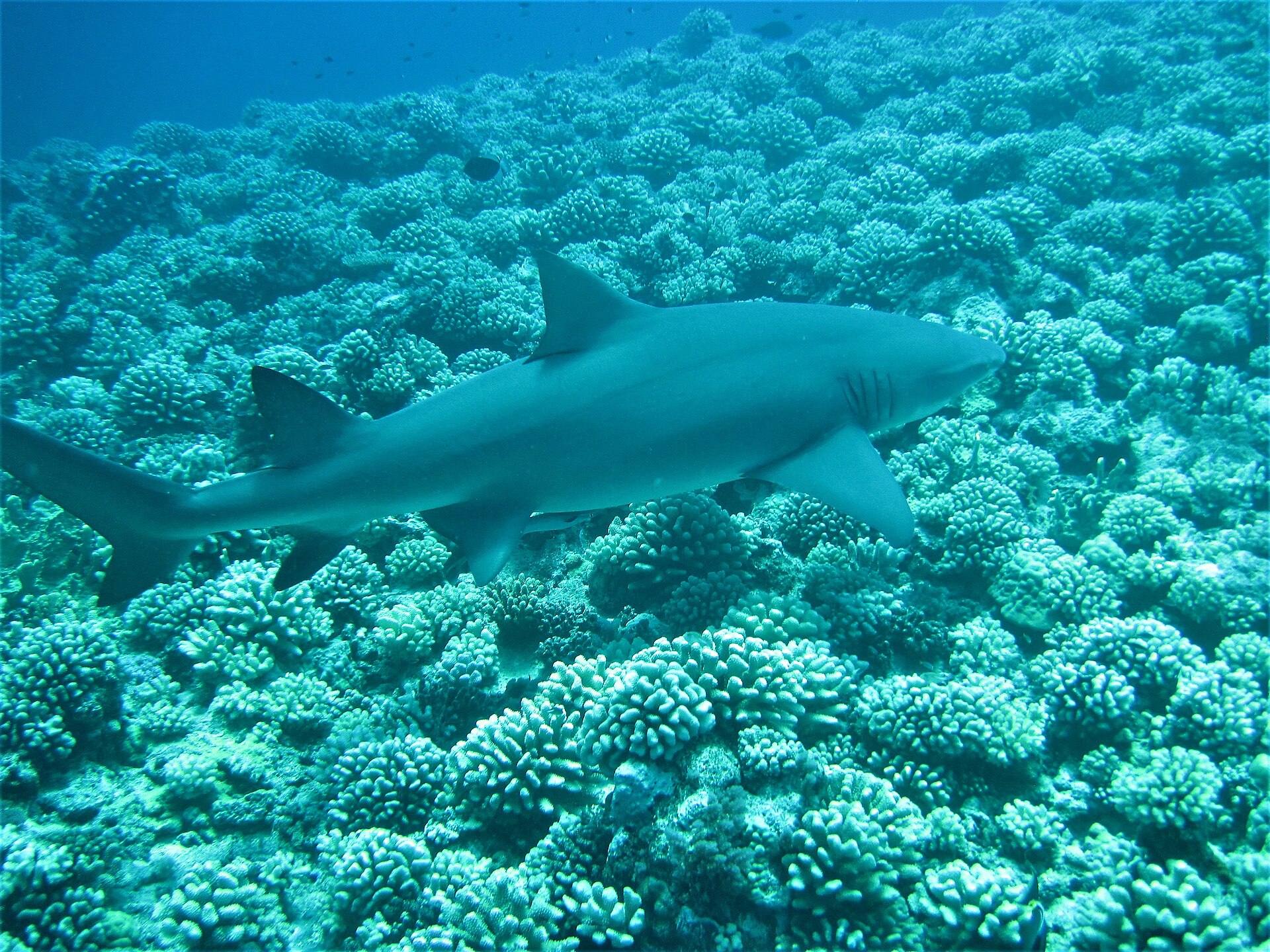
The sicklefin lemon shark is a broad-snouted, yellow-brown heavyweight whose curved fins look as if they were cut with a sickle. It is the Indo-Pacific cousin of the Atlantic lemon shark: stocky, blunt-headed and often wearing a slightly open, toothy grin. Adults patrol reef faces near deep water and shallow lagoons, while pups stay on reef flats and in mangroves. Divers meet it most reliably at Fiji's Shark Reef Marine Reserve off Beqa, where it is part of the regular cast of eight species on the provisioned dive, with females turning up more often than males, alone or in groups of up to six. Elsewhere it is an occasional sight in the Seychelles, where citizen scientists have logged several together, and a rare one at Ningaloo. Usually wary of divers unless food is involved, it deserves room and respect.
Where and when to see one
"Resident" means most dives at that destination encounter them; "seasonal" means reliably present in the listed months; anything else is a bonus, not a plan.
| Destination | Reliability | Months | Notes |
|---|---|---|---|
| Beqa Lagoon & Pacific HarbourFiji | Resident: seen on most dives | Year-round | |
| SeychellesSeychelles | Occasional | Year-round | |
| Ningaloo ReefAustralia | Rare | Year-round |
Best month, at a glance
| Month | Reliable destinations |
|---|---|
| January | Beqa Lagoon & Pacific Harbour · Seychelles · Ningaloo Reef |
| February | Beqa Lagoon & Pacific Harbour · Seychelles · Ningaloo Reef |
| March | Beqa Lagoon & Pacific Harbour · Seychelles · Ningaloo Reef |
| April | Beqa Lagoon & Pacific Harbour · Seychelles · Ningaloo Reef |
| May | Beqa Lagoon & Pacific Harbour · Seychelles · Ningaloo Reef |
| June | Beqa Lagoon & Pacific Harbour · Seychelles · Ningaloo Reef |
| July | Beqa Lagoon & Pacific Harbour · Seychelles · Ningaloo Reef |
| August | Beqa Lagoon & Pacific Harbour · Seychelles · Ningaloo Reef |
| September | Beqa Lagoon & Pacific Harbour · Seychelles · Ningaloo Reef |
| October | Beqa Lagoon & Pacific Harbour · Seychelles · Ningaloo Reef |
| November | Beqa Lagoon & Pacific Harbour · Seychelles · Ningaloo Reef |
| December | Beqa Lagoon & Pacific Harbour · Seychelles · Ningaloo Reef |
Understanding them
Habitat: Coral reefs, lagoons and reef faces near deep drop-offs over continental and island shelves, to 92 m. Juveniles stay in very shallow sandy lagoons, reef flats and turbid mangrove areas.
Range: Indo-Pacific from the Red Sea and South Africa, including the Seychelles, Mauritius and Madagascar, east to the Philippines and Vietnam and south to Australia, with records from Palau, the Marshall Islands and Tahiti.
Behavior: Cruises slowly over reef and sand and is usually hard to approach closely except where it is fed. At Beqa's provisioned dive the females visit more often than the males, alone or in groups of up to six.
Diet: Bottom-living bony fish, stingrays and smaller sharks.
Size: typically around 2.3 m; documented up to 3.8 m (total length; FishBase gives a 3.8 m maximum and maturity at about 2.3 m, and Elasmodiver puts typical adults at 2.2 to 2.4 m).
How to behave around one
Never corner, chase or touch it, and leave pups in shallow lagoons undisturbed. At provisioned dives, stay low behind the wall or line where the guides place you and keep hands away from the bait.
Conservation
Endangered on the IUCN Red List (2021) after declines driven by fishing for its meat, fins and liver oil; listed on CITES Appendix II.
Recently recorded near our dive sites
8 verified records within 5 to 10 km of 1 of our dive sites over the last 12 months (17 Nov 2025 to 16 Nov 2026). Latest: 14 Aug 2026, near Turquoise Bay, by imogenisunderwater ↗ (iNaturalist, CC BY-NC).
Most records near
Research-grade iNaturalist observations shared under CC0, CC BY or CC BY-NC, plus human sightings from GBIF and OBIS datasets under the same licences, within 5 km of a site with a sourced position or 10 km of an approximate one. A record near two sites counts once in the total and once on each site. Each site page credits the observers and datasets behind its records. How these are collected →
Watch
From the official channels

Catch this wave 🌊 | #montereybayaquarium #reeflife

Giant Pacific Octopus

Live African Penguin Cam After Hours | Monterey Bay Aquarium
Videos are embedded links to their creators' own channels. We host nothing and credit everything.