Rays
Smooth Stingray (Short-tail Stingray)
Bathytoshia brevicaudata · Cartilaginous fish, family Dasyatidae (whiptail stingrays); long placed in Dasyatis as Dasyatis brevicaudata
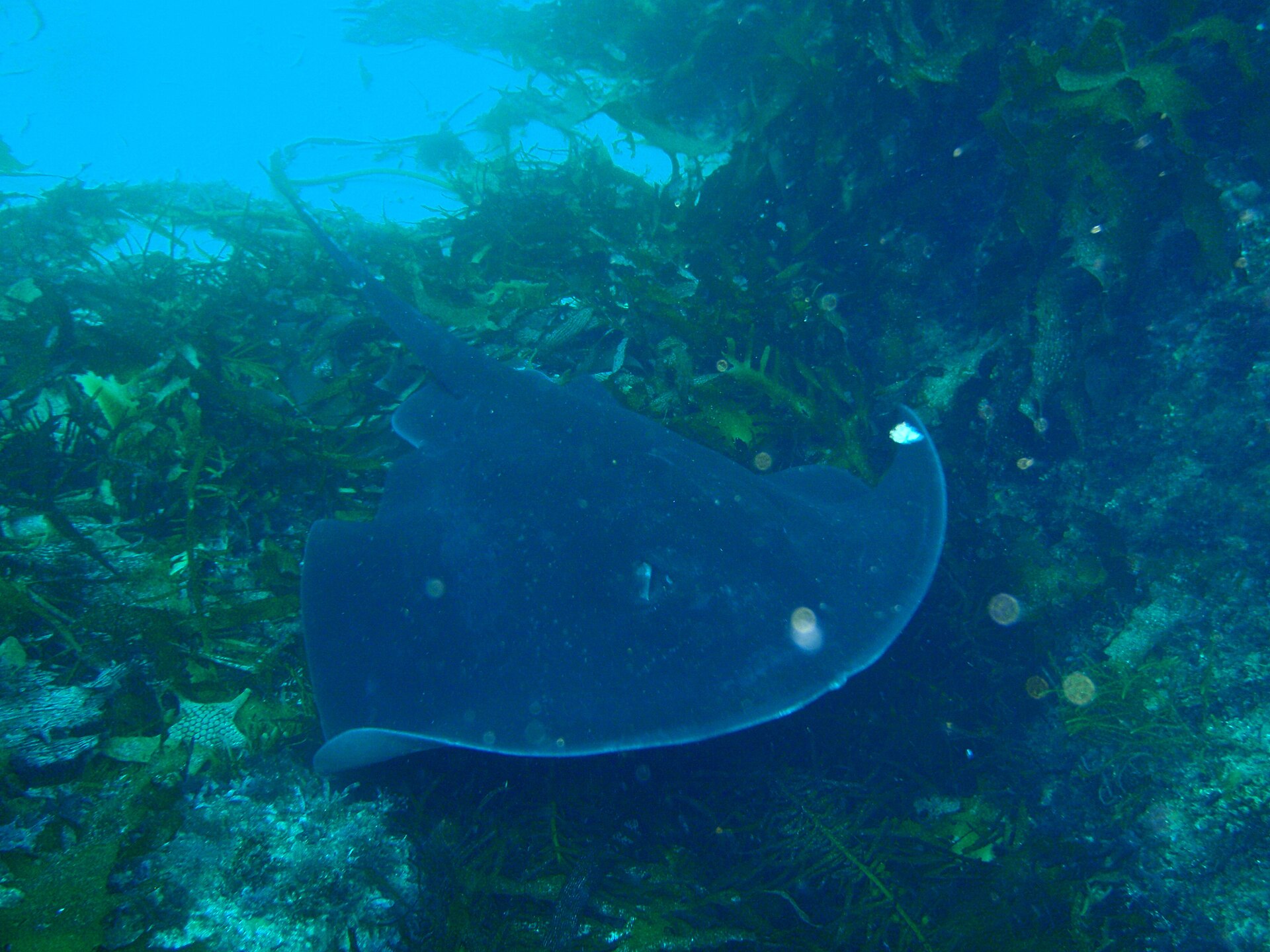
A stingray wider than a diver is tall, and curious with it. The smooth stingray is a contender for the largest of all stingrays: a thick, plain gray disc that can span a man's outstretched arms, a short heavy tail armed with one or two serrated barbs, and a weight that can pass 350 kg. It roams temperate shallows from southern Australia and northern New Zealand to southern Africa, cruising sand flats, jetty pylons and kelp reefs. Its most famous haunt is New Zealand's Poor Knights Islands, where rays gather in the archways and hang in the rising current, sometimes dozens at once; both mating and birth have been recorded in these groups. One longtime Poor Knights diver counted 53 in Northern Arch. Usually calm and often inquisitive, it can still deliver a dangerous sting, so give it the respect its size deserves.
Where and when to see one
"Resident" means most dives at that destination encounter them; "seasonal" means reliably present in the listed months; anything else is a bonus, not a plan.
| Destination | Reliability | Months | Notes |
|---|---|---|---|
| Poor Knights IslandsNew Zealand | Resident: seen on most dives | Year-round | |
| South AustraliaAustralia | Occasional | Year-round |
Best month, at a glance
| Month | Reliable destinations |
|---|---|
| January | Poor Knights Islands · South Australia |
| February | Poor Knights Islands · South Australia |
| March | Poor Knights Islands · South Australia |
| April | Poor Knights Islands · South Australia |
| May | Poor Knights Islands · South Australia |
| June | Poor Knights Islands · South Australia |
| July | Poor Knights Islands · South Australia |
| August | Poor Knights Islands · South Australia |
| September | Poor Knights Islands · South Australia |
| October | Poor Knights Islands · South Australia |
| November | Poor Knights Islands · South Australia |
| December | Poor Knights Islands · South Australia |
Understanding them
Habitat: Sand flats, bays, estuaries, jetties and rocky reefs, from the intertidal zone over the continental shelf; recorded to 476 m, and off southern Africa mostly on deep offshore banks. It also rises into midwater, as in the Poor Knights archways.
Range: Temperate Southern Hemisphere: southern Australia from Shark Bay to southern Queensland including Tasmania, northern New Zealand, and southern Africa from Cape Town to Mozambique.
Behavior: Inquisitive rather than aggressive: it often glides past divers over kelp or settles on sand in the shallows, and if startled it can bolt with a loud bang of its wings. At the Poor Knights dozens hover almost motionless in the current inside the archways.
Diet: Bottom fishes, bivalves, squid, crustaceans and buried invertebrates such as spoon worms, plus midwater prey like salps; it is also a ready scavenger of fish scraps.
Size: typically around 1.25 m; documented up to 4.3 m (total length (FishBase common length 1.25 m; maximum 4.3 m and over 350 kg), a contender for the largest stingray. At the Poor Knights some grow as wide as a man's outstretched arms, and catches up to 3.5 m across have been reported. Mature females are larger than males).
How to behave around one
Keep well clear of the tail, never block a ray's way out of an archway or hover directly above it, and do not feed or touch rays, even where they are used to fish scraps.
Conservation
Least Concern (assessed 2021). Often caught as bycatch by commercial and recreational fishers, but usually survives release; its best-known gathering site lies inside the Poor Knights marine reserve.
Charted sites known for them
Highlighted sites were charted for this species by our editors; numbers are GBIF occurrence records logged within about 5 km of a site since 1990.
Recently recorded near our dive sites
22 verified records within 5 to 10 km of 19 of our dive sites over the last 12 months (17 Nov 2025 to 16 Nov 2026), 1 of them in the last 30 days. Latest: 12 Nov 2026, near Fairy Bower, by Oliver Blunt ↗ (iNaturalist, CC BY-NC).
Most records near
Research-grade iNaturalist observations shared under CC0, CC BY or CC BY-NC, plus human sightings from GBIF and OBIS datasets under the same licences, within 5 km of a site with a sourced position or 10 km of an approximate one. A record near two sites counts once in the total and once on each site. Each site page credits the observers and datasets behind its records. How these are collected →
Watch
From the official channels

Catch this wave 🌊 | #montereybayaquarium #reeflife

Giant Pacific Octopus

Live African Penguin Cam After Hours | Monterey Bay Aquarium
Videos are embedded links to their creators' own channels. We host nothing and credit everything.