Cold Water
Sunflower Sea Star
Pycnopodia helianthoides · Echinoderm, sea star, family Asteriidae
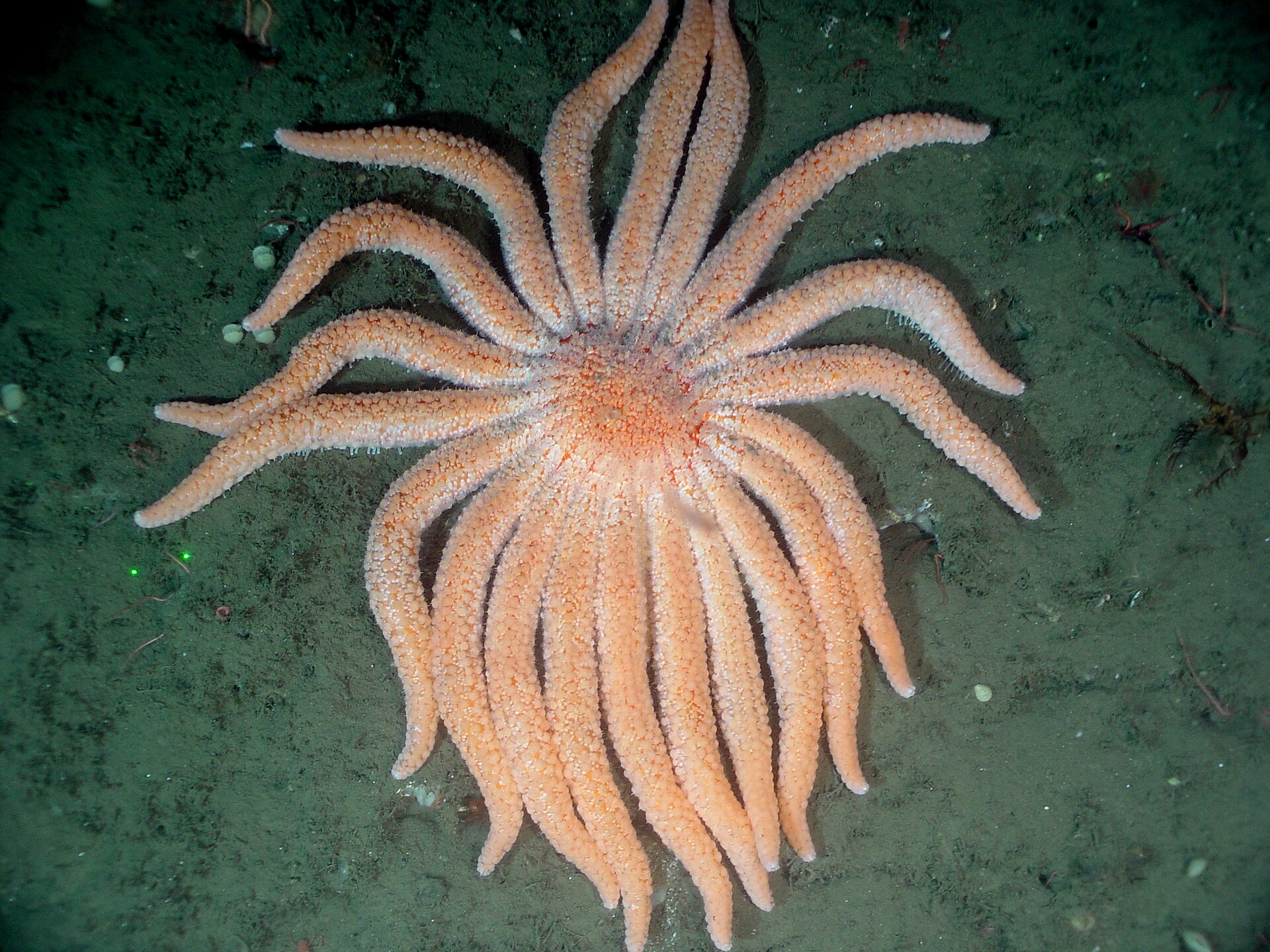
Until 2013 the sunflower sea star was a common giant of Pacific kelp forests: up to a meter across, with as many as 24 arms. It hunts at a pace that is startling for a sea star, gliding on some 15,000 tube feet, and urchins flee when they smell it coming. Then sea star wasting disease arrived. Between 2013 and 2017 it swept the coast largely from south to north, and more than 90 percent of sunflower stars between Alaska and Mexico died; the IUCN listed the species as Critically Endangered in 2020. The recovery is patchy but real. Reef Life Survey divers counted 15 in Barkley Sound in 2021 and 123 in 2023, most of them small, and Hakai Institute researchers found larger, more abundant stars in the fjords of BC's Central Coast than on the outer islands. Without this predator urchin numbers rise and kelp suffers, so every healthy star is worth a careful look.
Where and when to see one
"Resident" means most dives at that destination encounter them; "seasonal" means reliably present in the listed months; anything else is a bonus, not a plan.
| Destination | Reliability | Months | Notes |
|---|---|---|---|
| British ColumbiaCanada | Occasional | Year-round |
Best month, at a glance
| Month | Reliable destinations |
|---|---|
| January | British Columbia |
| February | British Columbia |
| March | British Columbia |
| April | British Columbia |
| May | British Columbia |
| June | British Columbia |
| July | British Columbia |
| August | British Columbia |
| September | British Columbia |
| October | British Columbia |
| November | British Columbia |
| December | British Columbia |
Understanding them
Habitat: Rocky reefs, kelp forests, seagrass beds and soft bottoms, from the low intertidal to at least 435 m.
Range: Northeast Pacific from Alaska to Baja California. The 2013 to 2017 die-off moved largely from south to north, and fjords on British Columbia's Central Coast now hold some of the largest, most abundant survivors.
Behavior: A hunter on the move: it glides over rock and sand on some 15,000 tube feet at up to about 1.5 m a minute, and purple urchins that smell it nearby run, hide and eat less.
Diet: Sea urchins, clams, snails, chitons, crabs, sea cucumbers and other sea stars, plus dead or dying squid.
Size: typically around 30 cm; documented up to 1 m (arm span, tip to tip; adults reach about 1 m, but most stars divers now find in BC are young: the largest of 123 counted in Barkley Sound in 2023 spanned 30 cm).
How to behave around one
Look without touching or lifting: the species is critically endangered and still threatened by wasting disease. Note the site, depth and size of any you find; divers' survey counts are how the recovery is being tracked.
Conservation
Critically Endangered (IUCN, 2020, amended 2021) after sea star wasting disease killed more than 90 percent of the population from 2013; NOAA proposed listing it as threatened under the US Endangered Species Act in 2023.
Charted sites known for them
Highlighted sites were charted for this species by our editors; numbers are GBIF occurrence records logged within about 5 km of a site since 1990.
Recently recorded near our dive sites
8 verified records within 5 to 10 km of 3 of our dive sites over the last 12 months (17 Nov 2025 to 16 Nov 2026), 4 of them in the last 30 days. Latest: 29 Oct 2026, near Seven Tree Island, by imcote ↗ (iNaturalist, CC BY-NC).
Most records near
Research-grade iNaturalist observations shared under CC0, CC BY or CC BY-NC, plus human sightings from GBIF and OBIS datasets under the same licences, within 5 km of a site with a sourced position or 10 km of an approximate one. A record near two sites counts once in the total and once on each site. Each site page credits the observers and datasets behind its records. How these are collected →
Watch
From the official channels

Catch this wave 🌊 | #montereybayaquarium #reeflife

Giant Pacific Octopus

Live African Penguin Cam After Hours | Monterey Bay Aquarium
Videos are embedded links to their creators' own channels. We host nothing and credit everything.