Invertebrates
Crown-of-Thorns Starfish
Acanthaster planci · Echinoderm, family Acanthasteridae; a coral-eating sea star, often abbreviated COTS
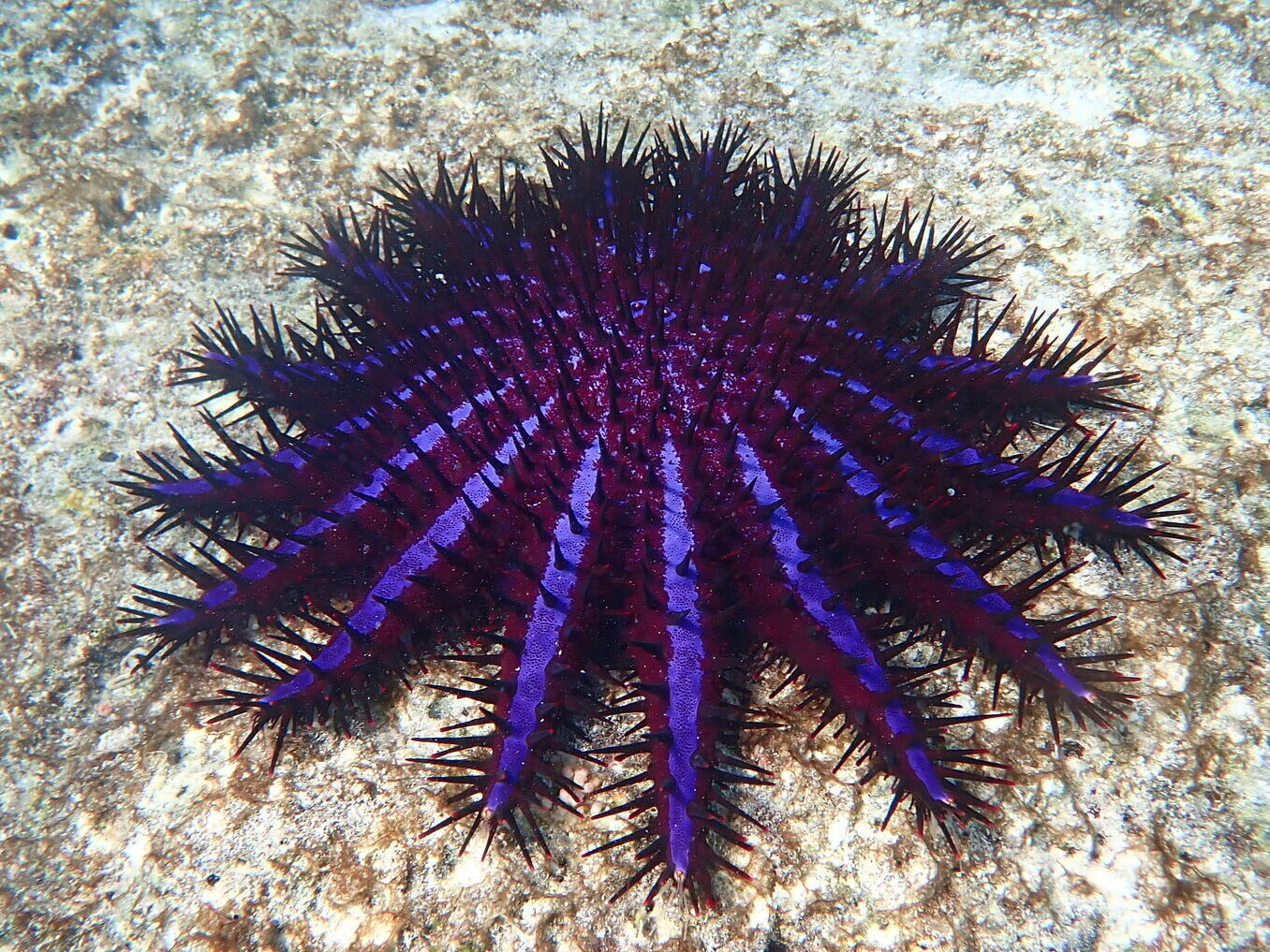
The crown-of-thorns starfish is the reef predator whose appetite makes headlines. A large adult (half a meter of spine-armored arms, often twenty of them) everts its stomach over living coral and digests the tissue straight off the skeleton, leaving stark white feeding scars. At natural densities it is a normal member of Indo-Pacific reefs; in outbreak years populations explode to thousands per reef and can strip kilometers of coral, and repeated outbreak waves rank among the largest single causes of coral loss on the Great Barrier Reef. Divers are often asked to report sightings, and licensed cull teams inject stars on managed reefs. Leave removal to them, since a mishandled star is dangerous and crude methods can spread the problem. The spines mean business: punctures bring strong pain, swelling, and occasionally embedded tips.
在哪里、什么时候能见到
"常驻"表示在该目的地潜水时大多数情况下都能遇见它们;"季节性"表示在所列月份内可靠出现;其他任何情况都是意外惊喜,而非计划中的保障。
| 目的地 | 可靠性 | 月份 | 备注 |
|---|---|---|---|
| Cairns & the Ribbon ReefsAustralia | Occasional | 全年皆宜 | |
| North & South Malé AtollsMaldives | Occasional | 全年皆宜 | |
| Okinawa & the Kerama IslandsJapan | Occasional | 全年皆宜 |
最佳月份一览
深入了解
栖息地: Coral reefs wherever live hard coral grows, sheltering by day and feeding openly during outbreaks.
分布范围: Indo-Pacific and Red Sea, from East Africa to the eastern Pacific fringe.
习性: Naturally sparse and mostly nocturnal; in outbreak years densities explode and stars feed in daylight en masse, leaving white feeding scars across whole reef tracts.
食性: Living hard-coral tissue, digested externally by everting the stomach over the colony; a large adult can clear several square meters a month.
体型: 通常约 0.3 m; 记录深度可达 0.7 m (total diameter including arms; large adults carry up to about 20 arms).
与它相处时的行为守则
Report sightings where reef managers ask for them and leave removal to licensed cull teams: improvised chopping can spread damage, and the spines punish bare-handed heroics.
保育
The species itself is not threatened. The management story is protecting coral from outbreaks, whose causes are debated but linked in part to nutrient runoff and loss of predators such as the giant triton.
以此著称的已标注潜点
高亮显示的潜点由编辑团队为该物种标注;数字为1990年以来潜点约5公里范围内的GBIF出现记录数。
观看
来自官方渠道

Wildlife of Monterey | New film in our auditorium

Live Aviary Cam | Monterey Bay Aquarium

Live Aviary Cam | Monterey Bay Aquarium
视频均为创作者自有频道的嵌入链接。我们不托管任何内容,所有来源均注明出处。