Macro
Weedy Scorpionfish (Rhinopias)
Rhinopias frondosa · Bony fish, family Scorpaenidae (scorpionfishes); type species of the genus Rhinopias
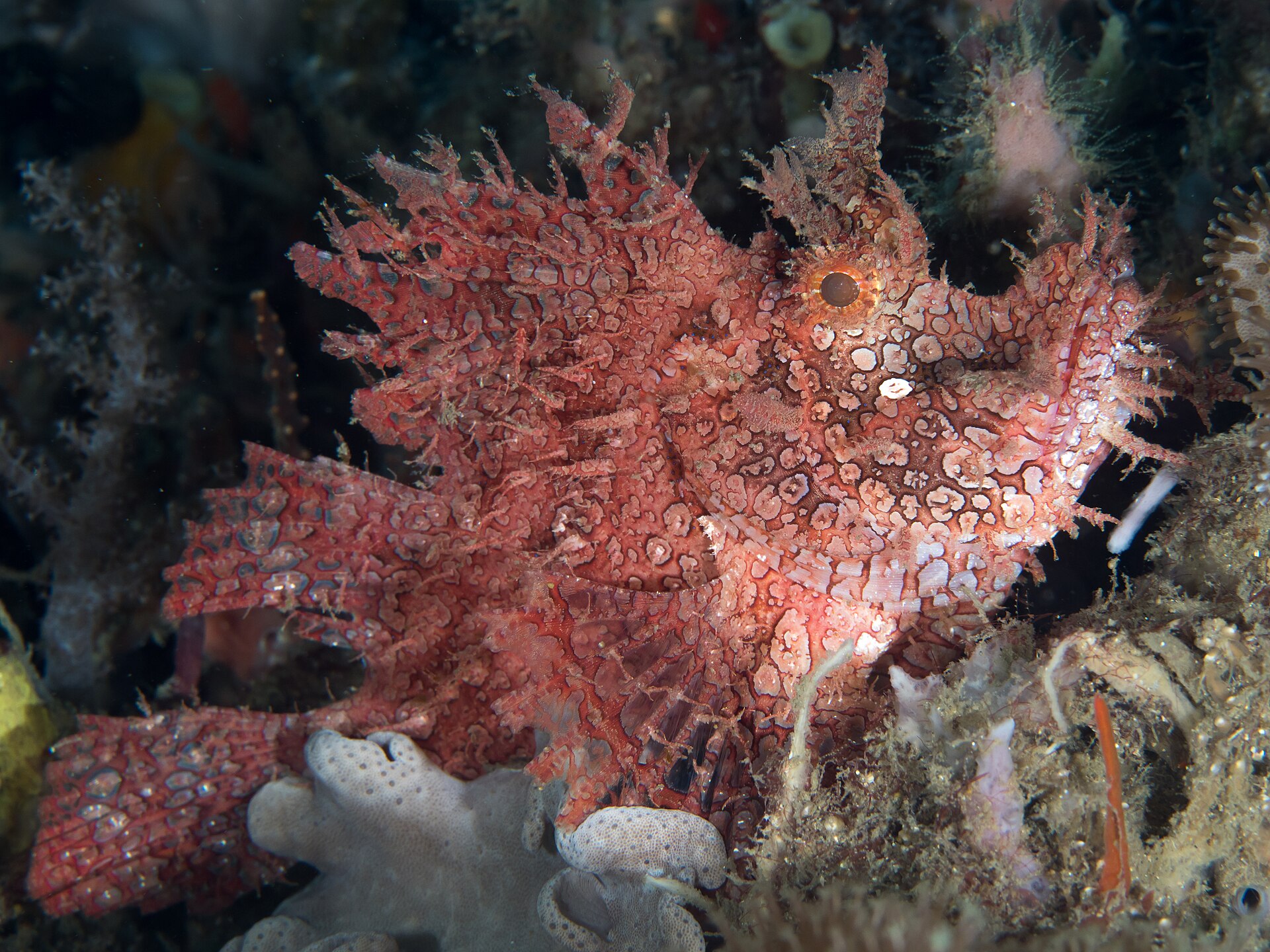
For many muck divers the weedy scorpionfish is the grail: a fish no longer than a hand, draped in weedy tassels and ringed spots. Colors run from yellow and orange to red and purple, but every animal carries the species' signature pattern of circular, dark-edged spots, and fish on algae-rich bottoms wear far more tassels than plainer ones living deeper among sponges. It hunts small fish and invertebrates, mostly at night, and seldom swims, preferring to shuffle over the bottom on its fins. Sightings come and go. An individual may hold the same patch of rubble for months and then vanish, which is why guides guard their locations and why this guide rates it occasional at best. Its relationship with the smooth-skinned paddle-flap Rhinopias is unsettled: the two are seen together and have been filmed mating at Alor, and some researchers think they are one species. Watch it, never move it, and keep your fins well clear of its rubble.
Where and when to see one
"Resident" means most dives at that destination encounter them; "seasonal" means reliably present in the listed months; anything else is a bonus, not a plan.
| Destination | Reliability | Months | Notes |
|---|---|---|---|
| Lembeh StraitIndonesia | Occasional | Year-round | |
| AnilaoPhilippines | Occasional | Year-round | |
| Banda Sea & AmbonIndonesia | Occasional | Year-round | |
| AlorIndonesia | Rare | Year-round |
Best month, at a glance
| Month | Reliable destinations |
|---|---|
| January | Lembeh Strait · Anilao · Banda Sea & Ambon · Alor |
| February | Lembeh Strait · Anilao · Banda Sea & Ambon · Alor |
| March | Lembeh Strait · Anilao · Banda Sea & Ambon · Alor |
| April | Lembeh Strait · Anilao · Banda Sea & Ambon · Alor |
| May | Lembeh Strait · Anilao · Banda Sea & Ambon · Alor |
| June | Lembeh Strait · Anilao · Banda Sea & Ambon · Alor |
| July | Lembeh Strait · Anilao · Banda Sea & Ambon · Alor |
| August | Lembeh Strait · Anilao · Banda Sea & Ambon · Alor |
| September | Lembeh Strait · Anilao · Banda Sea & Ambon · Alor |
| October | Lembeh Strait · Anilao · Banda Sea & Ambon · Alor |
| November | Lembeh Strait · Anilao · Banda Sea & Ambon · Alor |
| December | Lembeh Strait · Anilao · Banda Sea & Ambon · Alor |
Understanding them
Habitat: Rubble, sand and rocky or coral bottoms, often in current-prone channels and near algae, sponges or Goniopora coral. Recorded from 10 to 297 m; divers meet it from about 8 m down.
Range: Indo-West Pacific, from South Africa and Mauritius east to the Caroline Islands, north to southern Japan and south to eastern Australia. Dive sightings cluster on Indonesian and Philippine muck and rubble sites.
Behavior: Sits still among algae or rubble and rarely swims, moving over the bottom on its fins; individuals can hold the same small area for months. It is sometimes seen paired with the paddle-flap Rhinopias.
Diet: Small fishes and invertebrates, ambushed mostly at night.
Size: typically around 15 cm; documented up to 23 cm (total length; no common length is published, so 15 cm is a conservative figure below the 23 cm maximum).
How to behave around one
Keep hands, fins and pointers off the rubble around it; never herd or lift it onto a cleaner background, and keep strobe bursts few. Share the spot with other divers by taking turns rather than crowding the fish.
Conservation
Least Concern on the IUCN Red List (2016 assessment). It has no food-fishery value, but its rarity and color make it a high-priced aquarium fish.
Charted sites known for them
Highlighted sites were charted for this species by our editors; numbers are GBIF occurrence records logged within about 5 km of a site since 1990.
Recently recorded near our dive sites
9 verified records within 5 to 10 km of 13 of our dive sites over the last 12 months (17 Nov 2025 to 16 Nov 2026). Latest: 15 Jun 2026, near Seven Mile Reef, by aspearton ↗ (iNaturalist, CC BY-NC).
Most records near
Research-grade iNaturalist observations shared under CC0, CC BY or CC BY-NC, plus human sightings from GBIF and OBIS datasets under the same licences, within 5 km of a site with a sourced position or 10 km of an approximate one. A record near two sites counts once in the total and once on each site. Each site page credits the observers and datasets behind its records. How these are collected →
Watch
From the official channels

Giant Pacific Octopus

Live African Penguin Cam After Hours | Monterey Bay Aquarium

African Penguin Cam After Hours | Monterey Bay Aquarium
Videos are embedded links to their creators' own channels. We host nothing and credit everything.