Rays
Yellow Stingray
Urobatis jamaicensis · Cartilaginous fish, family Urotrygonidae (American round stingrays)
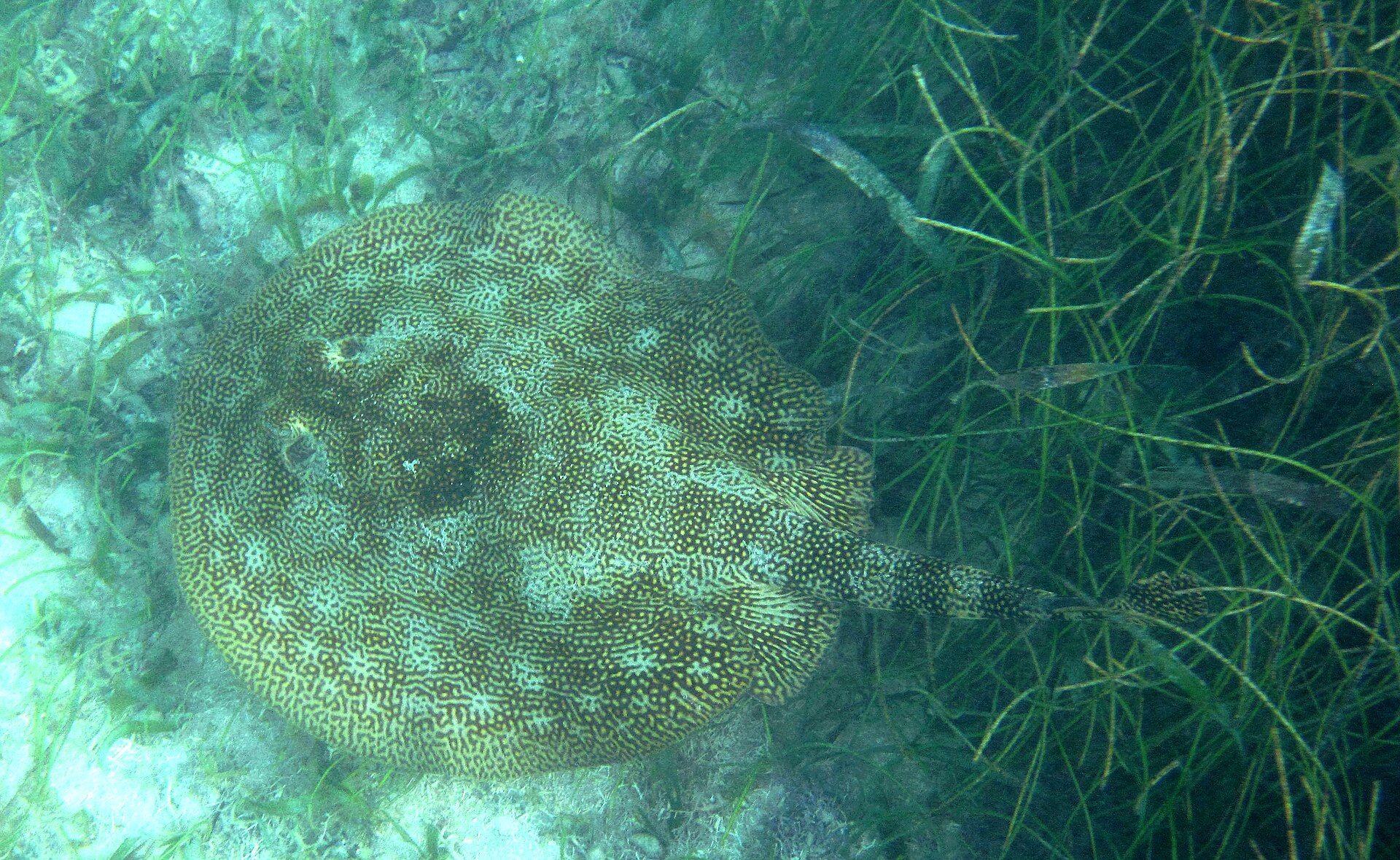
The yellow stingray is a dinner-plate ray patterned like sunlit sand, and it is easy to look straight at one without seeing it. The round disc carries either a dark green or brown network on a pale ground or a dense spray of tiny white, yellow and golden spots on a dark ground, and the short tail ends in a true caudal fin with a serrated venomous spine just ahead of it. It spends much of its time buried in sand or mud. It has a neat hunting trick: lifting the front edge of the disc to make a patch of shade, where small fish and shrimp take shelter within reach. Females give birth to litters of three or four live young after a mating in which the male grips the female's disc with his teeth. FishBase rates it easily approached. REEF divers logged it on 39% of survey dives around Cozumel in late 2024, far more often than elsewhere.
Where and when to see one
"Resident" means most dives at that destination encounter them; "seasonal" means reliably present in the listed months; anything else is a bonus, not a plan.
| Destination | Reliability | Months | Notes |
|---|---|---|---|
| CozumelMexico | Occasional | Year-round | |
| Belize Barrier ReefBelize | Occasional | Year-round | |
| Florida KeysUnited States | Rare | Year-round | |
| Little CaymanCayman Islands | Rare | Year-round |
Best month, at a glance
| Month | Reliable destinations |
|---|---|
| January | Cozumel · Belize Barrier Reef · Florida Keys · Little Cayman |
| February | Cozumel · Belize Barrier Reef · Florida Keys · Little Cayman |
| March | Cozumel · Belize Barrier Reef · Florida Keys · Little Cayman |
| April | Cozumel · Belize Barrier Reef · Florida Keys · Little Cayman |
| May | Cozumel · Belize Barrier Reef · Florida Keys · Little Cayman |
| June | Cozumel · Belize Barrier Reef · Florida Keys · Little Cayman |
| July | Cozumel · Belize Barrier Reef · Florida Keys · Little Cayman |
| August | Cozumel · Belize Barrier Reef · Florida Keys · Little Cayman |
| September | Cozumel · Belize Barrier Reef · Florida Keys · Little Cayman |
| October | Cozumel · Belize Barrier Reef · Florida Keys · Little Cayman |
| November | Cozumel · Belize Barrier Reef · Florida Keys · Little Cayman |
| December | Cozumel · Belize Barrier Reef · Florida Keys · Little Cayman |
Understanding them
Habitat: Shallow sand, mud and seagrass, often buried in the sediment, and especially sandy patches in and around coral reefs; ranges from the water's edge on sandy beaches to about 25 m.
Range: Western Atlantic from North Carolina through Florida and the Gulf of Mexico, the Bahamas, Yucatán and the Caribbean to northern South America.
Behavior: Rests buried or half-buried in sand, and sometimes lifts the front of its disc to make a patch of shade that lures small prey looking for shelter. Easily approached.
Diet: Shrimps and other small crustaceans, probably also small fishes, clams and worms.
Size: typically around 25 cm; documented up to 35 cm (disc width; the Florida Museum gives a maximum disc width of about 35 cm and total length to 66 cm (FishBase: 76 cm); the typical figure is the middle of the 20 to 35 cm range in Florent's Guide).
How to behave around one
Look before you kneel or put a hand on the sand, and shuffle your feet when wading. Don't uncover, chase or lift buried rays, and keep fin wash off them.
Conservation
Least Concern on the IUCN Red List (2020 assessment). It is taken in some fisheries and kept in public aquariums.
Charted sites known for them
Highlighted sites were charted for this species by our editors; numbers are GBIF occurrence records logged within about 5 km of a site since 1990.
Recently recorded near our dive sites
132 verified records within 5 to 10 km of 38 of our dive sites over the last 12 months (17 Nov 2025 to 16 Nov 2026), 5 of them in the last 30 days. Latest: 1 Nov 2026, near Cave of the Sleeping Sharks, by Christian Verde ↗ (iNaturalist, CC BY-NC).
Most records near
Research-grade iNaturalist observations shared under CC0, CC BY or CC BY-NC, plus human sightings from GBIF and OBIS datasets under the same licences, within 5 km of a site with a sourced position or 10 km of an approximate one. A record near two sites counts once in the total and once on each site. Each site page credits the observers and datasets behind its records. How these are collected →
Watch
From the official channels
Catch this wave 🌊 | #montereybayaquarium #reeflife

Giant Pacific Octopus

Live African Penguin Cam After Hours | Monterey Bay Aquarium
Videos are embedded links to their creators' own channels. We host nothing and credit everything.