Reef Fish
Zebra Moray
Gymnomuraena zebra · Bony fish, family Muraenidae (moray eels)
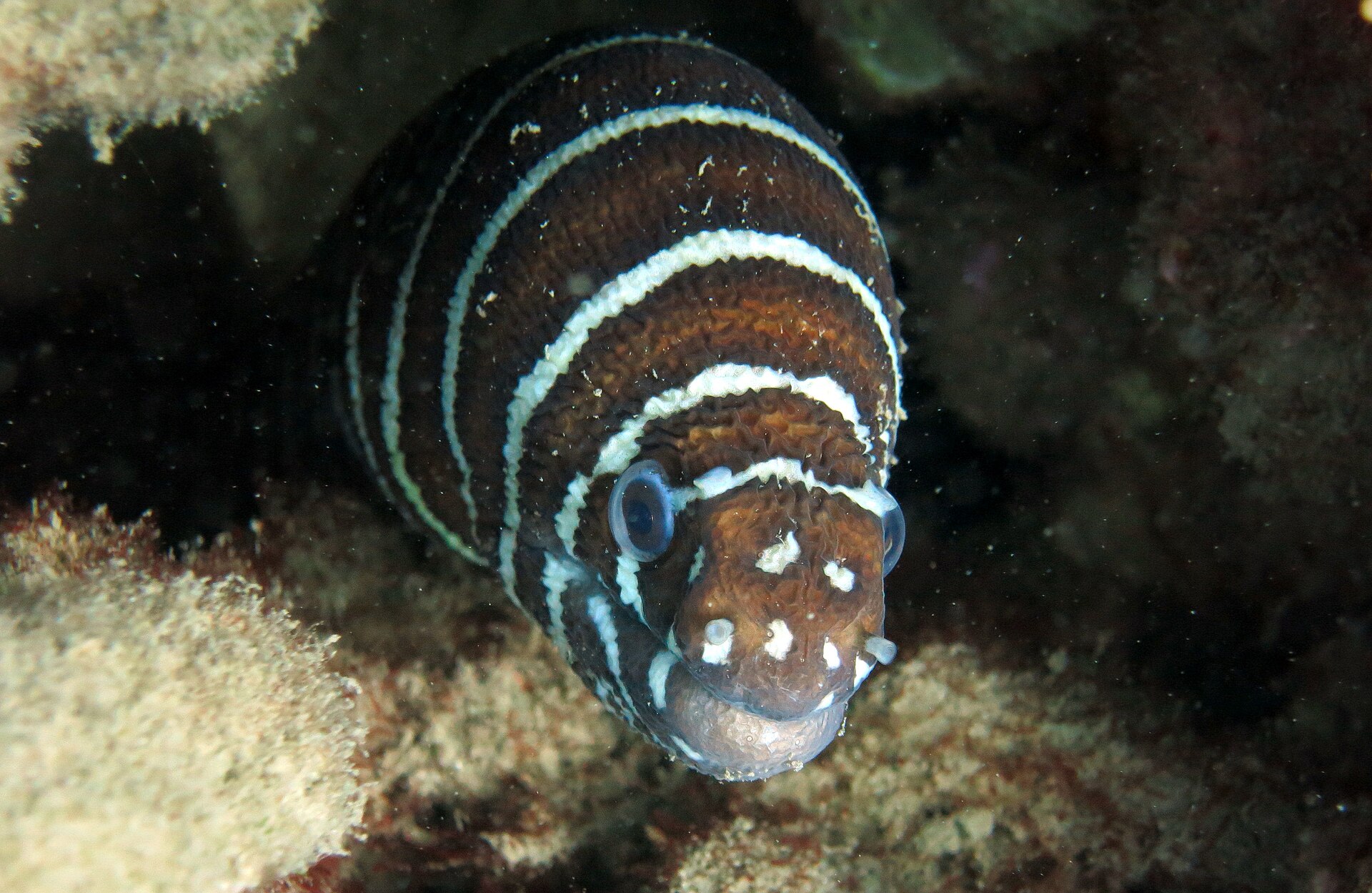
Most morays have fangs; the zebra moray has a mouth full of pebbles. Its jaws carry close-set, rounded teeth built for crushing, and its diet shows why: mostly xanthid crabs, plus other crustaceans, mollusks and sea urchins. The body is deep blackish brown ringed with many narrow pale bands, a pattern Reef Life Survey calls distinctive, and it can reach 1.5 m, although most seen are about 50 cm. It is secretive, living in crevices, ledges and holes on exposed reef flats and seaward reefs, so a sighting is usually a banded head or a coil glimpsed under a ledge. Reef Life Survey records it at fewer than 2 percent of the sites it surveys, which makes each encounter a small find. It ranges from the Red Sea to Hawaii and across to the Pacific coast of the Americas.
Where and when to see one
"Resident" means most dives at that destination encounter them; "seasonal" means reliably present in the listed months; anything else is a bonus, not a plan.
| Destination | Reliability | Months | Notes |
|---|---|---|---|
| Kona, HawaiʻiUnited States | Occasional | Year-round | |
| AnilaoPhilippines | Occasional | Year-round | |
| Ari AtollMaldives | Occasional | Year-round | |
| Sea of Cortez & Cabo PulmoMexico | Occasional | Year-round | |
| OʻahuUnited States | Occasional | Year-round | |
| Maui & MolokiniUnited States | Occasional | Year-round | |
| SeychellesSeychelles | Occasional | Year-round |
Best month, at a glance
Understanding them
Habitat: Crevices, ledges and holes on exposed reef flats and seaward reefs, over sandy and rocky bottoms. Recorded from about 1 to 50 m.
Range: Indo-Pacific from the Red Sea, East Africa and the Persian Gulf to the Society Islands, north to the Ryukyu and Hawaiian islands and south to the Great Barrier Reef; also the eastern Pacific from southern Baja California and from Guatemala to Colombia, including the Galapagos.
Behavior: Secretive; usually seen as a banded head or a coil of body inside a crevice or under a ledge. It may change sex from female to male, but this is unconfirmed.
Diet: Mainly xanthid crabs, plus other crustaceans, mollusks and sea urchins, crushed with close-set, pebble-like teeth.
Size: typically around 50 cm; documented up to 1.5 m (total length; commonly about 50 cm, with a recorded maximum of 1.5 m).
How to behave around one
Look into crevices, never reach into them, and do not feed morays. Keep your light off its face for long and leave it a clear way back into the reef.
Conservation
Least Concern on the IUCN Red List (2019 assessment). Widespread across the Indo-Pacific and eastern Pacific; our sources name no specific threats.
Charted sites known for them
Highlighted sites were charted for this species by our editors; numbers are GBIF occurrence records logged within about 5 km of a site since 1990.
Recently recorded near our dive sites
47 verified records within 5 to 10 km of 59 of our dive sites over the last 12 months (17 Nov 2025 to 16 Nov 2026), 4 of them in the last 30 days. Latest: 3 Nov 2026, near Fang Ming Wreck, by Jean-Paul Boerekamps ↗ (iNaturalist, CC0).
Most records near
Research-grade iNaturalist observations shared under CC0, CC BY or CC BY-NC, plus human sightings from GBIF and OBIS datasets under the same licences, within 5 km of a site with a sourced position or 10 km of an approximate one. A record near two sites counts once in the total and once on each site. Each site page credits the observers and datasets behind its records. How these are collected →
Watch
From the official channels

Catch this wave 🌊 | #montereybayaquarium #reeflife

Giant Pacific Octopus

Live African Penguin Cam After Hours | Monterey Bay Aquarium
Videos are embedded links to their creators' own channels. We host nothing and credit everything.