Eillon
Depth is the range from the top of the site to its usual maximum; "recommended cert" is the mainstream-agency level operators usually ask for, not a legal rule. Currents and visibility change daily, so treat everything here as planning ranges.
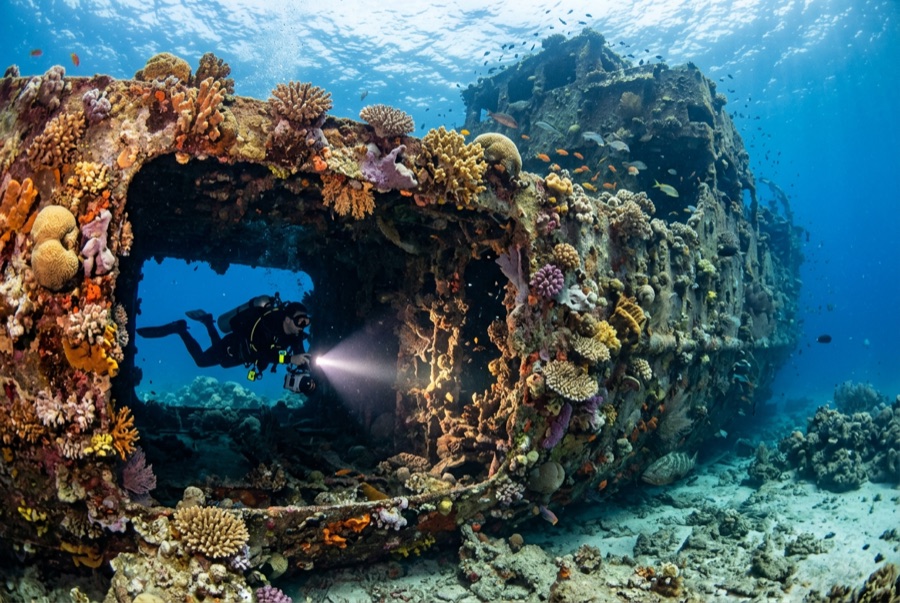
Eillon spent her last working years as a drug-running vessel; after she was seized she sat tied up in the Bridgetown careenage for about six years before being sunk in Carlisle Bay on 8 June 1996. At roughly 33 m she is the second-largest hull in the bay and among the deepest, lying tilted on the sand at 16 to 17 m. Her open interior is easy to enter, and in the bow a pocket of trapped air at about 7.5 m is roomy enough for two divers to put their heads up together. Keep breathing from the regulator there, because trapped air is not fit to breathe. She suits newer divers on a guided tour, and her interior keeps experienced divers busy too.
The moment you come for: Seized drug boat sunk in 1996; easy interior swim-throughs; trapped air pocket in the bow
Topography: Tilted steel vessel on sand at the deeper edge of the bay
Entry: Part of the Carlisle Bay wreck trail, reached by dive boat or by a longer swim from the beach.
Know before you splash
Hazards: Overhead environment inside the hull; do not breathe the air in the bow pocket; boat traffic in Carlisle Bay.
Conservation: Carlisle Bay is a protected area, designated to preserve its marine life and six major wrecks, and is managed by the Coastal Zone Management Unit.