Split Rock
Depth is the range from the top of the site to its usual maximum; "recommended cert" is the mainstream-agency level operators usually ask for, not a legal rule. Currents and visibility change daily, so treat everything here as planning ranges.
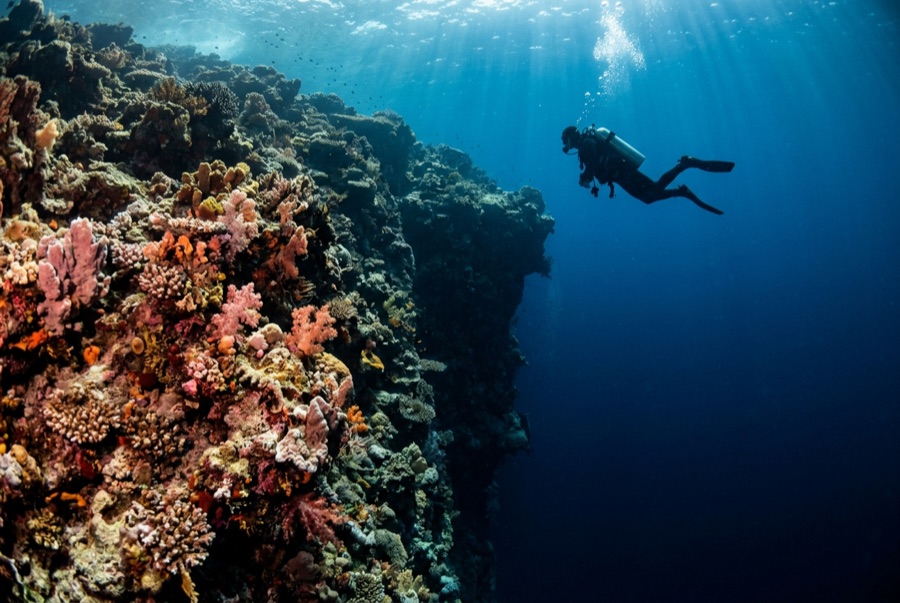
A narrow canyon that looks gouged through solid rock splits the reef here, and dropping through it is the usual way onto this North Side wall. Heading east leads to a ledge thick with black coral, back-lit at sunrise and well lit for photographers in the afternoon. West of the mooring several headlands jut from the wall, each with black coral on its western face, and the slight current around the points sets the coral polyps feeding. Brain and tubulate sponges deeper down often host brittle stars, and swim-throughs cut the wall in many places. Boats moor at about 17 m.
The moment you come for: Canyon entry through split rock; black coral ledges and headlands; brittle stars in deep sponges
Topography: Wall split by a narrow canyon, with headlands and black coral ledges
Current: A little current is common around each headland.
Entry: North coast mooring in the Queen's Highway zone, about 25 minutes by boat from the southeast docks.
Know before you splash
Hazards: Mild current around the headlands; the wall drops far past 30 m beside the black coral ledges.
Conservation: The public mooring lies in a Marine Reserve zone of the Cayman marine parks.
Marine forecast, next 5 days
Model forecast for the open sea near the site, for daytime hours (6 am to 6 pm local). It says nothing about visibility or marine life. Sea surface now: 29 °C / 85 °F (NOAA OISST satellite analysis, 18 Nov)
| Day | Surface | Waves (highest) | Swell | Wind |
|---|---|---|---|---|
| Wed 25 Nov | Slight | 0.8 m / 3 ft7 s · from SE · slight | 0.8 m7 s · from ESE | 11–12 ktfrom S · moderate breeze (F4) |
| Thu 26 Nov | Slight | 0.8 m / 2 ft8 s · from SE · slight | 0.7 m8 s · from SE | 6–9 ktfrom NNW · gentle breeze (F3) |
| Fri 27 Nov | Choppy | 1.4 m / 4 ft5 s · from E · moderate | 0.6 m8 s · from SE | 12–14 ktfrom NE · moderate breeze (F4) |
| Sat 28 Nov | Choppy | 1.3 m / 4 ft5 s · from ENE · moderate | 0.7 m8 s · from SE | 14–16 ktfrom ENE · fresh breeze (F5) |
| Sun 29 Nov | Slight | 0.8 m / 3 ft8 s · from SE · slight | 0.7 m8 s · from SE | 12–14 ktfrom E · moderate breeze (F4) |
Waves and swell: WAVEWATCH III global wave model (0.5°), run by the University of Hawaiʻi / PacIOOS with NOAA GFS winds; model cell 19.6 km from the site; heights are the highest daytime significant wave height, directions are where the waves come from. Wind: NOAA GFS (0.5°), 10 m wind, daytime average to highest, at a grid point 19.6 km from the site; gusts are stronger. Fetched 24 Nov 2026, 05:49 UTC from the latest model runs served by PacIOOS, refreshed daily. PacIOOS WW3 ↗ PacIOOS GFS ↗ How this is made →
Month by month at this site
Sea temperature, plankton and open-sea waves for each month, computed for this site from satellite and ocean-model data and averaged over recent years.
| Month | Sea surface | Plankton | Open-sea waves |
|---|---|---|---|
| JanuaryEditors' best month | 27 °C / 81 °F27–28 °C | 0.11 mg/m³More plankton | 0.7–2.5 m2–8 ft · moderate |
| FebruaryEditors' best month | 27 °C / 81 °F | 0.09 mg/m³More plankton | 0.8–1.8 m3–6 ft · moderate |
| MarchEditors' best month | 27 °C / 81 °F27–28 °C | 0.073 mg/m³ | 0.6–1.9 m2–6 ft · slight |
| AprilEditors' best month | 28 °C / 82 °F27–29 °C | 0.063 mg/m³Less plankton | 0.5–1.7 m2–6 ft · slight |
| MayEditors' best month | 29 °C / 84 °F28–29 °C | 0.062 mg/m³Less plankton | 0.5–1.6 m2–5 ft · slight |
| June | 29 °C / 84 °F28–30 °C | 0.077 mg/m³ | 0.8–1.7 m2–6 ft · slight |
| July | 30 °C / 85 °F29–30 °C | 0.068 mg/m³ | 0.8–1.5 m2–5 ft · slight |
| August | 30 °C / 86 °F30–31 °C | 0.065 mg/m³Less plankton | 0.5–1.4 m2–4 ft · slight |
| September | 30 °C / 86 °F30–31 °C | 0.06 mg/m³Less plankton | 0.3–1.2 m1–4 ft · slight |
| October | 30 °C / 86 °F29–31 °C | 0.074 mg/m³ | 0.4–1.8 m1–6 ft · slight |
| November | 29 °C / 84 °F | 0.096 mg/m³More plankton | 0.6–1.8 m2–6 ft · slight |
| DecemberEditors' best month | 28 °C / 83 °F28–29 °C | 0.11 mg/m³More plankton | 0.8–2.2 m3–7 ft · moderate |
Sea surface temperature: NOAA OISST v2.1 monthly means, 2016–2025 (NOAA NCEI, served by NOAA PSL), from a 25 km grid cell 2.2 km from the site. Large figure: the ten-year average for that month; small figure: its coolest and warmest year. NOAA PSL ↗
Plankton: chlorophyll-a from the NOAA S-NPP VIIRS satellite, 4 km monthly, 2016–2025 (NOAA STAR / CoastWatch): the median of the years with a clear view, from a pixel 7.9 km away over water at least 30 m deep (depth from NOAA ETOPO1), because over shallow reef and sand the seabed makes the satellite read too high. More plankton usually means greener, less clear water; suspended sediment (near river mouths and shallow banks) can push the reading up too, so treat a high value as a sign of murkier water rather than a plankton count. "Less" and "more plankton" mark the third of months at either end of this site's own year; they appear only where the greenest month has at least 1.5 times the chlorophyll of the clearest. NOAA CoastWatch ↗
Open-sea waves: significant wave height from the WAVEWATCH III global wave model (0.5°), run by the University of Hawaiʻi / PacIOOS with NOAA GFS winds, 2017–2025, at a model cell 19.6 km from the site. The range covers the middle 80% of days (10th to 90th percentile); the word is the WMO sea-state term for a typical day. PacIOOS ↗
A dash means too few years of data for that month (cloud, winter darkness or sea ice): we leave it empty rather than estimate it. How these are computed →
Coral heat stress this week
Degree Heating Weeks add up how far and how long the sea has run at least 1 °C above its usual warmest-month temperature over the past 12 weeks; NOAA Coral Reef Watch puts the risk of reef-wide bleaching at 4 °C-weeks and of heat-sensitive corals dying at 8. Reading from a 5 km satellite pixel 2.2 km from the site, refreshed weekly. Source: NOAA Coral Reef Watch, daily global 5 km product, version 3.1. NOAA Coral Reef Watch ↗