Lone Tree Arch
Depth is the range from the top of the site to its usual maximum; "recommended cert" is the mainstream-agency level operators usually ask for, not a legal rule. Currents and visibility change daily, so treat everything here as planning ranges.
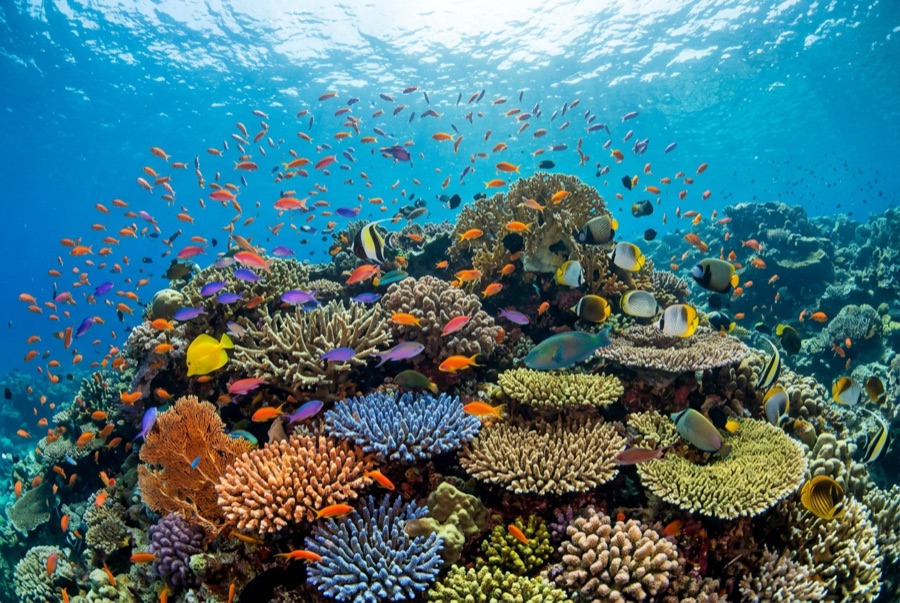
Lone Tree Arch takes its name from a single tree, the southernmost in the row along the beach inside Wawahiwaa Point, which stands a little apart from the rest and makes a handy shore mark. The true landmark is underwater: a big rock arch about 21 m northeast of the buoy, so prominent that from the surface it looks like a large submerged finger of rock, which is why some divers simply call the site Big Arch. Coral and boulders are scattered across the bottom around the mooring in about 12 m, and fish are plentiful. Closer to shore there is also a cavern whose roof is opened up by large skylights.
The moment you come for: Big rock arch near the mooring; cavern lit by large skylights; plentiful reef fish
Topography: Scattered coral and boulders, a large rock arch and a skylit cavern near shore
Entry: Moored boat dive inside the south face of Wawahiwaa Point, about 3.2 km north of Honokohau Harbor, off the southernmost tree in the line along the beach; the buoy is in about 12 m.
Know before you splash
Hazards: The inshore cavern is an overhead space; surge near the shoreline.
Conservation: Inside the Kona Coast Fisheries Management Area, where collecting and feeding fish are prohibited.
Marine forecast, next 6 days
Model forecast for the open sea near the site, for daytime hours (6 am to 6 pm local). It says nothing about visibility or marine life. Sea surface now: 27 °C / 80 °F (NOAA OISST satellite analysis, 18 Nov)
| Day | Surface | Waves (highest) | Swell | Wind |
|---|---|---|---|---|
| Tue 24 Nov | Slight | 0.8 m / 3 ft14 s · from W · slight | 0.5 m14 s · from W | 5–7 ktfrom WNW · gentle breeze (F3) |
| Wed 25 Nov | Slight | 1.0 m / 3 ft14 s · from NW · slight | 0.9 m14 s · from NW | 4–6 ktfrom WSW · light breeze (F2) |
| Thu 26 Nov | Choppy | 2.0 m / 7 ft16 s · from NW · moderate | 1.4 m10 s · from NW | 13–18 ktfrom NNW · fresh breeze (F5) |
| Fri 27 Nov | Choppy | 1.8 m / 6 ft13 s · from NW · moderate | 1.5 m13 s · from NW | 3–6 ktfrom W · light breeze (F2) |
| Sat 28 Nov | Slight | 1.1 m / 4 ft12 s · from NNW · slight | 0.7 m12 s · from NNW | 3–5 ktfrom WNW · light breeze (F2) |
| Sun 29 Nov | Slight | 0.9 m / 3 ft14 s · from SSW · slight | 0.6 m11 s · from NNE | 4–5 ktfrom WNW · light breeze (F2) |
Waves and swell: WAVEWATCH III global wave model (0.5°), run by the University of Hawaiʻi / PacIOOS with NOAA GFS winds; model cell 21.7 km from the site; heights are the highest daytime significant wave height, directions are where the waves come from. Wind: NOAA GFS (0.5°), 10 m wind, daytime average to highest, at a grid point 21.7 km from the site; gusts are stronger. Fetched 24 Nov 2026, 05:49 UTC from the latest model runs served by PacIOOS, refreshed daily. PacIOOS WW3 ↗ PacIOOS GFS ↗ How this is made →
Month by month at this site
Sea temperature, plankton and open-sea waves for each month, computed for this site from satellite and ocean-model data and averaged over recent years.
| Month | Sea surface | Plankton | Open-sea waves |
|---|---|---|---|
| January | 25 °C / 78 °F25–26 °C | 0.061 mg/m³ | 0.8–1.7 m3–6 ft · slight |
| February | 25 °C / 77 °F25–26 °C | 0.047 mg/m³ | 0.8–1.7 m3–6 ft · slight |
| March | 25 °C / 77 °F25–26 °C | 0.054 mg/m³ | 0.8–1.2 m2–4 ft · slight |
| AprilEditors' best month | 26 °C / 78 °F25–26 °C | 0.047 mg/m³ | 0.7–1.1 m2–4 ft · slight |
| MayEditors' best month | 26 °C / 79 °F26–27 °C | 0.049 mg/m³ | 0.7–1.1 m2–4 ft · slight |
| JuneEditors' best month | 27 °C / 80 °F26–27 °C | 0.051 mg/m³ | 0.6–1.1 m2–4 ft · slight |
| JulyEditors' best month | 27 °C / 81 °F27–28 °C | 0.044 mg/m³ | 0.6–1.0 m2–3 ft · slight |
| AugustEditors' best month | 27 °C / 81 °F27–28 °C | 0.05 mg/m³ | 0.6–1.1 m2–4 ft · slight |
| SeptemberEditors' best month | 28 °C / 82 °F27–29 °C | 0.059 mg/m³ | 0.7–1.0 m2–3 ft · slight |
| OctoberEditors' best month | 28 °C / 82 °F26–28 °C | 0.063 mg/m³ | 0.7–1.1 m2–4 ft · slight |
| November | 27 °C / 81 °F26–28 °C | 0.062 mg/m³ | 0.7–1.1 m2–4 ft · slight |
| December | 26 °C / 79 °F26–27 °C | 0.063 mg/m³ | 0.7–1.3 m2–4 ft · slight |
Sea surface temperature: NOAA OISST v2.1 monthly means, 2016–2025 (NOAA NCEI, served by NOAA PSL), from a 25 km grid cell 11.5 km from the site. Large figure: the ten-year average for that month; small figure: its coolest and warmest year. NOAA PSL ↗
Plankton: chlorophyll-a from the NOAA S-NPP VIIRS satellite, 4 km monthly, 2016–2025 (NOAA STAR / CoastWatch): the median of the years with a clear view, from a pixel 8.7 km away over water at least 30 m deep (depth from NOAA ETOPO1), because over shallow reef and sand the seabed makes the satellite read too high. More plankton usually means greener, less clear water; suspended sediment (near river mouths and shallow banks) can push the reading up too, so treat a high value as a sign of murkier water rather than a plankton count. Plankton changes little through the year here, so no month is flagged. NOAA CoastWatch ↗
Open-sea waves: significant wave height from the WAVEWATCH III global wave model (0.5°), run by the University of Hawaiʻi / PacIOOS with NOAA GFS winds, 2017–2025, at a model cell 21.7 km from the site. The range covers the middle 80% of days (10th to 90th percentile); the word is the WMO sea-state term for a typical day. PacIOOS ↗
A dash means too few years of data for that month (cloud, winter darkness or sea ice): we leave it empty rather than estimate it. How these are computed →
Coral heat stress this week
No bleaching heat stress. Degree Heating Weeks add up how far and how long the sea has run at least 1 °C above its usual warmest-month temperature over the past 12 weeks; NOAA Coral Reef Watch puts the risk of reef-wide bleaching at 4 °C-weeks and of heat-sensitive corals dying at 8. Reading from a 5 km satellite pixel 4.0 km from the site, refreshed weekly. Source: NOAA Coral Reef Watch, daily global 5 km product, version 3.1. NOAA Coral Reef Watch ↗