Reef Fish
Banggai Cardinalfish
Pterapogon kauderni · Bony fish, family Apogonidae (cardinalfishes); the only species in its genus
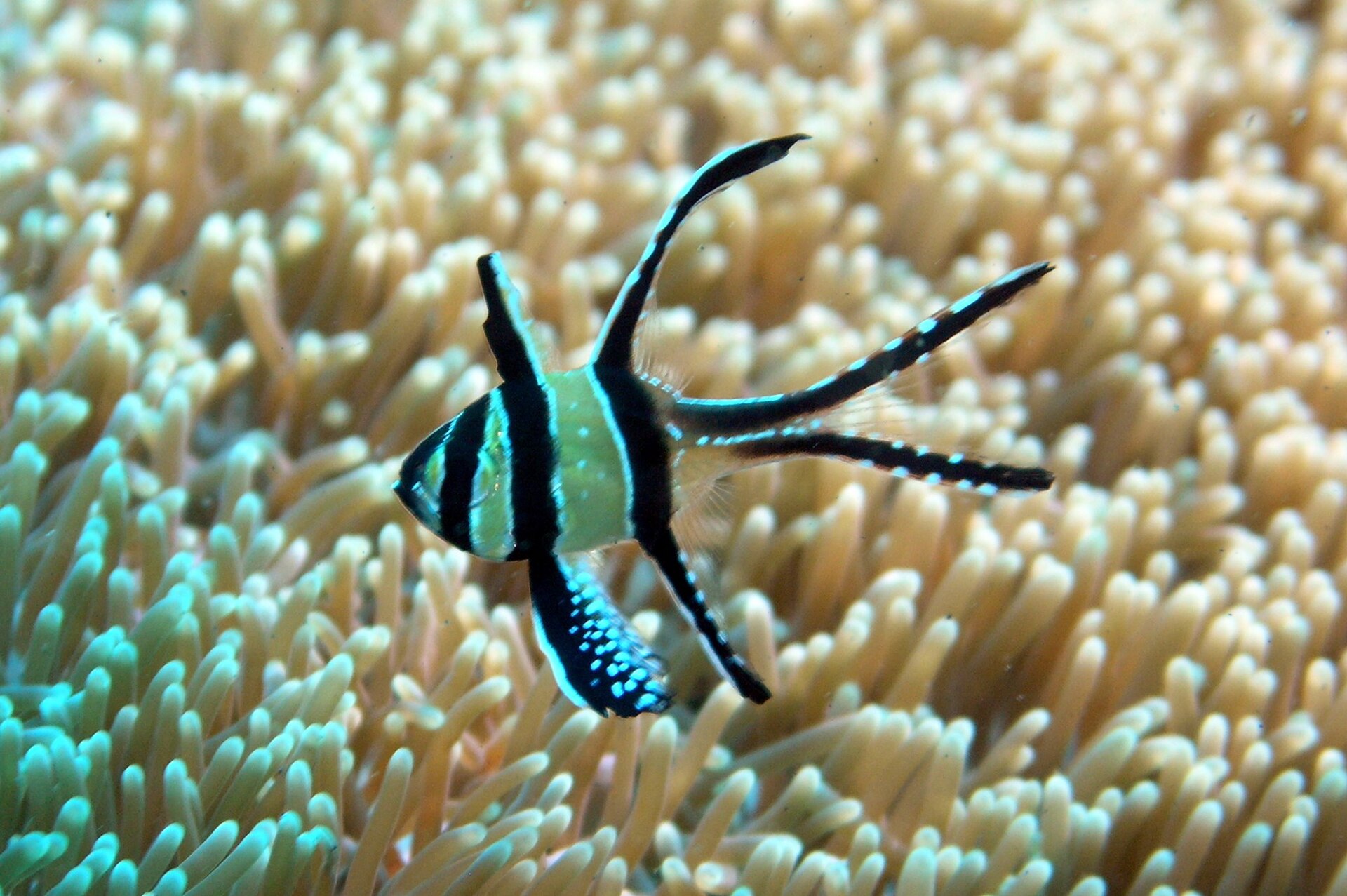
Few reef fish have a natural home as small as the Banggai cardinalfish: one island group off eastern Sulawesi, Indonesia. Bold black bars, a tasseled first dorsal fin, long trailing fin rays and white polka dots make it unmistakable, and that look made it an aquarium favorite, with hundreds of thousands exported each year in the early 2000s. Collection wiped out local populations on several islands, and it is now listed Endangered. Its biology made it vulnerable: males brood the eggs in their mouths and the young skip the drifting larval stage, so depleted groups are not restocked from elsewhere. Groups hover over long-spined urchins and anemones, retreating among the spines when threatened. The trade also spread it far beyond Banggai, and most divers now meet introduced fish, above all in Lembeh Strait, where traders released them around 2000, and in Bali's Gilimanuk Bay. Enjoy them, but they are no substitute for the wild stock: in Lembeh they are considered invasive.
Where and when to see one
"Resident" means most dives at that destination encounter them; "seasonal" means reliably present in the listed months; anything else is a bonus, not a plan.
| Destination | Reliability | Months | Notes |
|---|---|---|---|
| Lembeh StraitIndonesia | Resident: seen on most dives | Year-round | |
| Bali & Nusa PenidaIndonesia | Occasional | Year-round |
Best month, at a glance
| Month | Reliable destinations |
|---|---|
| January | Lembeh Strait · Bali & Nusa Penida |
| February | Lembeh Strait · Bali & Nusa Penida |
| March | Lembeh Strait · Bali & Nusa Penida |
| April | Lembeh Strait · Bali & Nusa Penida |
| May | Lembeh Strait · Bali & Nusa Penida |
| June | Lembeh Strait · Bali & Nusa Penida |
| July | Lembeh Strait · Bali & Nusa Penida |
| August | Lembeh Strait · Bali & Nusa Penida |
| September | Lembeh Strait · Bali & Nusa Penida |
| October | Lembeh Strait · Bali & Nusa Penida |
| November | Lembeh Strait · Bali & Nusa Penida |
| December | Lembeh Strait · Bali & Nusa Penida |
Understanding them
Habitat: Calm, shallow bays and reef flats with seagrass, sand and rubble, where groups shelter among long-spined sea urchins, sea anemones and branching corals. In its native islands it is most common at 1.5 to 2.5 m (FishBase records 0 to 16 m); in Lembeh Strait guides report it from 5 to 25 m.
Range: Native only to the Banggai Islands and a few nearby islets off eastern Sulawesi, Indonesia. The aquarium trade has introduced it to Lembeh Strait, Palu Bay, Kendari Bay, Gilimanuk Bay in Bali and other sites, all outside its natural range.
Behavior: Hovers in small, stable groups just above an urchin or anemone and slips among the spines or tentacles when threatened; unusually for a cardinalfish it is active by day. Males brood the eggs, and then the young, in an enlarged mouth.
Diet: Mainly copepods, plus other small planktonic and bottom-living animals.
Size: typically around 6 cm; documented up to 8.6 cm (total length; the 8.6 cm maximum is for a female; fish mature at about 4 cm, so 6 cm is a conservative figure for adults).
How to behave around one
Hover still and let the group settle back over its urchin or anemone; never prod the host to drive fish out, and keep strobe bursts short around brooding males. Do not collect fish, urchins or anemones, even from introduced populations.
Conservation
Endangered on the IUCN Red List (2025 assessment) and listed as Threatened under the US Endangered Species Act since 2016, because of collection for the aquarium trade and destructive fishing; local populations have disappeared from several islands. Captive-bred fish now dominate the trade, so wild-caught ones are never needed.
Watch
From the official channels

Catch this wave 🌊 | #montereybayaquarium #reeflife

Giant Pacific Octopus

Live African Penguin Cam After Hours | Monterey Bay Aquarium
Videos are embedded links to their creators' own channels. We host nothing and credit everything.