Reef Fish
Crocodilefish
Cymbacephalus beauforti · Bony fish, family Platycephalidae (flatheads); also called De Beaufort's flathead
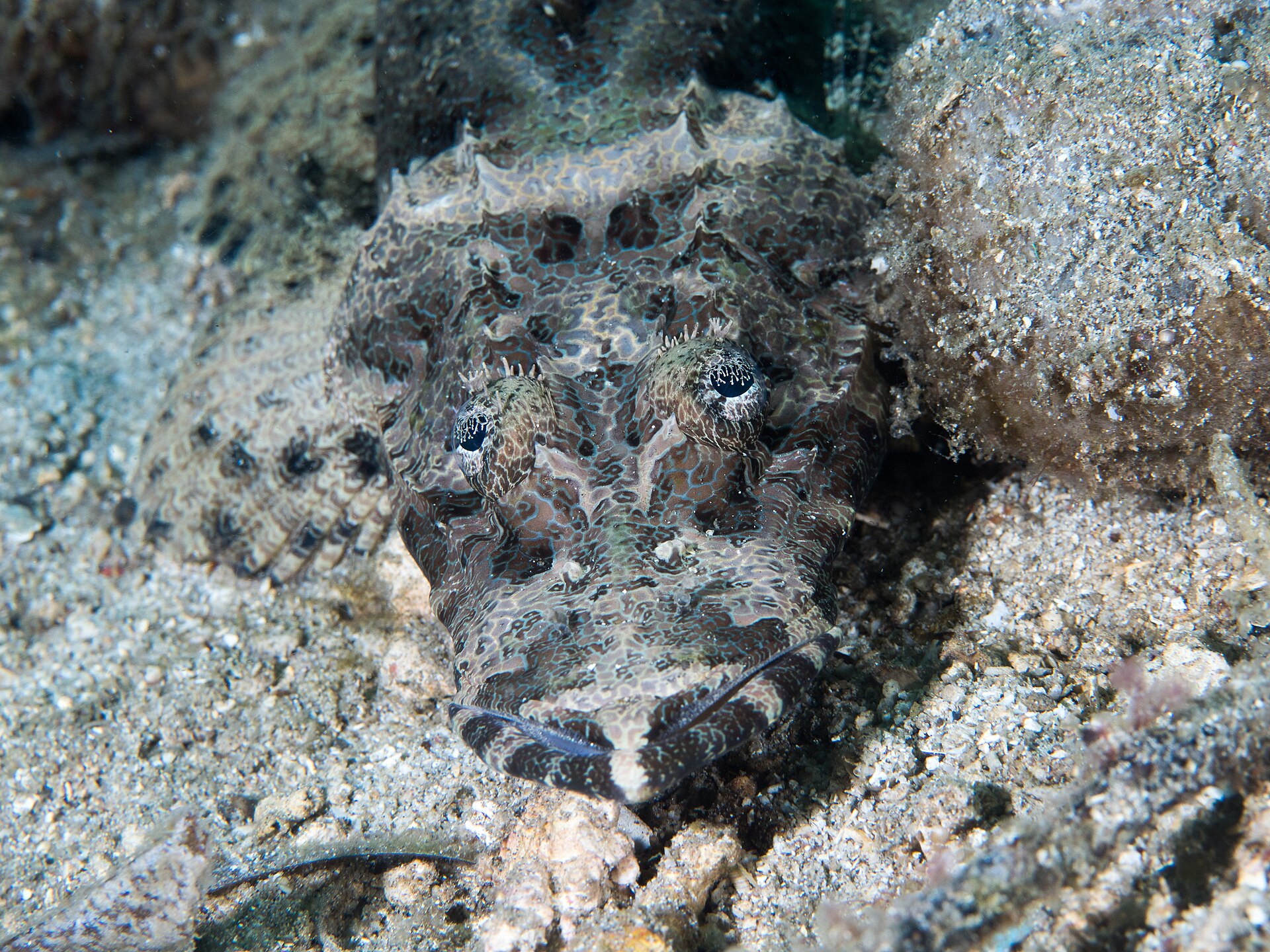
A crocodilefish looks like part of the seabed until you notice the eye, fringed with lacy flaps that hide the dark pupil. Those flaps, called iris lappets, break up the one feature that would otherwise give the fish away, while the broad, duck-billed head and long body are tiled in a mosaic of browns, grays and greens that matches sand, rubble and seagrass. Adults commonly reach about 35 cm and can grow to half a meter. It is an ambush predator of small fish and crustaceans, so its whole strategy is to lie still and wait, which also makes it one of the most cooperative large subjects on a muck dive. Juveniles start out almost black and only gradually take on the adult blotching. The species ranges across the western Pacific from the Philippines and Borneo to Papua New Guinea, Palau and New Caledonia. Look for it near reef edges, seagrass and mangroves, and watch from the side rather than from on top.
Where and when to see one
"Resident" means most dives at that destination encounter them; "seasonal" means reliably present in the listed months; anything else is a bonus, not a plan.
| Destination | Reliability | Months | Notes |
|---|---|---|---|
| Lembeh StraitIndonesia | Occasional | Year-round | |
| AnilaoPhilippines | Occasional | Year-round | |
| Bunaken & ManadoIndonesia | Occasional | Year-round |
Best month, at a glance
| Month | Reliable destinations |
|---|---|
| January | Lembeh Strait · Anilao · Bunaken & Manado |
| February | Lembeh Strait · Anilao · Bunaken & Manado |
| March | Lembeh Strait · Anilao · Bunaken & Manado |
| April | Lembeh Strait · Anilao · Bunaken & Manado |
| May | Lembeh Strait · Anilao · Bunaken & Manado |
| June | Lembeh Strait · Anilao · Bunaken & Manado |
| July | Lembeh Strait · Anilao · Bunaken & Manado |
| August | Lembeh Strait · Anilao · Bunaken & Manado |
| September | Lembeh Strait · Anilao · Bunaken & Manado |
| October | Lembeh Strait · Anilao · Bunaken & Manado |
| November | Lembeh Strait · Anilao · Bunaken & Manado |
| December | Lembeh Strait · Anilao · Bunaken & Manado |
Understanding them
Habitat: Sand and rubble bottoms of sheltered or semi-exposed reefs, often near seagrass, mangroves or coral. Recorded from about 1 m to at least 30 m, though many records are in the shallows.
Range: Western Pacific, from the Philippines, Borneo and the Moluccas east to Papua New Guinea, Palau, Yap and New Caledonia, north to Ishigaki in southern Japan and west to the Mentawai Islands off Sumatra.
Behavior: Lies flat on sand or rubble, relying on its mottled camouflage and fringed eye lappets, and snaps up fish and crustaceans that pass close to its wide mouth. Small juveniles are almost black and gradually change to the blotched adult pattern.
Diet: Small fishes and crustaceans, taken by ambush.
Size: typically around 35 cm; documented up to 50 cm (total length; FishBase gives 35 cm as the common length and 50 cm as the maximum).
How to behave around one
Approach slowly and settle beside it without touching the bottom; never nudge, lift or reposition it for a better angle, and go easy with lights and strobes on the eyes. If it swims off, it has been disturbed: let it go.
Conservation
Listed Least Concern by the IUCN (2016 assessment). Like other shallow muck species it depends on the sand, seagrass and mangrove-edge habitats closest to the coast.
Charted sites known for them
Highlighted sites were charted for this species by our editors; numbers are GBIF occurrence records logged within about 5 km of a site since 1990.
Recently recorded near our dive sites
32 verified records within 5 to 10 km of 32 of our dive sites over the last 12 months (17 Nov 2025 to 16 Nov 2026), 2 of them in the last 30 days. Latest: 3 Nov 2026, near Paradise 2 (Mabul), by 葫芦爷送娃娃 ↗ (iNaturalist, CC BY-NC).
Most records near
Research-grade iNaturalist observations shared under CC0, CC BY or CC BY-NC, plus human sightings from GBIF and OBIS datasets under the same licences, within 5 km of a site with a sourced position or 10 km of an approximate one. A record near two sites counts once in the total and once on each site. Each site page credits the observers and datasets behind its records. How these are collected →
Watch
From the official channels

Giant Pacific Octopus

Live African Penguin Cam After Hours | Monterey Bay Aquarium

African Penguin Cam After Hours | Monterey Bay Aquarium
Videos are embedded links to their creators' own channels. We host nothing and credit everything.