Cephalopods
Bobtail Squid
Euprymna spp. · Cephalopod mollusk, family Sepiolidae (bobtail squids); a genus-level record, because the muck-site animals dive guides call Euprymna berryi cannot be identified to species from photos
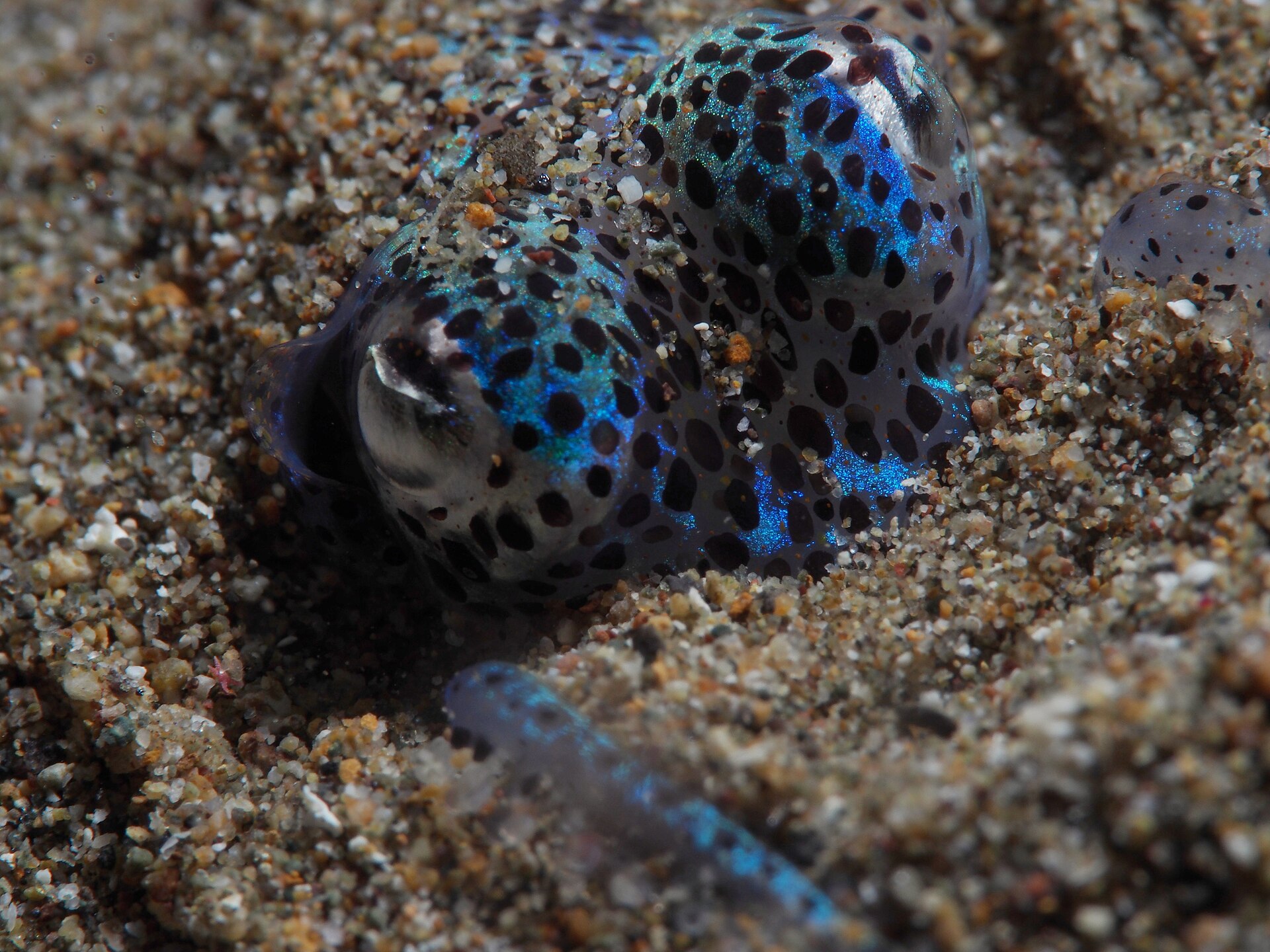
Bobtail squid are thumb-sized cephalopods that spend the day buried in sand and come out at night glittering with blue and green. Despite the name they are not true squid but sepiolids, a separate family related to both squid and cuttlefish, with a rounded mantle a few centimeters long and two small fins like ears. At night they hunt small crustaceans over the sand, and they carry a light organ colonized by luminous Vibrio bacteria that is thought to hide their silhouette from below. Disturbed, a bobtail digs in with its fins and pulls sand over its back with its arms, and a white torch beam is often enough to send it under. Guides at Lembeh, Anilao and Dauin call their animals Euprymna berryi, but that species is documented from China to Japan, and Euprymna species are told apart mainly by the enlarged suckers on males' arms, which no photo shows. This guide therefore treats them at genus level.
Where and when to see one
"Resident" means most dives at that destination encounter them; "seasonal" means reliably present in the listed months; anything else is a bonus, not a plan.
| Destination | Reliability | Months | Notes |
|---|---|---|---|
| Dumaguete, Dauin & Apo IslandPhilippines | Resident: seen on most dives | Year-round | |
| Lembeh StraitIndonesia | Occasional | Year-round | |
| AnilaoPhilippines | Occasional | Year-round |
Best month, at a glance
| Month | Reliable destinations |
|---|---|
| January | Dumaguete, Dauin & Apo Island · Lembeh Strait · Anilao |
| February | Dumaguete, Dauin & Apo Island · Lembeh Strait · Anilao |
| March | Dumaguete, Dauin & Apo Island · Lembeh Strait · Anilao |
| April | Dumaguete, Dauin & Apo Island · Lembeh Strait · Anilao |
| May | Dumaguete, Dauin & Apo Island · Lembeh Strait · Anilao |
| June | Dumaguete, Dauin & Apo Island · Lembeh Strait · Anilao |
| July | Dumaguete, Dauin & Apo Island · Lembeh Strait · Anilao |
| August | Dumaguete, Dauin & Apo Island · Lembeh Strait · Anilao |
| September | Dumaguete, Dauin & Apo Island · Lembeh Strait · Anilao |
| October | Dumaguete, Dauin & Apo Island · Lembeh Strait · Anilao |
| November | Dumaguete, Dauin & Apo Island · Lembeh Strait · Anilao |
| December | Dumaguete, Dauin & Apo Island · Lembeh Strait · Anilao |
Understanding them
Habitat: Sand, silt and fine rubble in shallow coastal water, buried by day and active on the bottom at night; E. berryi has been recorded to 107 m.
Range: Euprymna species live across the Indo-West Pacific. E. berryi itself is documented from China and Taiwan to Japan, while the similar E. morsei reaches the Philippines and Indonesia; which species live at each muck site is unresolved.
Behavior: Buries itself by day and emerges at night to hunt over the sand. Disturbed, it uses its fins to dig in and its arms to cover itself with sand grains, vanishing within seconds.
Diet: Mainly small bottom-living crustaceans.
Size: typically around 3 cm; documented up to 5 cm (mantle length; figures published for E. berryi, the name used locally: males to 3 cm, females to 5 cm).
How to behave around one
Use a red or dimmed light and keep the beam off its eyes; approach low and slowly without fanning sand, and never dig one up or push it out of the sediment for a better picture.
Conservation
No IUCN assessment covers the genus; E. berryi, the name used in dive guides, is listed Data Deficient (2012 assessment). Their shallow night habitat is easily damaged by careless finning.
Charted sites known for them
Highlighted sites were charted for this species by our editors; numbers are GBIF occurrence records logged within about 5 km of a site since 1990.
Recently recorded near our dive sites
44 verified records (any species in this group) within 5 to 10 km of 33 of our dive sites over the last 12 months (17 Nov 2025 to 16 Nov 2026), 4 of them in the last 30 days. Latest: 5 Nov 2026, near Twilight Zone (Laha), by Gregor Bailar ↗ (iNaturalist, CC BY).
Most records near
Research-grade iNaturalist observations shared under CC0, CC BY or CC BY-NC, plus human sightings from GBIF and OBIS datasets under the same licences, within 5 km of a site with a sourced position or 10 km of an approximate one. A record near two sites counts once in the total and once on each site. Each site page credits the observers and datasets behind its records. How these are collected →
Watch
From the official channels

Giant Pacific Octopus

Live African Penguin Cam After Hours | Monterey Bay Aquarium

African Penguin Cam After Hours | Monterey Bay Aquarium
Videos are embedded links to their creators' own channels. We host nothing and credit everything.