Cephalopods
Coconut Octopus
Amphioctopus marginatus · Cephalopod mollusk, family Octopodidae; described in 1964 as Octopus marginatus; also called the veined octopus
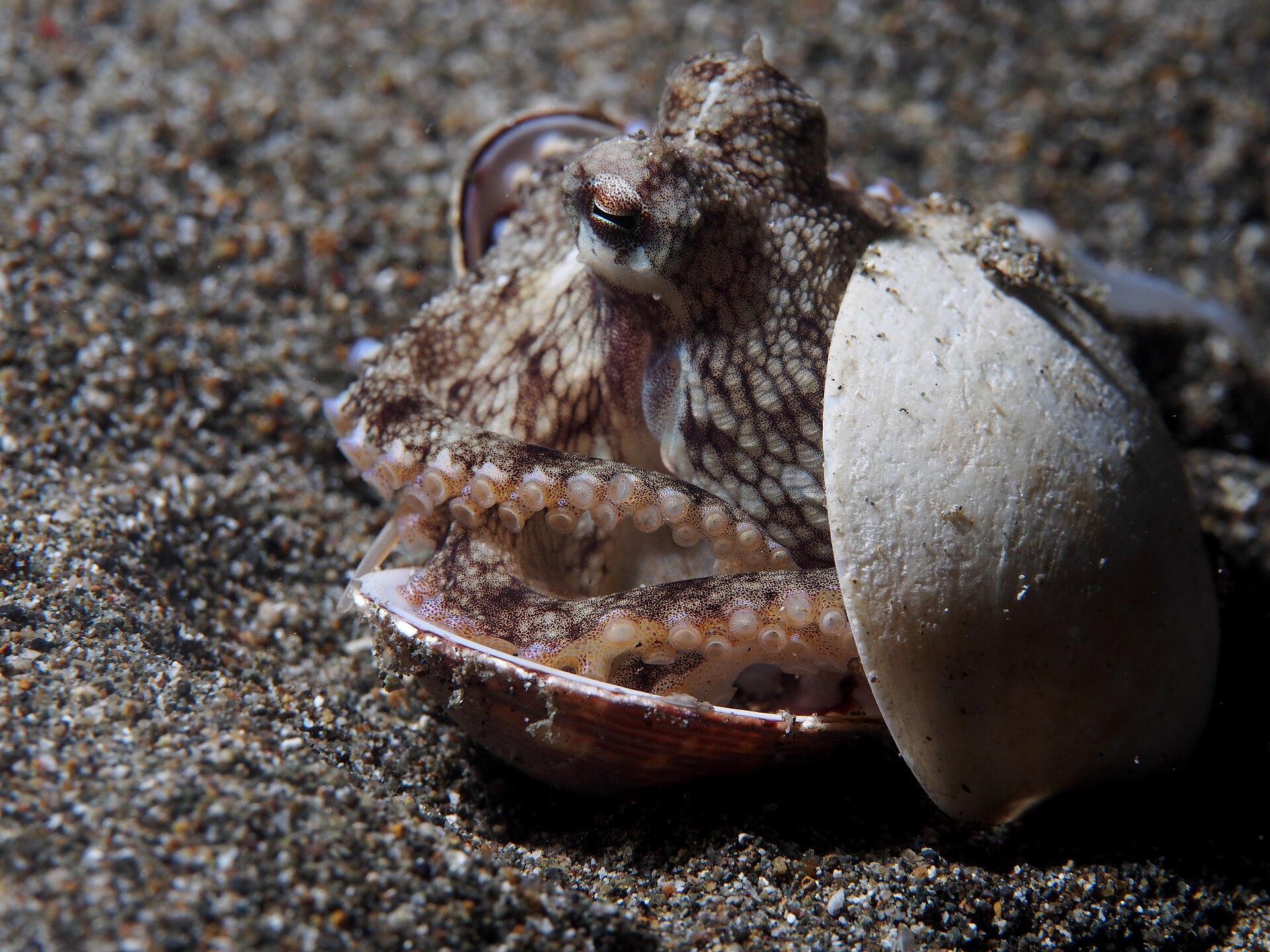
The coconut octopus carries its house with it: two halves of a coconut shell or clam, tucked beneath its body as it stilt-walks across the mud. When a threat appears or it stops to rest, it pulls the halves together and shuts itself inside like a portable bunker. Biologists working in Indonesia described this in 2009 as defensive tool use, arguing that hauling the shells is awkward and only pays off later, which made the species famous far beyond diving. It is also one of only two octopuses known to walk on two arms, first described off Sulawesi in 2005. Without coconuts it uses clam shells, bottles and other litter on sand and mud bottoms, and it hunts crabs and clams, mostly at night. Expect a mid-sized octopus with dark, vein-like lines over pale skin and contrasting white suckers. Never offer it a shell or bottle to stage a photo; the behavior worth seeing is the one it chooses.
Where and when to see one
"Resident" means most dives at that destination encounter them; "seasonal" means reliably present in the listed months; anything else is a bonus, not a plan.
| Destination | Reliability | Months | Notes |
|---|---|---|---|
| Bali & Nusa PenidaIndonesia | Occasional | Year-round | |
| Lembeh StraitIndonesia | Occasional | Year-round | |
| AnilaoPhilippines | Occasional | Year-round | |
| Dumaguete, Dauin & Apo IslandPhilippines | Occasional | Year-round |
Best month, at a glance
Understanding them
Habitat: Sand and mud bottoms with plenty of shells and debris to hide in, from the shallows to at least 190 m; divers usually meet it at 5 to 25 m.
Range: Tropical Indo-West Pacific, from the Indian Ocean to the western Pacific.
Behavior: By day it shelters in clam shells, coconut halves, bottles or cans, or buries itself; at night it forages in the open. It carries stacked shell halves beneath its body, walking on stiffened arms, and closes itself inside them when threatened; it can also walk on two arms while holding the other six up as a disguise.
Diet: Crustaceans such as box crabs (Calappa) and bivalves.
Size: typically around 20 cm; documented up to 30 cm (total length including arms; the mantle is typically 5 to 10 cm; animals in the 2009 coconut study had arms about 15 cm long and bodies about 8 cm wide).
How to behave around one
Never hand it a coconut, shell or bottle, lift its shelter, or tease it out for a picture; stay low over the sand without kicking up silt, and keep lights off its eyes when it peeks out. Leave occupied bottles and cans where they are.
Conservation
Least Concern on the IUCN Red List (2018 assessment). It lives in shallow coastal muck habitat, the kind most affected by development and runoff.
Charted sites known for them
Highlighted sites were charted for this species by our editors; numbers are GBIF occurrence records logged within about 5 km of a site since 1990.
Recently recorded near our dive sites
66 verified records within 5 to 10 km of 20 of our dive sites over the last 12 months (17 Nov 2025 to 16 Nov 2026), 4 of them in the last 30 days. Latest: 14 Nov 2026, near Blue Magic, by mbp349 ↗ (iNaturalist, CC BY-NC).
Most records near
Research-grade iNaturalist observations shared under CC0, CC BY or CC BY-NC, plus human sightings from GBIF and OBIS datasets under the same licences, within 5 km of a site with a sourced position or 10 km of an approximate one. A record near two sites counts once in the total and once on each site. Each site page credits the observers and datasets behind its records. How these are collected →
Watch
From the official channels

Catch this wave 🌊 | #montereybayaquarium #reeflife

Giant Pacific Octopus

Live African Penguin Cam After Hours | Monterey Bay Aquarium
Videos are embedded links to their creators' own channels. We host nothing and credit everything.