Cephalopods
Wonderpus Octopus
Wunderpus photogenicus · Cephalopod mollusk, family Octopodidae; described in 2006 in its own genus, Wunderpus
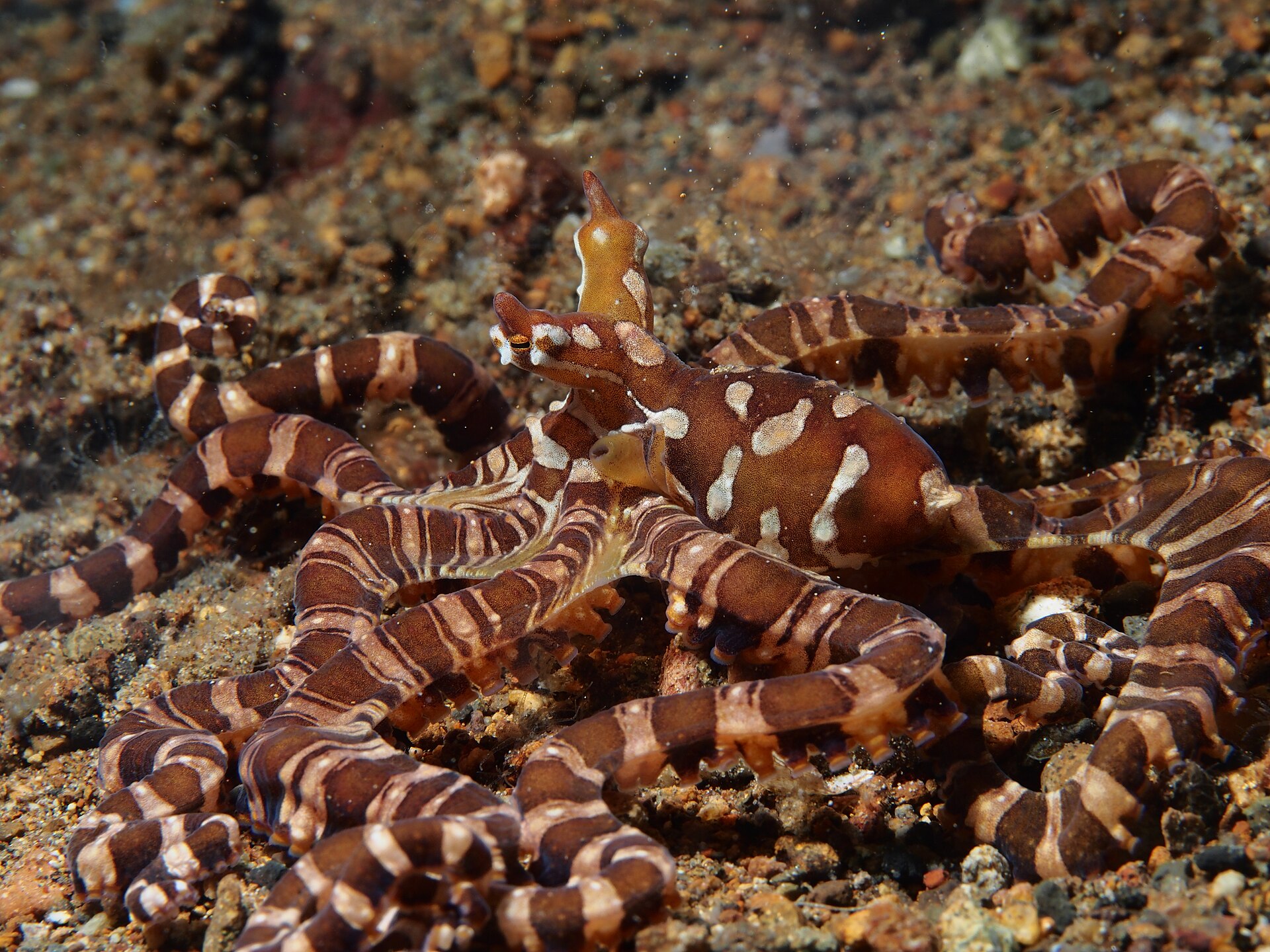
Photographers loved the wonderpus before science named it in 2006, and its species name, photogenicus, says so. It is a slender octopus, rusty brown with white spots and bands, with eyes raised on stalks and arms five to seven times the length of its small mantle. On soft sediment it spends much of the day in a burrow and comes out in the half-light of dusk and dawn, probing holes with single arms or casting its webbed arms over the sand like an umbrella to trap small fish and crabs. Telling it from the mimic octopus, which shares the same muck sites, is a classic briefing test: the wonderpus has a large round white spot at the tip of its mantle where the mimic has a U-shaped patch, a single long, blunt papilla over each eye, and relatively shorter arms. Every animal's white markings are unique, so photos can identify individuals, and researchers have asked divers to send theirs.
Where and when to see one
"Resident" means most dives at that destination encounter them; "seasonal" means reliably present in the listed months; anything else is a bonus, not a plan.
| Destination | Reliability | Months | Notes |
|---|---|---|---|
| Bali & Nusa PenidaIndonesia | Occasional | Year-round | |
| Lembeh StraitIndonesia | Occasional | Year-round | |
| AnilaoPhilippines | Occasional | Year-round | |
| Dumaguete, Dauin & Apo IslandPhilippines | Occasional | Year-round | |
| Milne BayPapua New Guinea | Rare | Year-round |
Best month, at a glance
Understanding them
Habitat: Sand, mud and rubble on sheltered soft-sediment slopes, living in burrows it digs or takes over from other animals; recorded from 0.5 m to at least 20 m.
Range: Indo-Malayan Archipelago: Indonesia and the Philippines east to Papua New Guinea, the Solomon Islands and Vanuatu, with records from Malaysian Borneo.
Behavior: Spends much of the day in a burrow, sometimes using the same one for weeks, and forages in the half-light of dusk and dawn, probing holes with single arms or throwing its web over the sand like a net. Long-armed octopuses foraging in the open in broad daylight are more likely to be mimic octopuses.
Diet: Small fishes and crabs, flushed from the sediment or trapped beneath its web.
Size: typically around 15 cm; documented up to 23 cm (total length including the long arms; the mantle is only 2 to 3.6 cm long, and specimens in the 2006 description measured about 13 to 23 cm).
How to behave around one
Never poke a pointer into its burrow or wiggle it in the sand to lure the animal out; wait at a distance with dimmed lights, stay off the bottom, and let it forage on its own schedule.
Conservation
Least Concern on the IUCN Red List (2019 assessment). It is sold as a costly aquarium species, while alive it has high value to dive tourism, notably in Bali and North Sulawesi.
Recently recorded near our dive sites
28 verified records within 5 to 10 km of 22 of our dive sites over the last 12 months (17 Nov 2025 to 16 Nov 2026), 1 of them in the last 30 days. Latest: 18 Oct 2026, near Nudi Falls, by mikejh ↗ (iNaturalist, CC BY-NC).
Most records near
Research-grade iNaturalist observations shared under CC0, CC BY or CC BY-NC, plus human sightings from GBIF and OBIS datasets under the same licences, within 5 km of a site with a sourced position or 10 km of an approximate one. A record near two sites counts once in the total and once on each site. Each site page credits the observers and datasets behind its records. How these are collected →
Watch
From the official channels
Catch this wave 🌊 | #montereybayaquarium #reeflife

Giant Pacific Octopus

Live African Penguin Cam After Hours | Monterey Bay Aquarium
Videos are embedded links to their creators' own channels. We host nothing and credit everything.