Reef Fish
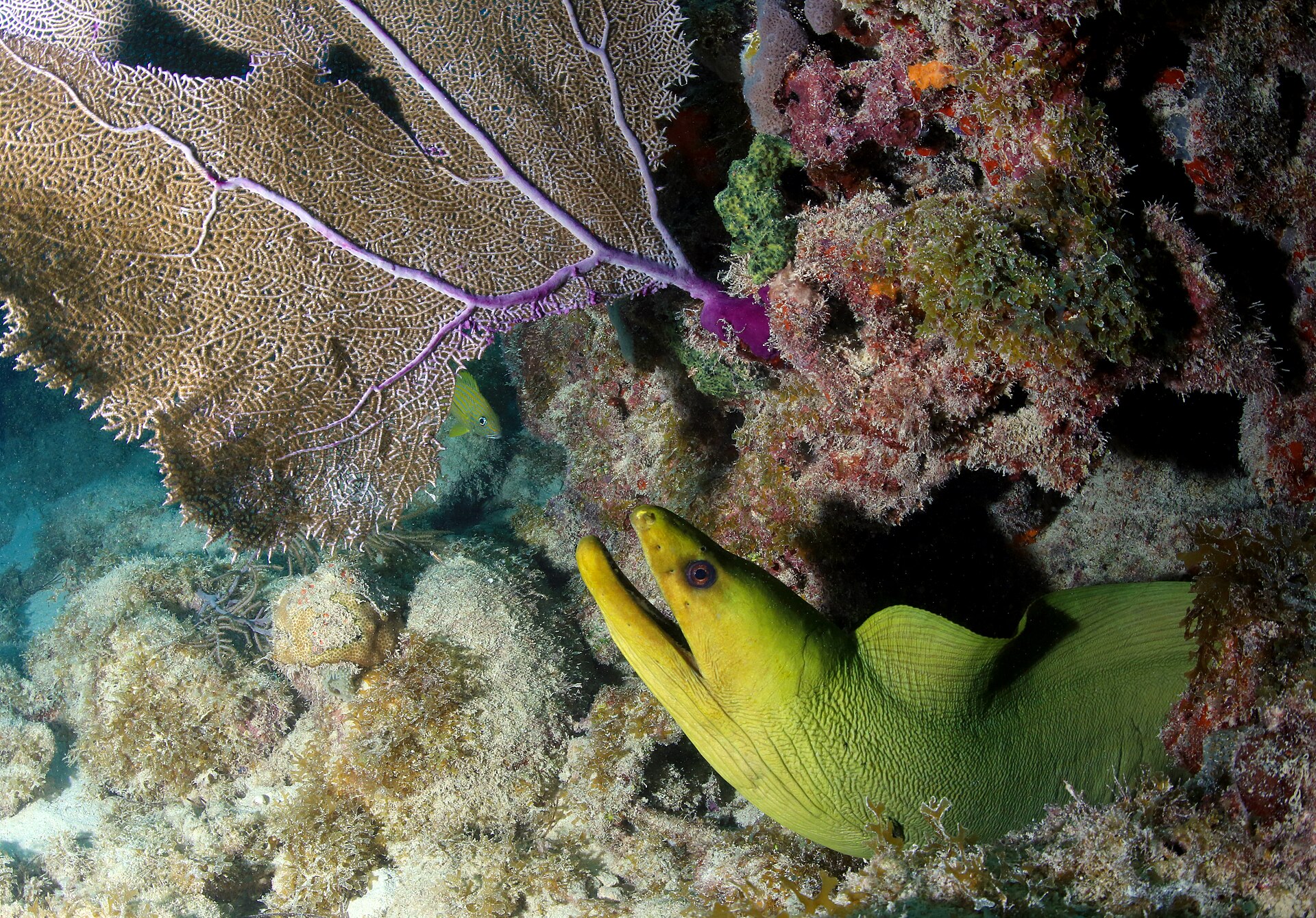
Green Moray
Gymnothorax funebris · Bony fish, family Muraenidae (moray eels)
The green moray is not really green: its skin is dark brown, and the color comes from a coat of yellowish mucus. That mucus protects it from parasites and disease. Underneath is one of the largest morays anywhere, reaching 2.5 m and 29 kg, a solid, muscular eel that by day usually shows only its head at the mouth of a reef hole. The gaping, closing jaws look like a threat but are how it breathes, pumping water past small gills. After dark the moray leaves its crevice and works through the reef by smell, sliding into gaps after fishes, crabs, octopuses and shrimps. Green morays also visit cleaning stations, holding still while wrasses and cleaner shrimps work over the skin. Large fish can carry ciguatoxin, one more reason the species is better watched than caught. REEF divers logged it on about a quarter of survey dives at both Fernando de Noronha and Jardines de la Reina.
Where and when to see one
"Resident" means most dives at that destination encounter them; "seasonal" means reliably present in the listed months; anything else is a bonus, not a plan.
| Destination | Reliability | Months | Notes |
|---|---|---|---|
| CozumelMexico | Occasional | Year-round | |
| Belize Barrier ReefBelize | Occasional | Year-round | |
| RoatánHonduras | Occasional | Year-round | |
| Florida KeysUnited States | Occasional | Year-round | |
| CuraçaoCuraçao | Occasional | Year-round | |
| Jardines de la ReinaCuba | Occasional | Year-round | |
| Fernando de NoronhaBrazil | Occasional | Year-round |
Best month, at a glance
Understanding them
Habitat: Rocky shorelines, coral reefs and mangroves, also tidal creeks, harbors and seagrass; hides in crevices by day. Usually shallower than 30 m, with records to 50 m.
Range: Western Atlantic from New Jersey and Bermuda through the northern Gulf of Mexico to Brazil, including Ascension Island; common throughout the Bahamas, the Caribbean and the Florida Keys.
Behavior: By day a big head juts from a reef hole, jaws opening and closing; that is breathing, pumping water over small gills, not a threat. At night it leaves the crevice to hunt through the reef, and it visits cleaning stations to be groomed by wrasses and shrimps.
Diet: Fishes, crabs, cephalopods and shrimps, hunted mainly at night and largely by smell.
Size: typically around 1.5 m; documented up to 2.5 m (total length; FishBase gives a common length of 1.5 m and a maximum of 2.5 m and 29 kg; the Florida Museum puts the usual maximum nearer 1.8 m).
How to behave around one
Photograph from in front of the hole at a respectful distance, not from directly above it. No feeding, poking or touching, and keep fingers out of crevices, especially at night when morays are out hunting.
Conservation
Least Concern on the IUCN Red List (2015 assessment). It is fished on a minor scale and shown in public aquariums; large individuals are known to be ciguatoxic.
Charted sites known for them
Highlighted sites were charted for this species by our editors; numbers are GBIF occurrence records logged within about 5 km of a site since 1990.
Recently recorded near our dive sites
104 verified records within 5 to 10 km of 69 of our dive sites over the last 12 months (17 Nov 2025 to 16 Nov 2026), 4 of them in the last 30 days. Latest: 10 Nov 2026, near Playa del Carmen Bull Shark Dive, by Thies ↗ (iNaturalist, CC BY-NC).
Most records near
Research-grade iNaturalist observations shared under CC0, CC BY or CC BY-NC, plus human sightings from GBIF and OBIS datasets under the same licences, within 5 km of a site with a sourced position or 10 km of an approximate one. A record near two sites counts once in the total and once on each site. Each site page credits the observers and datasets behind its records. How these are collected →
Watch
From the official channels
Catch this wave 🌊 | #montereybayaquarium #reeflife

Giant Pacific Octopus

Live African Penguin Cam After Hours | Monterey Bay Aquarium
Videos are embedded links to their creators' own channels. We host nothing and credit everything.