Discover where to dive, when to go, and what you could see.

Discover where to dive, when to go, and what you could see.
★
Menu
Destinations Dive Sites Marine Life Wrecks News
Plan a trip Trip planner When to dive Top dive sites Bucket-list encounters Reef health this week Cost calculator Comparisons Marine-life calendar Water temperature Liveaboards Operators & resorts Marine parks Hyperbaric chambers World map
Your diving Dive log Life list ★ Saved
Cave Diving All cave diving Destinations & Dive Sites Cave Systems & Maps Training & Qualifications Dive Centers & Guides Equipment & Technology Safety & Incident Research Science, History & Conservation Resources & Updates
Regions Australia, New Zealand & East AsiaCaribbean & Western AtlanticEurope, Atlantic & MediterraneanIndian Ocean & East AfricaPacific Islands & MicronesiaRed Sea & Middle EastSoutheast Asia & Coral TriangleThe Americas & Eastern Pacific Countries
Learn & Tools All guides Certifications Gear guides Videos Ask the Data AI Agents API
About About us Methodology Disclaimer Contact
Your view
★ Saved

Your starred destinations, sites and species, stored in this browser.

Dive log

Log your dives and import them from a dive computer. Kept on this device.

Life list

Every species you have seen, with where and when.

API GATEWAY

Free read-only JSON access to the atlas's cached data.

Dark mode

Guided View
New to diving? Depths, currents, certification levels? We explain every term as you browse, in plain English. Same data, with the help built in.

Expert View
You already know the difference between a wall and a drift. Just the data: clean, fast and compact. This is the default view.

Interface language
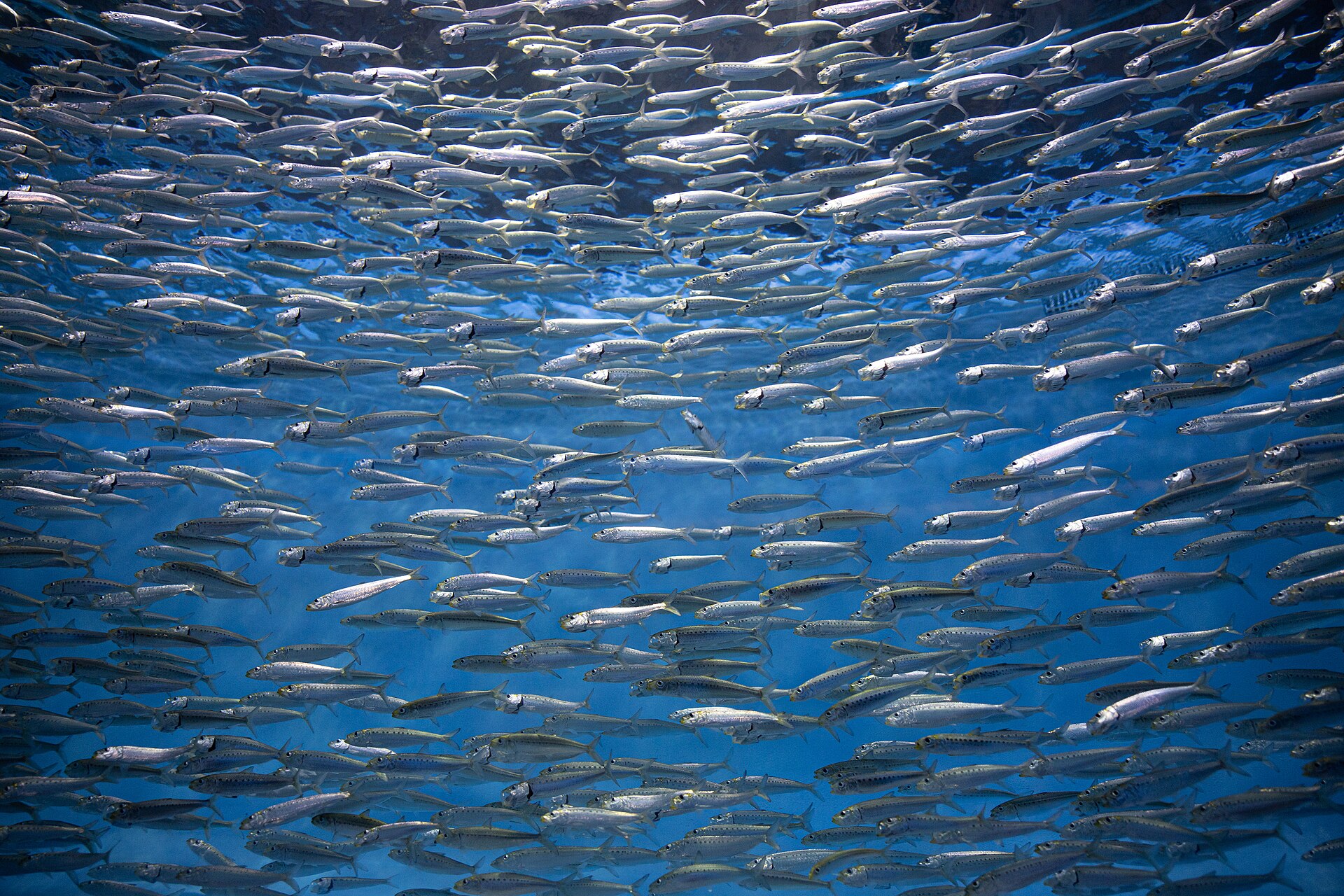
Sardine (South African Pilchard)
Photo: Dana L. Brown from Lucas Valley, USA · CC BY-SA 2.0 · Wikimedia Commons

Big Fish

Sardine (South African Pilchard)

Sardinops sagax · Bony fish, family Alosidae (shads and sardines, formerly in Clupeidae); southern African fish belong to the lineage once named Sardinops ocellatus

IUCN: LC ~20 cm 0–40 m depth band Well documented

Each winter a small share of South Africa's sardines moves east up the Wild Coast toward KwaZulu-Natal, and a crowd of predators follows. The fish travel in a narrow band of cool water squeezed between the shore and the warm Agulhas Current, and when the shoals are driven to the surface, common dolphins, copper, dusky and blacktip sharks, Cape fur seals, gamefish and plunge-diving Cape gannets attack at once. That is the Sardine Run, usually in June or July, and divers come from around the world to join it from boats. Scientists now read it as a spawning migration by a genetically distinct subpopulation rather than a hunt for food, and in some years it is not detected at all. Each fish is only about 20 cm long, a silver sliver feeding on plankton, but together they fuel most of the coast's large predators.

Where and when to see one

"Resident" means most dives at that destination encounter them; "seasonal" means reliably present in the listed months; anything else is a bonus, not a plan.

DestinationReliabilityMonthsNotes
The Sardine Run (Wild Coast)South Africa Seasonal: reliable in season Jun–Jul

Best month, at a glance

MonthReliable destinations
June The Sardine Run (Wild Coast)
July The Sardine Run (Wild Coast)

Understanding them

Habitat: Coastal surface waters over the continental shelf, in huge shoals; recorded to 200 m. Off South Africa the winter run follows a narrow band of cool water squeezed between the coast and the warm Agulhas Current.

Range: Temperate and subtropical coasts of the Indo-Pacific as several regional lineages: southern Africa, Australia, Japan, Chile and Peru, and California.

Behavior: Lives its whole life in vast shoals near the surface. When predators attack, the shoal is driven up against the surface, where dolphins, sharks, gamefish, seals and plunge-diving gannets feed on it together.

Diet: Plankton filtered through sieve-like gill rakers: young fish take zooplankton such as copepods, adults more phytoplankton.

Size: typically around 20 cm; documented up to 39.5 cm (standard length (snout to the base of the tail); common length 20 cm, maximum 39.5 cm and about 490 g).

How to behave around one

The Sardine Run is a blue-water, boat-based event: stay with your guide, enter and leave the water when the skipper says, and keep to the edge of a feeding frenzy rather than swimming into it. Never chase or herd a shoal for photos.

Conservation

Least Concern (IUCN 2018); heavily fished, with about 200,000 metric tons a year caught off the Western Cape, and in some years the run is not detected by coastal observers.

Watch

From the official channels

All videos →

Videos are embedded links to their creators' own channels. We host nothing and credit everything.

Sources: KwaZulu-Natal Sharks Board ↗African Journal of Marine Science ↗FishBase ↗IUCN Red List ↗WoRMS ↗ · Facts verified against the sources above; fields without support are labeled not yet verified.

Australia, New Zealand & East Asia

Cairns & the Ribbon ReefsNingaloo ReefBrisbane, Moreton Bay and the Sunshine CoastCoral Sea & Osprey ReefIshigaki & the Yaeyama IslandsOkinawa & the Kerama IslandsPoor Knights IslandsSouthern Great Barrier Reef: Lady Elliot, Lady Musgrave & Heron Islands

Caribbean & Western Atlantic

BonaireCozumelRiviera Maya & the CenotesBelize Barrier ReefGrand CaymanIsla Mujeres & CancúnRoatánTiger Beach & Grand Bahama

Europe, Atlantic & Mediterranean

Malta & GozoSilfra & IcelandThe AzoresBalearic IslandsCabo de Palos & Islas Hormigas Marine ReserveCanary IslandsLarnaca & the ZenobiaScapa Flow

Indian Ocean & East Africa

North & South Malé AtollsAri AtollBaa Atoll & Hanifaru BayFuvahmulahAliwal Shoal & UmkomaasAndaman IslandsMafia IslandMauritius

Pacific Islands & Micronesia

PalauChuuk (Truk) LagoonFakaravaKona, HawaiʻiRangiroaTaveuni & Rainbow ReefBeqa Lagoon & Pacific HarbourEspiritu Santo

Red Sea & Middle East

Sharm El Sheikh & Ras MohammedBrothers, Daedalus & St John'sDahabHurghada & El GounaMarsa Alam & the Deep SouthAqabaDaymaniyat IslandsEilat

Southeast Asia & Coral Triangle

Bali & Nusa PenidaKomodoRaja AmpatSipadan & MabulAnilaoCoronGili Islands & LombokKoh Tao

The Americas & Eastern Pacific

Galápagos IslandsCocos IslandFlorida KeysSea of Cortez & Cabo PulmoSocorro & the RevillagigedosBritish ColumbiaCalifornia Channel IslandsCosta Rica Pacific Coast