Rays
Shark Ray (Bowmouth Guitarfish)
Rhina ancylostomus · Cartilaginous fish, family Rhinidae (wedgefishes); the only species in its genus, also spelled Rhina ancylostoma
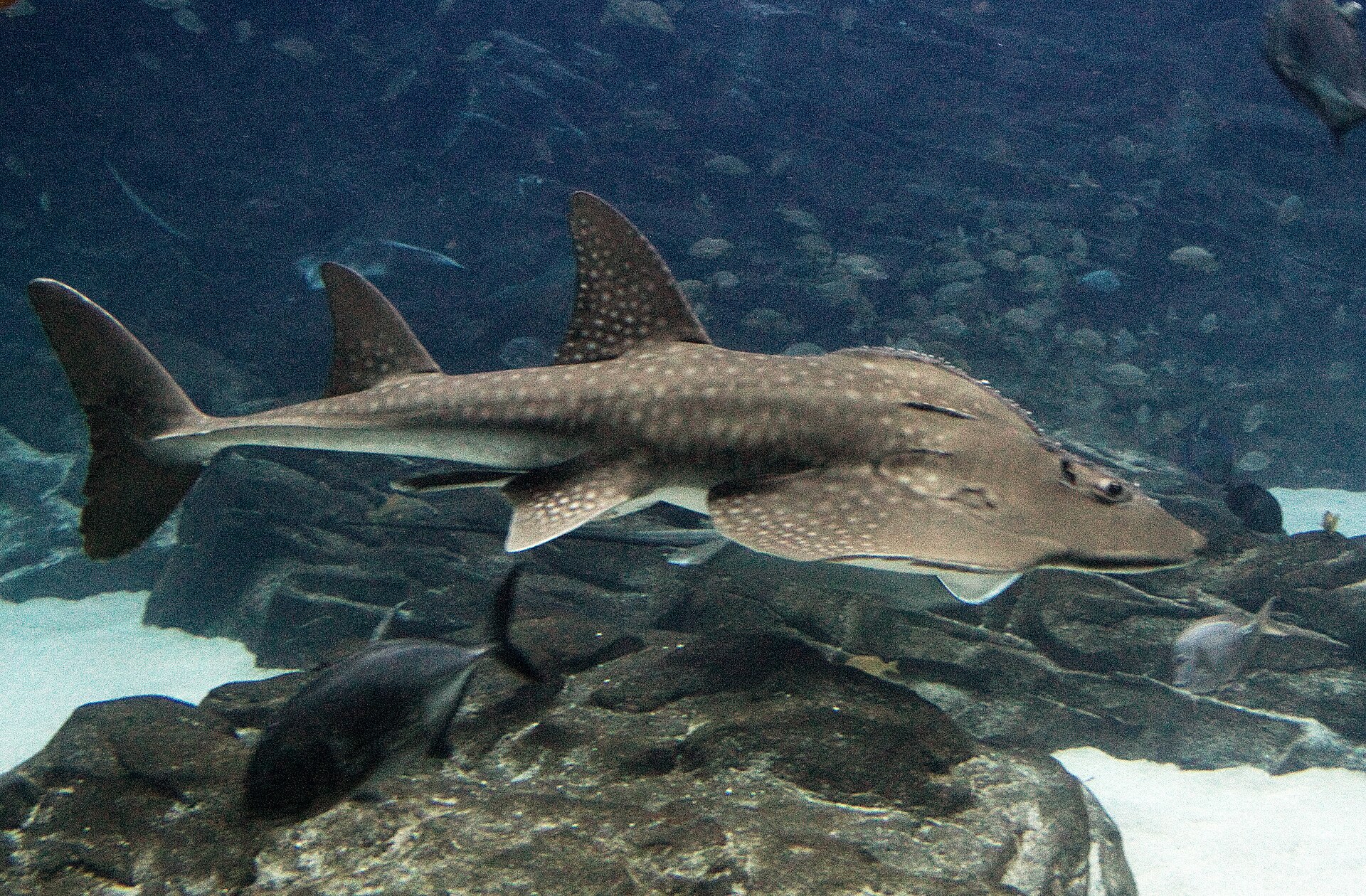
Part shark, part ray, and in serious trouble. The shark ray carries a broad, rounded head, ridges of thorns over its eyes and back, and tall shark-like fins on a body that can reach 3 m, its blue-gray skin scattered with white spots and a white-edged black mark above each pectoral fin. Divers rarely see one: it is uncommon across a huge Indo-West Pacific range and is caught widely for its valuable fins and meat, while in Thailand its thorns are even made into bracelets. The IUCN lists it as Critically Endangered. Most encounters are brief, a heavy-bodied fish cruising low over sand near a reef before turning away. Off Tofo in Mozambique, remote cameras on a deep cleaning station logged 18 visits between 2021 and 2024, a few of them alongside reef manta rays. Treat any sighting as a privilege and share your photos with local researchers.
Where and when to see one
"Resident" means most dives at that destination encounter them; "seasonal" means reliably present in the listed months; anything else is a bonus, not a plan.
| Destination | Reliability | Months | Notes |
|---|---|---|---|
| Tubbataha ReefsPhilippines | Rare | Year-round | |
| Ningaloo ReefAustralia | Rare | Year-round | |
| Tofo BeachMozambique | Rare | Year-round | |
| Sodwana BaySouth Africa | Rare | Year-round | |
| Townsville & the YongalaAustralia | Rare | Year-round |
Best month, at a glance
Understanding them
Habitat: Sand and mud bottoms near reefs and other structure, close inshore and around offshore coral reefs, sometimes high in the water column. Recorded from 3 to 90 m.
Range: Tropical Indo-West Pacific, from KwaZulu-Natal and the Red Sea across the Indian Ocean and Southeast Asia to southern Japan, New Guinea and northern Australia.
Behavior: Usually cruises low over sand and reef, occasionally rising high into the water column, and is hard to approach. Off Mozambique it visits deep cleaning stations, sometimes circling them in turn with reef manta rays.
Diet: Bottom fishes such as croakers, plus crabs, prawns, bivalves and cephalopods, crushed with ridged, undulating tooth plates.
Size: typically around 1.8 m; documented up to 3 m (total length; FishBase puts maturity at about 1.5–1.8 m and the maximum at 3 m, with weights to 135 kg).
How to behave around one
Let it pass rather than following: a chased shark ray simply leaves. Stay off cleaning stations it is approaching, never touch the thorny back, and avoid firing strobes at close range.
Conservation
Critically Endangered (assessed 2019): it is caught widely in artisanal and commercial fisheries for its fins and meat, and habitat degradation adds pressure. Listed on CITES Appendix II, so international trade is monitored.
Watch
From the official channels

Catch this wave 🌊 | #montereybayaquarium #reeflife

Giant Pacific Octopus

Live African Penguin Cam After Hours | Monterey Bay Aquarium
Videos are embedded links to their creators' own channels. We host nothing and credit everything.