Macro
Variable Neon Slug
Nembrotha kubaryana · Mollusk, nudibranch (dorid), family Polyceridae; the striped Nembrotha nigerrima, named in the same 1877 paper, is now treated as a color form of this species
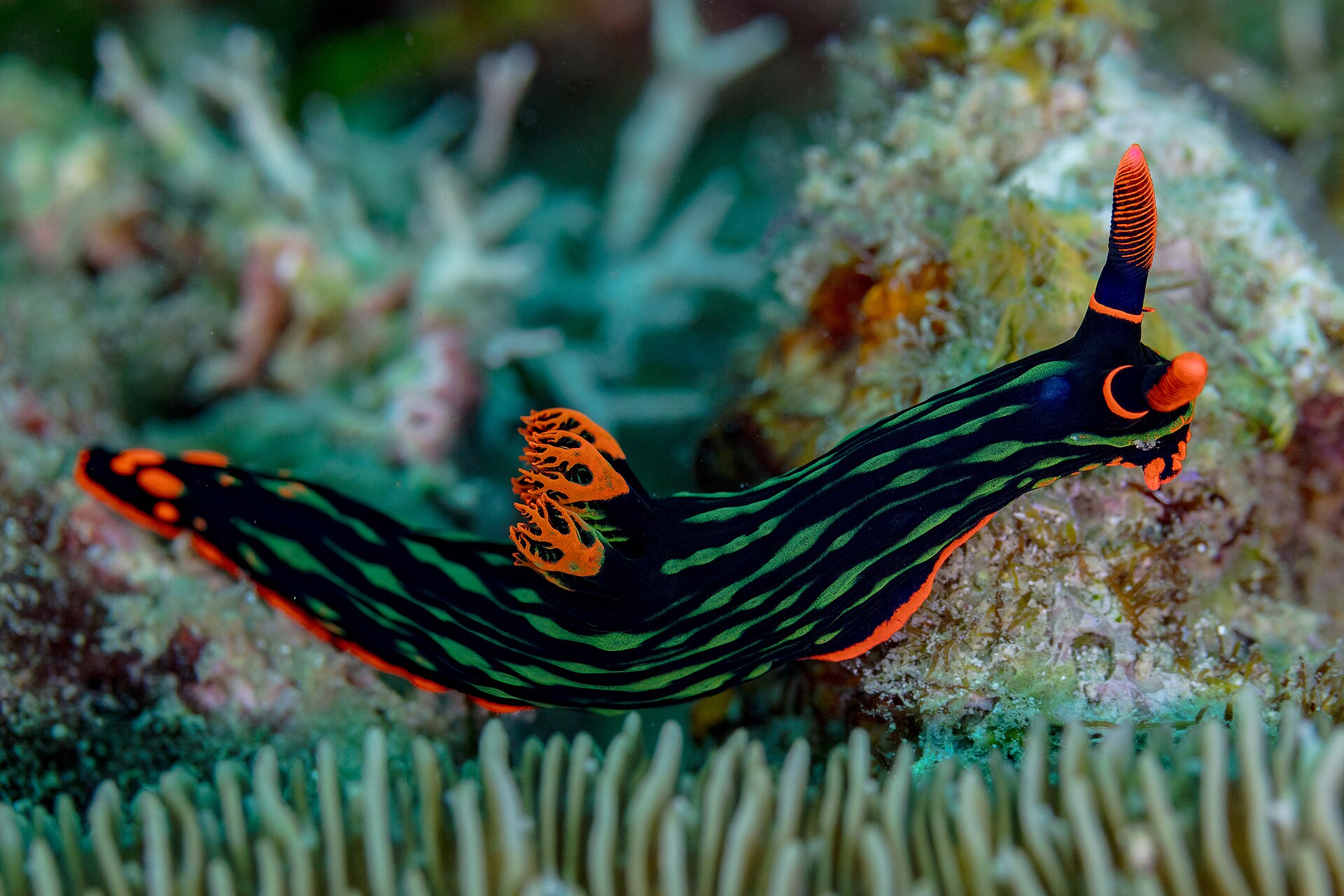
Black velvet, neon green and traffic-cone orange: Nembrotha kubaryana dresses like a warning sign, and it is one. This big polycerid, usually 4 to 8 cm and occasionally more than 12, feeds on colonial sea squirts and, as Valerie Paul's team reported in 1990, stores their feeding-deterrent compounds and oozes them in mucus when bothered. The 'variable' in its name is earned: the green may come as spots or as long ridges, or be replaced by pink-orange marks, while a bright orange rim around the foot separates it from the look-alike Nembrotha cristata. For years the striped form was called Nembrotha nigerrima, until a 2008 revision showed the two are one species. Conspicuous rather than cryptic, it is one of the easier large nudibranchs to find, from Anilao's Sombrero Island to Ningaloo's Lighthouse Bay, where divers have photographed it being eaten by Roboastra, nudibranchs that hunt other nudibranchs. Look for pairs mating side by side.
Where and when to see one
"Resident" means most dives at that destination encounter them; "seasonal" means reliably present in the listed months; anything else is a bonus, not a plan.
| Destination | Reliability | Months | Notes |
|---|---|---|---|
| AnilaoPhilippines | Resident: seen on most dives | Year-round | |
| Cairns & the Ribbon ReefsAustralia | Occasional | Year-round | |
| Bali & Nusa PenidaIndonesia | Occasional | Year-round | |
| Ningaloo ReefAustralia | Occasional | Year-round | |
| Lembeh StraitIndonesia | Occasional | Year-round | |
| Dumaguete, Dauin & Apo IslandPhilippines | Occasional | Year-round | |
| Bunaken & ManadoIndonesia | Occasional | Year-round |
Best month, at a glance
Understanding them
Habitat: Coral reefs, walls and rubble slopes near the colonial sea squirts it feeds on; records run from 5 m on Bunaken's reef edge to 30 m off Apo Island.
Range: Tropical Indo-West Pacific, with records from Western Australia's Ningaloo Reef and the Great Barrier Reef north through Indonesia, Malaysia and the Philippines to the Solomon Islands.
Behavior: Glides conspicuously over reef and rubble, often on or beside its sea squirt prey; mating pairs turn up, and at Ningaloo divers have photographed predatory Roboastra nudibranchs eating it.
Diet: Colonial ascidians (sea squirts), whose feeding-deterrent chemicals it stores and releases in slime when disturbed.
Size: typically around 7 cm; documented up to 12 cm (body length; adults usually run 4–8 cm, and the Sea Slug Forum notes some grow beyond 120 mm).
How to behave around one
Look, don't lift: handling triggers its defensive slime, and moving it off a sea squirt colony costs it a meal. Keep fins clear of the ascidians and keep strobe sessions short.
Conservation
Not evaluated by the IUCN Red List. Widespread and frequently seen; its fortunes follow the sea squirt colonies it feeds on.
Recently recorded near our dive sites
109 verified records within 5 to 10 km of 58 of our dive sites over the last 12 months (17 Nov 2025 to 16 Nov 2026), 6 of them in the last 30 days. Latest: 3 Nov 2026, near Paradise 2 (Mabul), by 葫芦爷送娃娃 ↗ (iNaturalist, CC BY-NC).
Most records near
Research-grade iNaturalist observations shared under CC0, CC BY or CC BY-NC, plus human sightings from GBIF and OBIS datasets under the same licences, within 5 km of a site with a sourced position or 10 km of an approximate one. A record near two sites counts once in the total and once on each site. Each site page credits the observers and datasets behind its records. How these are collected →
Watch
From the official channels

Giant Pacific Octopus

Live African Penguin Cam After Hours | Monterey Bay Aquarium

African Penguin Cam After Hours | Monterey Bay Aquarium
Videos are embedded links to their creators' own channels. We host nothing and credit everything.