Macro
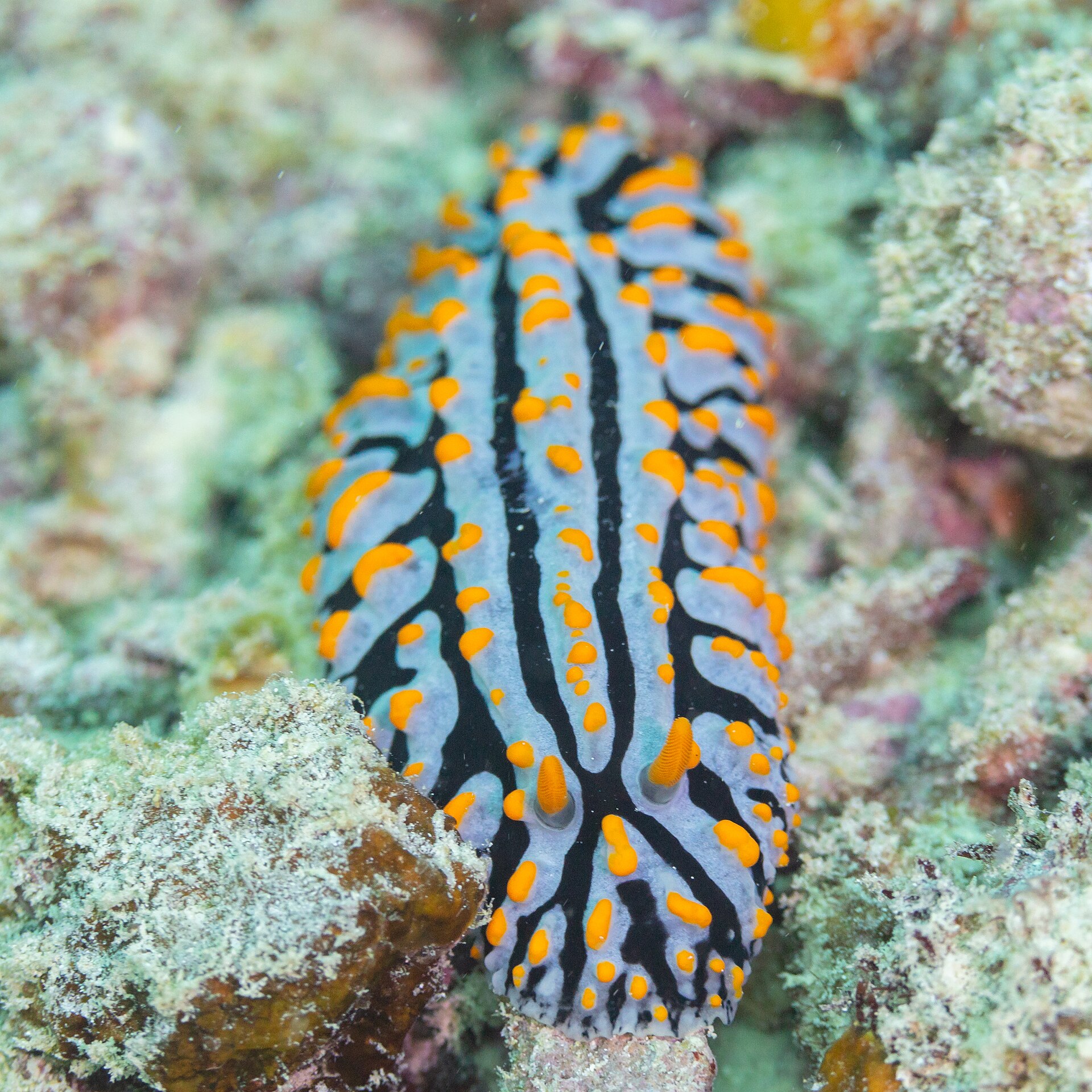
Varicose Phyllidia
Phyllidia varicosa · Mollusk, nudibranch (dorid), family Phyllidiidae; like all phyllidiids it has no gill rosette on the back, its gills lying in a groove under the mantle edge
Most nudibranchs hide by day; Phyllidia varicosa crawls across the open reef at noon, because almost nothing wants to eat it. This big phyllidiid, up to about 10 cm, wears three to six lumpy blue-gray ridges whose tubercles are capped in yellow, and it lacks the feathery gill rosette of other dorids: its gills are tucked into a groove beneath the mantle edge. Its protection comes from sponges. It feeds on them and stores their noxious compounds in tiny skin glands that can release a white secretion toxic enough to kill every fish in an aquarium, a strong argument for leaving it on the reef. It ranges from the Red Sea to the central Pacific, and phyllidiids are often the nudibranchs divers see most on day dives. Several look-alikes share its colors; a black line along the sole of the foot is the clincher, but that is a job for photographs, not handling.
Where and when to see one
"Resident" means most dives at that destination encounter them; "seasonal" means reliably present in the listed months; anything else is a bonus, not a plan.
| Destination | Reliability | Months | Notes |
|---|---|---|---|
| Bali & Nusa PenidaIndonesia | Resident: seen on most dives | Year-round | |
| PalauPalau | Occasional | Year-round | |
| Cairns & the Ribbon ReefsAustralia | Occasional | Year-round | |
| Hurghada & El GounaEgypt | Occasional | Year-round | |
| Brothers, Daedalus & St John'sEgypt | Occasional | Year-round | |
| Koh TaoThailand | Occasional | Year-round | |
| AnilaoPhilippines | Occasional | Year-round | |
| Lembeh StraitIndonesia | Occasional | Year-round |
Best month, at a glance
Understanding them
Habitat: Coral reefs, rubble and sand patches, crawling fully exposed in daylight; records run from 4 m in Thailand to 25 m on a Red Sea wreck, and SeaLifeBase gives 10–20 m as its usual range.
Range: Throughout the Indo-West Pacific, including the Red Sea and the central Pacific.
Behavior: Crawls openly across the reef by day, as phyllidiids do, protected by its chemistry; the body is stiff and leathery rather than soft, and white skin glands can release a toxic secretion when it is disturbed.
Diet: Sponges, whose noxious chemicals it stores in small glands in its skin.
Size: typically around 6 cm; documented up to 10 cm (body length; a 104 mm specimen from Guam is the largest documented in our sources, and most animals divers see are 3–8 cm).
How to behave around one
Don't pick it up or flip it to check the black line on its sole; that is a job for photographs. Never collect one for an aquarium: it cannot be fed there and its secretions can poison the tank.
Conservation
Not evaluated by the IUCN Red List. Common and widespread; it is sometimes sold to aquarists, a trade the Sea Slug Forum discourages because it cannot be fed in captivity and can poison other tank life.
Recently recorded near our dive sites
187 verified records within 5 to 10 km of 123 of our dive sites over the last 12 months (17 Nov 2025 to 16 Nov 2026), 7 of them in the last 30 days. Latest: 9 Nov 2026, near Boo Windows, by mbp349 ↗ (iNaturalist, CC BY-NC).
Most records near
Research-grade iNaturalist observations shared under CC0, CC BY or CC BY-NC, plus human sightings from GBIF and OBIS datasets under the same licences, within 5 km of a site with a sourced position or 10 km of an approximate one. A record near two sites counts once in the total and once on each site. Each site page credits the observers and datasets behind its records. How these are collected →
Watch
From the official channels

Giant Pacific Octopus

Live African Penguin Cam After Hours | Monterey Bay Aquarium

African Penguin Cam After Hours | Monterey Bay Aquarium
Videos are embedded links to their creators' own channels. We host nothing and credit everything.