Sharks
Angelshark
Squatina squatina · Cartilaginous fish, family Squatinidae (angel sharks)
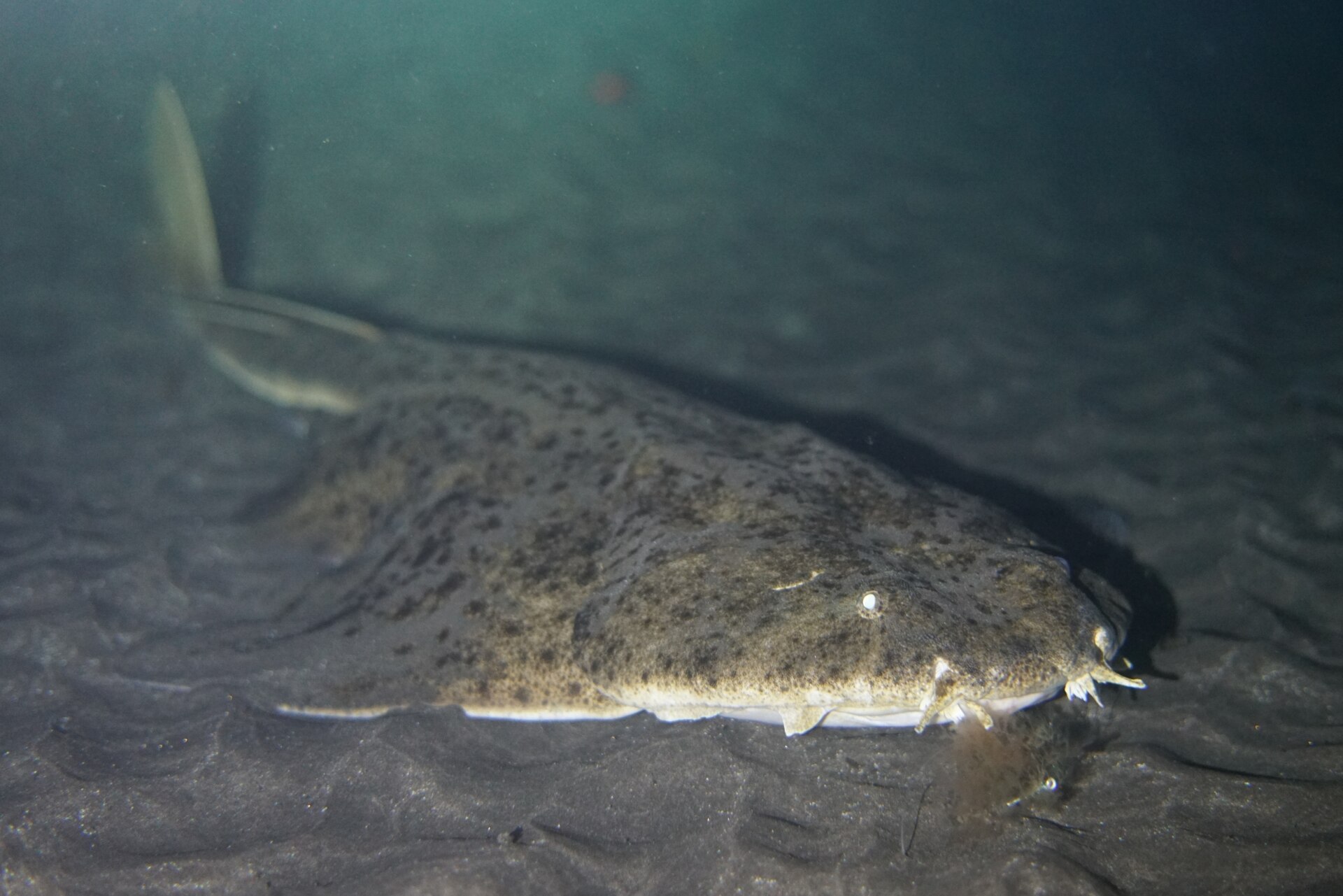
An angelshark is a shark flattened into the outline of a ray, and on Canary Island sand it is usually nothing more than a faint oval with two eyes. Once common from Norway to the Mediterranean, it has been fished out of most of that range and is now Critically Endangered, which makes the Canaries the one place where divers still meet it regularly. Sightings come from all seven islands, more often in the east, at sites such as El Cabrón marine park on Gran Canaria. Large males move inshore in winter to mate, while pregnant females and newborn pups dominate from April to July, and Las Teresitas beach on Tenerife is a confirmed nursery. The shark lies buried and still, eyes protruding, waiting for a fish to wander within range. Slow, patient searching of open sand beside reefs is how guides find them; fast-finning divers swim straight past.
Where and when to see one
"Resident" means most dives at that destination encounter them; "seasonal" means reliably present in the listed months; anything else is a bonus, not a plan.
| Destination | Reliability | Months | Notes |
|---|---|---|---|
| Canary IslandsSpain | Resident: seen on most dives | Year-round |
Best month, at a glance
| Month | Reliable destinations |
|---|---|
| January | Canary Islands |
| February | Canary Islands |
| March | Canary Islands |
| April | Canary Islands |
| May | Canary Islands |
| June | Canary Islands |
| July | Canary Islands |
| August | Canary Islands |
| September | Canary Islands |
| October | Canary Islands |
| November | Canary Islands |
| December | Canary Islands |
Understanding them
Habitat: Sand and mud bottoms, often beside rocky reefs, seagrass or algae, where it lies buried with only its eyes showing; recorded to 150 m. In the Canaries divers see it from less than 1 m to 45 m, with newborns only in water shallower than 25 m.
Range: The northeastern Atlantic, historically from Norway to northwest Africa and through the Mediterranean. It has vanished from much of that range, and the Canary Islands are now its stronghold.
Behavior: Lies motionless and half-buried by day, trusting its camouflage even when a diver is close. It becomes active at night, swimming off the bottom, and juveniles move close to shore after dark.
Diet: Mainly flatfish and other bottom fish, plus skates, crustaceans and mollusks, ambushed from beneath the sand.
Size: typically around 1.5 m; documented up to 2.44 m (total length; females grow larger than males: FishBase gives 1.83 m for males, 2.44 m for females and a common length of 1.5 m. Canary Islands sightings range from 20 cm pups to 2 m adults).
How to behave around one
Never touch, uncover or move a buried angelshark, and don't fan sand off its back for a photo. Hover rather than kneel, keep at least a body length away, and keep strong lights off its eyes at night. Disturbing angelsharks is illegal in Canary Island waters; follow the Angel Shark Project's diver code of conduct and report your sightings to it.
Conservation
Critically Endangered (IUCN 2019) after severe declines from fishing across its range. Listed since 2019 as in danger of extinction under Spanish law in Canary waters, which bans killing, capturing or disturbing it, and on CMS Appendices I and II.
Watch
From the official channels

Giant Pacific Octopus

Live African Penguin Cam After Hours | Monterey Bay Aquarium

African Penguin Cam After Hours | Monterey Bay Aquarium
Videos are embedded links to their creators' own channels. We host nothing and credit everything.