Invertebrates
Bobbit Worm
Eunice aphroditois · Annelid, bristle worm (class Polychaeta), family Eunicidae; the name may cover more than one giant species
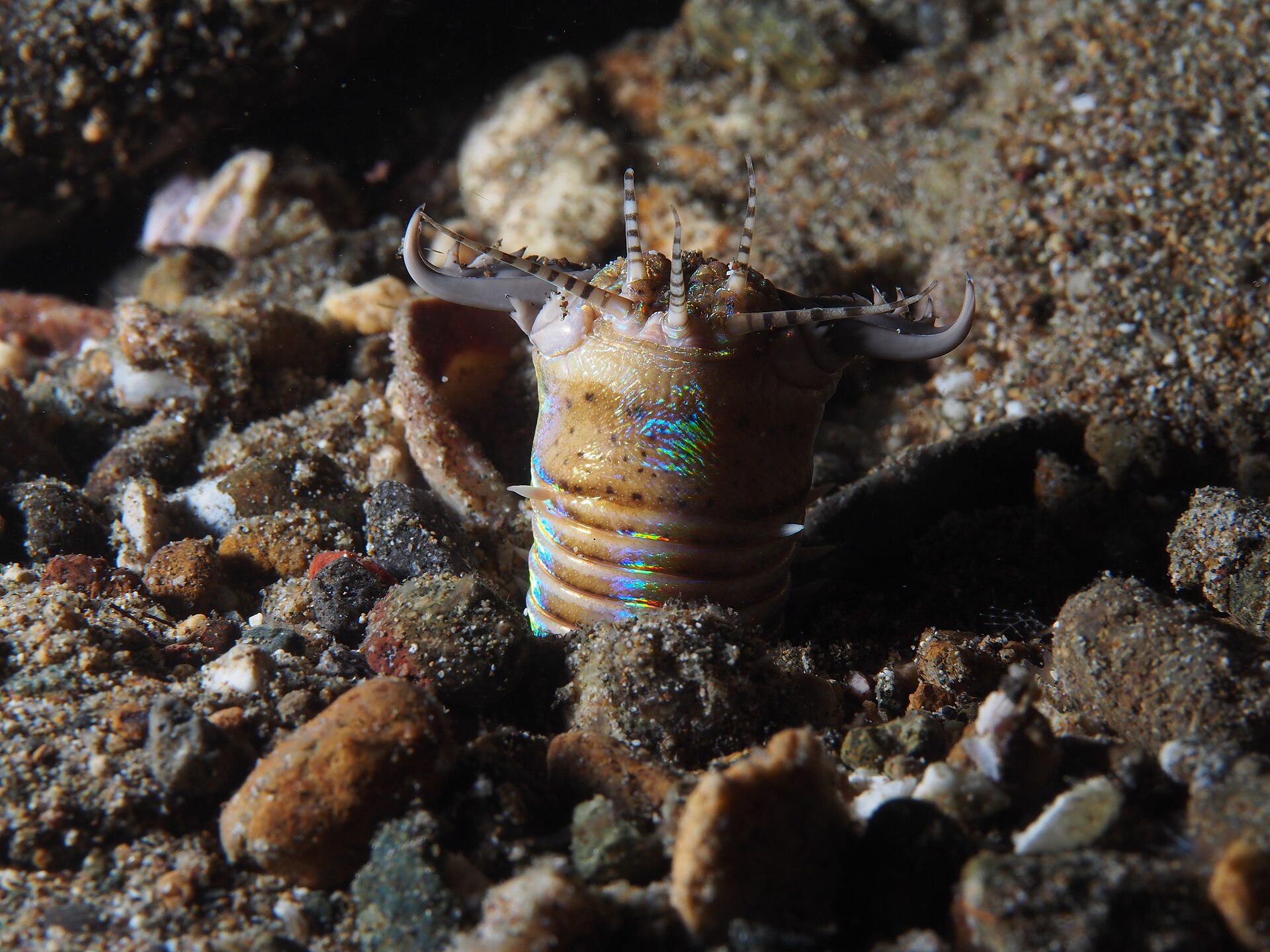
Divers see only a bobbit worm's antennae and jaws at a hole in the sand; the rest of the body, sometimes meters long, stays buried. The worm waits with five antennae spread, and when a fish comes too close it lunges up with startling speed, grabs with jaws that open like scissors, and drags the prey into the sediment. Night dives on Indonesian and Philippine muck sites are the usual place to watch, often where cardinalfish wander near the burrow. Size claims run wild online. The best-documented giant, found in a fish-farm float in Japan, measured 299 cm with 673 segments, while Japanese specimens are usually reported at about 1 m and some mature worms are under 10 cm. The name is a puzzle too: Eunice aphroditois was described from a 45 cm specimen from Sri Lanka, and a 2011 review argues that the giant worms divers photograph may include more than one species. Keep lights brief and off its head, and never tempt it with bait.
Where and when to see one
"Resident" means most dives at that destination encounter them; "seasonal" means reliably present in the listed months; anything else is a bonus, not a plan.
| Destination | Reliability | Months | Notes |
|---|---|---|---|
| Lembeh StraitIndonesia | Occasional | Year-round | |
| AnilaoPhilippines | Occasional | Year-round | |
| Bali & Nusa PenidaIndonesia | Rare | Year-round |
Best month, at a glance
| Month | Reliable destinations |
|---|---|
| January | Lembeh Strait · Anilao · Bali & Nusa Penida |
| February | Lembeh Strait · Anilao · Bali & Nusa Penida |
| March | Lembeh Strait · Anilao · Bali & Nusa Penida |
| April | Lembeh Strait · Anilao · Bali & Nusa Penida |
| May | Lembeh Strait · Anilao · Bali & Nusa Penida |
| June | Lembeh Strait · Anilao · Bali & Nusa Penida |
| July | Lembeh Strait · Anilao · Bali & Nusa Penida |
| August | Lembeh Strait · Anilao · Bali & Nusa Penida |
| September | Lembeh Strait · Anilao · Bali & Nusa Penida |
| October | Lembeh Strait · Anilao · Bali & Nusa Penida |
| November | Lembeh Strait · Anilao · Bali & Nusa Penida |
| December | Lembeh Strait · Anilao · Bali & Nusa Penida |
Understanding them
Habitat: Long burrows in sand and fine sediment; recorded from 1 to 200 m, but divers find it on shallow night dives, as at 5 to 6 m under Anilao Pier.
Range: Reported under this name from warm seas worldwide, but a 2011 review argues that true Eunice aphroditois, described from Sri Lanka, should be limited to the Indian Ocean and western Pacific; the divers' bobbit worm is photographed mainly in the Philippines and Indonesia.
Behavior: Stays hidden by day. At night it rests with its five antennae spread at the burrow mouth and strikes upward with startling speed when prey comes close, dragging it below; it retracts quickly when divers approach or lights linger on it.
Diet: Fish, bivalves and other worms, seized at the burrow mouth and pulled underground.
Size: typically around 1 m; documented up to 2.99 m (body length of the whole worm, of which divers see only a few centimeters; Japanese specimens are usually reported at about 1 m, the 299 cm Shirahama worm is the best-documented giant, and some mature worms are under 10 cm).
How to behave around one
Sweep your light across it briefly instead of holding the beam on its head, keep fingers and pointers away from the burrow, and never offer it a fish or other bait to provoke a strike.
Conservation
Not assessed by the IUCN. Its taxonomy is unresolved, so how widespread or common the divers' bobbit worm really is remains unknown.
Watch
From the official channels

Catch this wave 🌊 | #montereybayaquarium #reeflife

Giant Pacific Octopus

Live African Penguin Cam After Hours | Monterey Bay Aquarium
Videos are embedded links to their creators' own channels. We host nothing and credit everything.