Reptiles
Marine Iguana
Amblyrhynchus cristatus · Reptile, family Iguanidae; the world's only sea-going lizard, endemic to the Galápagos
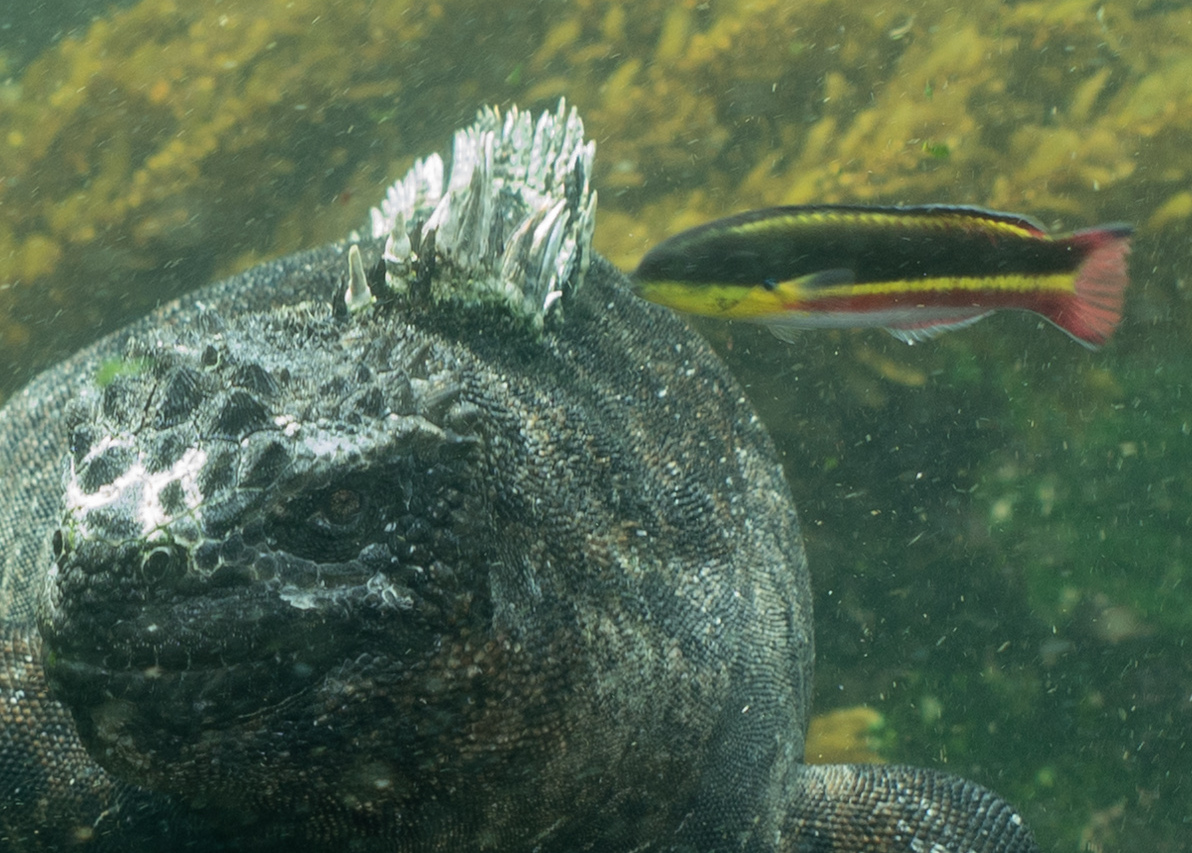
The only lizard on Earth that forages in the sea. Galápagos marine iguanas look like small dragons crusted in salt, and colonies of hundreds pile together on black lava to soak up the sun. Feeding is a cold-water gamble: most graze algae exposed at low tide, but the big males swim out and dive, sometimes for half an hour, to crop seaweed from the rocks, sculling with a flattened tail while the legs trail behind, before hauling out to warm up again. Snorkel off Fernandina and you may watch one grazing a few meters down, sometimes with a wrasse picking at its skin. In lean El Niño years they can shrink in length to survive, then regrow when food returns. Introduced cats, dogs and rats, oil spills and stronger El Niños are the main threats.
Where and when to see one
"Resident" means most dives at that destination encounter them; "seasonal" means reliably present in the listed months; anything else is a bonus, not a plan.
| Destination | Reliability | Months | Notes |
|---|---|---|---|
| Galápagos IslandsEcuador | Resident: seen on most dives | Year-round |
Best month, at a glance
| Month | Reliable destinations |
|---|---|
| January | Galápagos Islands |
| February | Galápagos Islands |
| March | Galápagos Islands |
| April | Galápagos Islands |
| May | Galápagos Islands |
| June | Galápagos Islands |
| July | Galápagos Islands |
| August | Galápagos Islands |
| September | Galápagos Islands |
| October | Galápagos Islands |
| November | Galápagos Islands |
| December | Galápagos Islands |
Understanding them
Habitat: Rocky lava shorelines and the intertidal and shallow subtidal zones, with colonies close to the sea. Feeding dives usually go to 1.5–5 m for 5 to 10 minutes, but an iguana can descend to 12 m and stay about 30 minutes.
Range: Endemic to the Galápagos Islands, Ecuador, on almost every rocky shoreline; Fernandina holds by far the largest population.
Behavior: Basks for long periods to warm up, then feeds in cold water before hauling out again. Only the large males dive offshore, swimming with a flattened tail while the legs trail; in the breeding season males defend territories with head-bobbing and headbutting.
Diet: Red and green algae: females and small males crop algae exposed at low tide, while large males dive to graze offshore.
Size: typically around 60 cm; documented up to 1.3 m (total length; SeaLifeBase gives a maximum of 1.3 m, with females reaching about 0.6 m. Size varies hugely between islands, from small Genovesa and Wolf animals to much larger Santa Cruz, Isabela and Fernandina iguanas, and males are bigger than females).
How to behave around one
Stay a couple of meters away, never touch or feed iguanas, avoid stepping on basking groups or nest burrows, and give a grazing iguana room underwater: a chilled animal needs to get back to its rock to warm up.
Conservation
Vulnerable (assessed 2020), with some island populations rated Endangered. El Niño famines can kill large parts of a colony, and introduced cats, dogs, pigs and rats take young and eggs; nearly all its range lies within Galápagos National Park.
Watch
From the official channels

Catch this wave 🌊 | #montereybayaquarium #reeflife

Giant Pacific Octopus

Live African Penguin Cam After Hours | Monterey Bay Aquarium
Videos are embedded links to their creators' own channels. We host nothing and credit everything.