Dive sites, seasons and marine life — researched, mapped, planned.
Menu
Destinations Dive Sites Marine Life Wrecks News
Plan a trip Trip planner When to dive Cost calculator Comparisons Marine-life calendar Water temperature Liveaboards Operators & resorts Marine parks Hyperbaric chambers World map
Regions Australia, New Zealand & East AsiaCaribbean & Western AtlanticEurope, Atlantic & MediterraneanIndian Ocean & East AfricaPacific Islands & MicronesiaRed Sea & Middle EastSoutheast Asia & Coral TriangleThe Americas & Eastern Pacific Countries
Learn & Tools All guides Certifications Gear guides Videos Ask the Data AI Agents API
About About us Methodology Disclaimer Contact
Your view
★ Saved

Your starred destinations, sites and species — stored in this browser.

API GATEWAY

Free read-only JSON access to the atlas's cached data.

Dark mode

🧭 Guided View
New to diving — depths, currents, certification levels? We explain every term as you browse, in plain English. Same data, with the help built in.

⚡ Expert View
You already know the difference between a wall and a drift. Just the data — clean, fast and compact. This is the default view.

Interface language
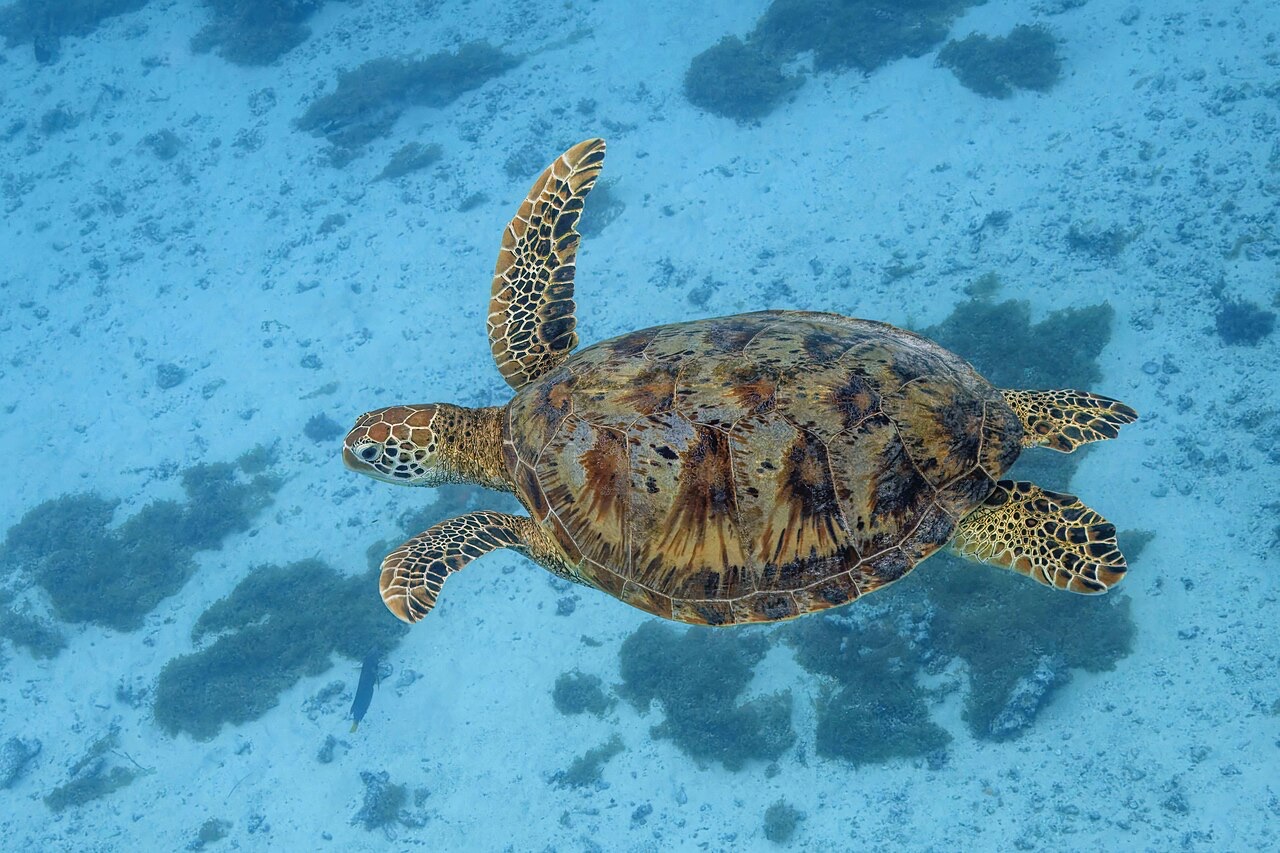
Green Sea Turtle — illustration
AI-generated illustration for The Scuba Atlas — illustrative, not a documentary photograph.

Turtles

Green Sea Turtle

Chelonia mydas · Marine reptile — family Cheloniidae

IUCN: EN (decreasing) ~1.0 m carapace length; large adults weigh 150–200 kg 0–40 m depth band Well documented

The green turtle is diving's great normalizer: on the right reef it becomes as ordinary as parrotfish, and never stops being wonderful. A big adult is a coffee-table of smooth olive shell topped by a small, gentle-jawed head built for mowing grass, trailing a wake of nibbled seagrass stubble across the lagoon floor. At Sipadan they stack along the wall like parked cars; at Marsa Alam's seagrass bays they graze beside snorkelers all day; Hawaiian greens haul out to bask on beaches, a habit almost unique to that population. Fifty years of protection have rebuilt many nesting populations — one of marine conservation's genuine success stories, still incomplete.

Where and when to see one

"Resident" means most dives at that destination encounter them; "seasonal" means reliably present in the listed months; anything else is a bonus, not a plan.

DestinationReliabilityMonthsNotes
Riviera Maya & the CenotesMexico Resident — seen on most dives Year-round
Galápagos IslandsEcuador Resident — seen on most dives Year-round
Cairns & the Ribbon ReefsAustralia Resident — seen on most dives Year-round
Sipadan & MabulMalaysia Resident — seen on most dives Year-round
Kona, HawaiʻiUnited States Resident — seen on most dives Year-round
Marsa Alam & the Deep SouthEgypt Resident — seen on most dives Year-round

Best month, at a glance

MonthReliable destinations
January Riviera Maya & the Cenotes · Galápagos Islands · Cairns & the Ribbon Reefs · Sipadan & Mabul · Kona, Hawaiʻi · Marsa Alam & the Deep South
February Riviera Maya & the Cenotes · Galápagos Islands · Cairns & the Ribbon Reefs · Sipadan & Mabul · Kona, Hawaiʻi · Marsa Alam & the Deep South
March Riviera Maya & the Cenotes · Galápagos Islands · Cairns & the Ribbon Reefs · Sipadan & Mabul · Kona, Hawaiʻi · Marsa Alam & the Deep South
April Riviera Maya & the Cenotes · Galápagos Islands · Cairns & the Ribbon Reefs · Sipadan & Mabul · Kona, Hawaiʻi · Marsa Alam & the Deep South
May Riviera Maya & the Cenotes · Galápagos Islands · Cairns & the Ribbon Reefs · Sipadan & Mabul · Kona, Hawaiʻi · Marsa Alam & the Deep South
June Riviera Maya & the Cenotes · Galápagos Islands · Cairns & the Ribbon Reefs · Sipadan & Mabul · Kona, Hawaiʻi · Marsa Alam & the Deep South
July Riviera Maya & the Cenotes · Galápagos Islands · Cairns & the Ribbon Reefs · Sipadan & Mabul · Kona, Hawaiʻi · Marsa Alam & the Deep South
August Riviera Maya & the Cenotes · Galápagos Islands · Cairns & the Ribbon Reefs · Sipadan & Mabul · Kona, Hawaiʻi · Marsa Alam & the Deep South
September Riviera Maya & the Cenotes · Galápagos Islands · Cairns & the Ribbon Reefs · Sipadan & Mabul · Kona, Hawaiʻi · Marsa Alam & the Deep South
October Riviera Maya & the Cenotes · Galápagos Islands · Cairns & the Ribbon Reefs · Sipadan & Mabul · Kona, Hawaiʻi · Marsa Alam & the Deep South
November Riviera Maya & the Cenotes · Galápagos Islands · Cairns & the Ribbon Reefs · Sipadan & Mabul · Kona, Hawaiʻi · Marsa Alam & the Deep South
December Riviera Maya & the Cenotes · Galápagos Islands · Cairns & the Ribbon Reefs · Sipadan & Mabul · Kona, Hawaiʻi · Marsa Alam & the Deep South

Understanding them

Habitat: Seagrass meadows, algae-covered reef flats, and lagoons; sleeps under reef ledges and migrates long distances to natal nesting beaches

Range: Circumglobal in tropical and subtropical seas, with major populations in the Caribbean, Red Sea, Indian Ocean, Coral Triangle, Pacific islands, and Australia

Behavior: A placid grazer that crops seagrass in slow, methodical mouthfuls, surfaces in a leisurely arc to breathe, and wedges beneath the same ledges night after night. Where protected and habituated, as at Sipadan or Hawaii, it treats divers as scenery and continues feeding at arm's length.

Diet: Adults graze seagrass and algae — the diet that greens their fat and names the species; juveniles are more omnivorous

Size: typically around 1.0 m; documented up to 1.2 m (carapace length; large adults weigh 150–200 kg).

How to behave around one

No touching or riding — illegal in most range states — keep hands off resting turtles, never block one's path to the surface to breathe, and give nesting beaches and mating pairs wide berth. Flash restrictions apply at many sites.

Conservation

Endangered globally, though many index nesting populations are climbing after decades of beach protection and harvest bans; boat strikes, net bycatch, and warming-skewed hatchling sex ratios are the live threats.

Charted sites known for them

Watch

From the official channels

All videos →

Videos are embedded links to their creators' own channels — we host nothing and credit everything.

Sources: NOAA Fisheries ↗IUCN Red List ↗ · Facts verified against the sources above; fields without support are labeled not yet verified.

Australia, New Zealand & East Asia

Cairns & the Ribbon ReefsNingaloo ReefCoral Sea & Osprey ReefOkinawa & the Kerama IslandsPoor Knights IslandsTownsville & the YongalaGreen IslandIzu Peninsula

Caribbean & Western Atlantic

BonaireCozumelRiviera Maya & the CenotesBelize Barrier ReefGrand CaymanIsla Mujeres & CancúnRoatánTiger Beach & Grand Bahama

Europe, Atlantic & Mediterranean

Malta & GozoSilfra & IcelandThe AzoresCanary IslandsLarnaca & the ZenobiaScapa FlowArctic NorwayMadeira

Indian Ocean & East Africa

North & South Malé AtollsAri AtollBaa Atoll & Hanifaru BayAliwal Shoal & UmkomaasMafia IslandMauritiusSeychellesSodwana Bay

Pacific Islands & Micronesia

PalauChuuk (Truk) LagoonFakaravaKona, HawaiʻiRangiroaTaveuni & Rainbow ReefBeqa Lagoon & Pacific HarbourEspiritu Santo

Red Sea & Middle East

Sharm El Sheikh & Ras MohammedBrothers, Daedalus & St John'sDahabHurghada & El GounaMarsa Alam & the Deep SouthAqabaDaymaniyat IslandsMusandam Peninsula

Southeast Asia & Coral Triangle

Bali & Nusa PenidaKomodoRaja AmpatSipadan & MabulAnilaoCoronKoh TaoLembeh Strait

The Americas & Eastern Pacific

Galápagos IslandsCocos IslandFlorida KeysSea of Cortez & Cabo PulmoSocorro & the RevillagigedosBritish ColumbiaCalifornia Channel IslandsCosta Rica Pacific Coast